I had been waiting for an opportunity to try the Coffee Jar for a fair while. It is not that it is in a remote location, it is in fact situated on Parkway just five minutes walk from Camden or Primrose Hill. Nonetheless it feels as if it needed a special trip to get there (and, though this is pre-empting the end of this cafe-physics review, it does deserve such a ‘special trip’). Inside, there is seating at the window and running along one wall, and although it is not the smallest of cafés, it is certainly a ‘cosy’ one. This is not intended as an estate agent’s euphemism but instead to emphasise the additional meanings of this word to convey a warmth and friendliness about the space that the Coffee Jar definitely has. So far, we have been twice (see, the ‘special trip’ is worth it!). The coffee comes from Monmouth and so unsurprisingly, on the two occasions I had a coffee there (Americano and Soya Latte), it was very well done and enjoyable. At the front of the counter are a wide selection of home made cakes and cookies. While this presentation can be awkward for allergy sufferers (nutty cakes or cakes with loose nuts on top are placed side by side with the nut free options which could give contamination issues), the cookies were very good (more on the cookies later).
As befits the name, hand painted jars and coffee mugs decorate the end of the tables (and can be purchased should you wish). Individual art pieces decorate the walls while the window is painted with a scene that is somehow mirrored (shadowed?) in the ink prints on the take-away cups. All in all, there is plenty to notice in this “cosy” space. And so it took a fairly long time before I noticed the fish that was dangling above my head.
Apologies for the blurry photo but you can see the robot fisherman on the shelf.
Yes, this seemed an odd thing to me too, so I checked and indeed, a wooden fish was suspended on a string from something hidden on the shelf above my seat. At this point, an opportunity arose to go and sit at the window and so I was able to turn and look properly at the cause of the suspended wooden fish which was actually a toy robot. It just gets more surreal. But indeed, on the shelf above the seats against the wall was a toy robot fishing, a wooden fish hanging at the end of his (her?) line.
A robot that is fishing can prompt a large number of questions which seem to me to be at the intersection of science and philosophy. To what extent has automation improved our lives? Is it a good or a bad thing to use robots in jobs traditionally done by humans? Moving away from robots and towards computers, what about artificial intelligence? Much has been written about artificial intelligence in recent years. There is some angst about whether robots will come to take-over the world with an ability to think that far surpasses our human ability. Alternatively, there are people who look to artificial intelligence with the hope that it will help us drive cars or investigate pollution or all manner of other (to a greater or lesser degree) useful things. One test that has been suggested as a way of establishing whether any particular computer, or artificial intelligence, can think is the Turing test proposed in 1950 by Alan Turing. A prize set up to reward the first computer “chatbot” that could reliably mislead human judges into thinking that it was itself a human (the Loebner prize) has so far not been won (a prize is awarded each year for the most convincing chatbot but so far, none has been so reliably convincing as a human to win the top, “gold” prize).
Unusually I had a soya latte.
But the robot on the shelf was not represented as thinking but as fishing, an occupation that is associated with relaxation. This robot was not just thinking, it was taking time out to relax; it was represented as being alive and sentient. This prompts a rather different question to that of merely intelligence: At what point do we say that something is living? How can we define life? As could perhaps be expected, NASA has taken some time to consider this question. As they say on their website:
“Comparing the semantic task [of defining life] to the ancient Hindu story of identifying an elephant by having each of six blind men touch only the tail, the trunk, or the leg, what answer a biologist might give can differ dramatically from the answer given by a theoretical physicist.”
Which may make you wonder well, what would a theoretical physicist say about how we could define life? Erwin Schrödinger (1887-1961) had a very interesting, physics-based, definition of life. Although he is now perhaps more famous for his equation or his cat, in 1944 he wrote a book called “What is Life” (opens as pdf). To very briefly summarise, the argument goes that the tendency of all inanimate objects is towards equilibrium. A hot cup of coffee will lose heat to its immediate environment and so reach the same temperature as its surroundings, a small amount of blue food colouring at the bottom of a glass of water will eventually colour the entire glass a paler blue. To be alive is to defer this state of equilibrium for to achieve equilibrium is the same thing as death. Schrödinger argued that rather than merely consume energy, living things consumed negative entropy from their food-stuff. Entropy is a quantity introduced with the theory of thermodynamics. It is often taken as a measure of the order in a system (though there are caveats to that). The second law of thermodynamics states that for a closed system, the entropy of the system will either increase or stay the same. This suggests that to avoid equilibrium, or equivalently to avoid death, the living thing must consume order (or negative entropy) and somehow stave off this tendency to maximum entropy. To answer the objection that it would be easy to consume negative entropy by eating diamonds (which are highly ordered crystals) and so therefore that there has to be more to life than this, Schrödinger expanded on the thermodynamics of his argument. That bit gets quite technical and so is another reason that, if you are interested, it is worth getting hold of the book.
So to return to one of the first questions but phrase it in a slightly different way. Could a robot cookie maker replace the “home-made” cookies that were on offer in the Coffee Jar? It turns out that this is a subject that my often-times cafe-physics review companion (let’s call them J) has quite an opinion about. We visited the Coffee Jar twice partly because of the cookies! It seems to me that J would not have been impressed by the cookies were they robotically mass manufactured. There was something very appealing in the home made quality of them. So, there we go, one of the questions answered neither scientifically nor philosophically but on the very reasonable basis that home made cookies taste and look better. Do let me know if you agree if and when you visit the Coffee Jar.
The Coffee Jar is at 83 Parkway, NW1 7PP
“What is life?” Erwin Schrödinger, Cambridge University Press, first published 1944, my edition published 2013
I had been waiting for an opportunity to try Kin Cafe in Fitzrovia for a while. Having followed them on Twitter, I had been tempted by the large selection of great-looking vegetarian and vegan food choices tweeted almost daily. Although I’m no longer a vegetarian, appetising meat-free meals are always appealing. So it had been on my “to try” list for a long time (preferably for lunch). However, sometimes things don’t work out quite the way you had initially hoped and so it was late afternoon by the time we ended up at Kin, sadly no lunch then. So we settled on an Americano, soya hot chocolate and a slice of Butternut and ginger cake. The coffee (from Clifton Coffee) was very fruity and full of character, highly enjoyable while sitting in the window overlooking the street outside. The cake meanwhile deserves a special mention. Not only was the cake very good, the helpful staff at Kin were very confident in their knowledge that this cake was nut-free and they also ensured that the new member of staff (being trained) used a new cake slice to serve it. Extra ‘points’ for a nut-allergy aware café and definitely a tick in the “cafes with good nut knowledge box”.
As we sat with our drinks, one of Beethoven’s quartets was playing through the loudspeakers. For me, Beethoven being played in the background is a bonus for any café but it did, perhaps, mean that I was less sociable than normal with my frequent companion in these reviews; the quartets are too absorbing. I do hope the hot chocolate made up for it.
Tables are supported by struts forming triangles. But this is not the Pythagorean link.
Inside the café, tables along the wall were each stabilised by a diagonal support. A practical arrangement that had the visual effect of forming a triangle with the wall. While this did make me think about force-balancing and Pythagoras, this is not the link to Pythagoras alluded to in the title. No, instead the connection goes back to the Beethoven and the links between music and mathematics. Perhaps we no longer immediately think of music and mathematics as being particularly connected, after all one is an ‘art’ and the other a ‘science’. But music and mathematics have, traditionally, been so inextricably linked that, as Susan Wollenberg wrote in ‘Music and Mathematics’* “… it is their separation that elicits surprise”.
Some of the links between music and mathematics are explored in this TED-Ed talk about the maths to be found in Beethoven’s Moonlight Sonata. This part of the link between music and mathematics comes in the relation between what is known as consonant and dissonant notes. The first part of the Moonlight Sonata is made up of triplets of notes that sound good to our ears when they are played together. As Pythagoras is said to have discovered (see link here, opens as pdf), there is an interestingly simple relation between notes that are consonant with each other. Whether you look at the frequency of the notes or the length of a string required to play them, the ratio of two consonant notes seems to be a simple number ratio.
For example, the A of an oboe has a frequency of 440 Hz*. The A one octave higher is at 880 Hz, a factor of 2. If we took instead a series of notes of frequency f, then we could find a series of consonant notes at f:2f:3f. But now, remembering that octaves are separated by a factor of 2 and that they ‘sound good’ together, this will mean that the ratio of frequencies f:1.5f:2f will also sound good. This set of frequencies just happens to coincide with the C-G-C’ chord that forms the basis of many guitar based pieces of music. As you continue looking at these simple number ratios you can start to build a set of notes that eventually forms a scale.
The artist Fuseli once lived diagonally opposite Kin Cafe. J. James notes that Fuseli was part of the artistic revolution that was paralleled by Beethoven and the Romantics in the musical sphere**.
But the links go deeper than this. In the same book “Music and Mathematics”, JV Field wrote “..in Ancient, medieval and Renaissance times, to claim that the order of the universe was ‘musical’ was to claim that it was expressible in terms of mathematics.” Indeed, Kepler looked for these musical harmonies in the maths of the planetary system. Although he found no ‘harmonies’ in the ratio of the periods of the planets then known, he did find musical scales in the ratios of the speeds of the planets (measured when they were closest to the Sun, at the perihelion, and furthest from the Sun, at the aphelion). Other simple number ratios can be found when we look to different regions of the Solar System. The periods of three of the Galilean moons of Jupiter for example have the ratio 1:2:4 (Io:Europa:Ganymede). While we would no longer describe these patterns as reflecting the harmony of the Universe (see here instead for current understanding), perhaps we ought to ponder the next sentence that Field wrote in the chapter on Musical Cosmology:
“We still believe [that the universe is expressible in terms of mathematics] now. Indeed, mathematical cosmology has proved so powerful that it is perhaps difficult to take a sufficiently cold hard look at the metaphysical basis on which it rests. On the other hand, the explicitly musical cosmologies derived more directly from the Ancient tradition seem sufficiently fantastic to invite instant questioning of their underlying metaphysics…”
One to consider next time you happen to wander into Kin Cafe, or another café playing such mathematical composers as Beethoven.
Kin Cafe can be found at 22 Foley St, W1W 6DT
*Music and Mathematics, Edited by J. Fauvel, R. Flood, R. Wilson, Oxford University Press (2003)
** The Music of the Spheres, J. James, Copernicus (Springer-Verlag), (1993)
Lastly, a video of Wilhelm Kempff playing Beethoven’s Moonlight Sonata. I would really recommend playing it twice, the first time to listen only, the second to watch while Kempff plays. His performance is fascinating.
It’s nearly 7 years since Kaffeine first opened its doors on Great Titchfield St, but Kaffeine on Eastcastle Street is a new addition having opened just over a year ago. We visited the younger Kaffeine a couple of weekends ago when looking for a coffee in the Oxford St area. Along with an iced coffee, an Americano and a long black, we had a raspberry/cashew slice and a slice of banana bread. It was a relief to find that Kaffeine had a good nut policy so I could confidently enjoy my banana bread, knowing it was nut-free, while a friend devoured the cashew containing slice. The staff were attentive and friendly and there was plenty of space inside to sit and chat while taking in the surroundings. In this regard, it was nice to see this same point being made on Kaffeine’s own website where it says that you can “…sit at the high stools at the massive sun filled front windows and watch the world go by”. With the accompanying coffee, what more could you want? The coffee was, of course, very good (beans from Square Mile), and it was great to see that part of the philosophy behind Kaffeine is to take “the art and science and practice of making espresso coffee to a whole new level”. It’s always a pleasure to see those three distinct, but essential, elements combined. I do however remain unconvinced that many could tell the difference (in a blind taste test) between an Americano and a long black.
The table top at Kaffeine, Eastcastle St.
Complimentary mint-infused water was on offer at the back of the cafe and, although this made the Daily Grindlast week, there was just too much to notice at Kaffeine to make this the subject of the cafe-physics review. Indeed, from the perspective of anyone who wants to slow down and notice things in a café, Kaffeine is brilliant. This cafe-physics review could have been about so many different things. There were the weights holding the door open in a pulley system. The trademark neon sign. The compact-ness of the cashew/raspberry slice or the reflectivity of the copper on the side of the counter. I was in cafe-physics review heaven! So many different mental alleyways to run down and explore as the different bits of physics came into view. From pulleys to Archimedes, cakes to ceramics science, copper to atoms or to the odd puzzle about the colour of gold, all these will have to wait for another time. This time, what struck me was not what could be seen but what could be felt.
Far from going into a subjective piece about the ambience of the cafe, I mean this statement far more literally. The table, with the wooden grain, felt rough. In the middle of the table, a piece of slate had a surface that was more smooth and then, on the walls behind us, highly glazed tiles were very smooth indeed. What do we mean by rough or smooth, how rough is rough, how smooth is smooth and what has it to do with the “magic mirrors” of Japan?
Smooth tiled wall at Kaffeine
The wooden bit of the table for instance has a surface that undulates with a height of the order of about a millimetre. The slate is far smoother but the surface would still be rough, probably on a length scale tens to hundred microns or so (about the size of espresso to medium grind coffee). The tiles are a lot smoother than both the wood or the slate but they are still not so smooth that they could be considered flat on an atomic scale. To be flat on an atomic scale, the surface would have to have a height variation 100 000 times smaller than the smallest particles in an espresso grind*. While some crystals can, naturally, have ‘faces’ that are this smooth, the semiconductor industry needs to be able to achieve this level of flatness routinely to provide the electronics for your smart phones, computers and even perhaps the electronic scales that are used to help you make your coffee.
The mirror-like copper clad counter.
In ordinary life however, perhaps we think that a smooth surface is like that of a mirror. So it is worth taking a look at an odd type of mirror for which very small variations on the surface cause a very strange effect: the “Magic mirrors” of the far East. Typically made of bronze, these mirrors have been manufactured for nearly 2000 years. On the back surface of the mirror is an artwork (perhaps signs of the zodiac or other religious symbols) which is in relief. The front of the mirror meanwhile is highly polished but slightly convex. Looking directly at the front surface of the mirror, there is no visible sign of the image on the back. Maybe you don’t find this surprising, the mirror is solid bronze after all and we can’t see through solid metal. However, if you were to take a step back, shine light on the front of the mirror and look at the reflection of the mirror projected onto the wall, the image at the back can clearly be seen, there in the reflection (you can see photos of this effect here).
Initially this phenomenon was dismissed as ‘trickery’ but subsequent, careful, study showed that small deviations from perfect curvature on the reflecting surface were enough to cause the effect. Although the mirrors were cast and then polished, nonetheless, stresses and strains from the pattern on the back had propagated through the atomic structure that forms the metal and resulted in tiny, invisible to the eye, changes on the front surface of the mirror. Sometimes it does appear that looking at things in a different light can really change our impression of what something is.
Kaffeine can be found at 15 Eastcastle St. W1T 3AY
* Scaling to coffee grind size approximate but based on measurement of grind size reported here.
There is something somehow inviting in the minimalism that greets you as you walk into Wa Café in Ealing. Behind the glass counter on your left are a series of colourful cakes along with pastries and buns containing more Japanese-style treats such as the Sakura Anpan (a roll filled with red bean paste). The drinks menu features the usual set of coffees with a more extensive tea menu serving different sorts of Japanese tea. We had a long black (which according to London’s Best coffee is from Nude), the Sakura Anpan and a pot of Hoji Cha (roasted green tea). The coffee came in a delightful ceramic cup with a layering in the interior of the cup reminiscent of rock strata of the Earth. The tea arrived in a pot together with a glass that seemed linked to the type of tea that had been ordered. Glancing around the cafe, it was apparent that different teas were served in differently shaped glasses. Was this due to the fact that glass shape can affect the perceived taste of wine and so maybe also tea?
The saucer for the coffee cup featured a carved pattern that, although different, reminded me of the medieval labyrinths that you can find (such as in Chartres Cathedral). But it was the individual style of the pottery that caused me to recollect a story I had discovered while researching a previous Daily Grindarticle (and then didn’t use at the time). The story concerned a ship wreck just off the coast of Malaysia which was leading to a reassessment of our ideas about ancient trading routes and population migrations. As pottery is often one of the bits of the cargo that does not degrade significantly under the water, it is pottery that provides clues for some of our ideas about the past.
Drinking the coffee revealed ‘layers’ in the cup.
For this article on Wa Cafe though, a little digging revealed a recent archaeological discovery that involved not the pottery itself, but what had been in the pots. It had been known for some time that the first pottery found in Japan dated to about 16,000 years ago, and that around 11,500 years ago there was a significant increase in the volume of pottery produced. As this surge in pottery making was coincident with the end of the last ice age, it was thought that this increase in pottery production was driven by the availability of new sources of food as the climate warmed. So, it came as a surprise when the ‘charred surface deposits’ – meaning the bits of food left after cooking, found in the interior of the pots were actually analysed.
Using a general technique called mass spectrometry, the authors of the study investigated what elements could be found in the food deposits on the pots. They particularly looked at the ratio of carbon and nitrogen in the pots. The proportion and type of element in the food remains have been shown to indicate what had been cooked in the pot, whether it was meat, fish or vegetable matter. As the authors analysed the results they found that the pots were used for cooking fish, fish and more fish. From 16,000 years ago and on for a further 9000 years, the pots were used for fish. Although there was a shift towards the consumption of freshwater fish through the time period studied, there was not the significant change to meat and vegetable matter that had been expected prior to this analysis. The function of the pots had remained constant over millennia.
A medieval labyrinth and the coffee saucer at Wa. It is thought that many labyrinths were used as meditative aids as you walked your way through them. What would you meditate on while drinking your coffee?
This suggests that rather than the increase in pottery production being about a change in function of the pot, the pots had a distinct cultural use that was unchanged through the warming climate. The results of the analysis challenge the preconceived ideas that had been previously been held. The full paper can be found here.
To an untrained and naive eye of course, I wonder if the people using these pots just had some odd recipes for fish. Maybe they made plenty of vegetable soup (which they rarely burned) but always chargrilled the fish in the pot leading to a prevalence of fish in the ‘charred surface remains’. Nonetheless, this is probably just a poor understanding of what the authors meant by ‘charred surface remains’, surely not every cook burns their fish!
How do you drink your cold-brew? How about iced-coffee or iced-tea? Would you drink it through a straw? Maybe a smoothie or a milkshake would be ok. Perhaps you’ve noticed that you need a large straw to drink that milkshake while a small straw works for ‘thinner’ drinks. But what is the connection between this and the measurement of your blood pressure? It is not that drinking coffee gives you high blood pressure or the reverse. That question can be left for discussion on other websites. No, the question is, can drinking a milkshake through a straw give you an insight into the problems of high blood pressure caused by the build up of cholesterol?
If you are currently in a café, why not try an experiment. Get two straws and try drinking a cold drink using both of them together. It’s tricky but it is do-able, you can drink your drink. Now place one straw such that it is ‘sucking’ on the air outside the glass with the other straw still in the drink. Without cheating you can no longer ‘suck’ up that cold brew. Plugging either end of the ‘free to air’ straw enables you once again to drink your coffee. This experiment demonstrates that you are not really ‘sucking’ the liquid through the straw, rather you are generating a pressure difference between the top of the straw (a lower pressure in your mouth) and atmospheric pressure (higher pressure, around the drink) that pushes the liquid through the straw. Attempting to drink through two straws when one is open to the atmosphere cancels out that pressure difference.
The straw on the left has a diameter of 3mm, on the right, 6mm.
Now another experiment. How do straws of different diameters affect the amount of liquid you can ‘pull’ through the straw? Try it. I have two straws in this picture, the smaller one has a diameter of 3mm, the larger one a diameter of 6mm. It takes a lot longer to drink a quantity of liquid through the smaller straw than it does the larger straw (assuming that you are drinking the same drink with each straw). For example, I drank 200ml of water in 10-12 sec with the larger straw but 26 sec with the smaller straw.
Back in the early nineteenth century two people were each investigating how liquid flowed through narrow tubes. Jean Leonard Marie Poiseuille (1797-1869) was investigating tubes of diameter 0.013-0.65mm in order to understand the flow of blood through capillaries in the body. Gotthilf Heinrich Ludwig Hagen (1797-1884) was investigating tubes between 2.3-6mm diameter (the same as the straws in the picture). Although they came to their conclusions independently, their work now forms the basis of parts of our understanding of the circulation of blood in the body†. What is now known as the Hagen-Poiseuille law states that the flow of liquid through the straw (or blood vessel) is proportional to the pressure difference between the two ends of the straw (how much you ‘suck’ so to speak) and the radius of the straw raised to the fourth power*. That is, it is the radius x radius x radius x radius. Doubling the radius of the straw results in a 2x2x2x2 (= 16) increase in flow rate.
Experimenting with the two straws does not give you quite the 16x difference that you may expect from this law perhaps partly because the flow into the straw is turbulent. If you maintained a uniform flow through the straws, you should find that the difference in flow rate between the two straws would be closer to 16x.
A straw in water, another physics-phenomenon that is worth contemplating for a while.
Of course, what applies to straws applies equally well to arteries or even the alveoli in your lungs. If your arteries get clogged by too much cholesterol, the reduction in the diameter of the artery leads to a reduced flow of the blood. A decrease in the diameter of an artery by just twenty percent more than halves the flow rate of blood through it (thereby increasing the blood pressure required to maintain ‘normal’ flow rate). Similarly the constriction of the alveoli in the lungs of asthmatics reduces the flow rate of air through the lungs in an asthma attack.
So it is not quite the fact that drinking cold-brew through a thin straw can give you high blood pressure. It is rather that thinking about how liquid moves through straws can help you to think about what is going on in your body. Those arteries of yours may be worth thinking about as you sip your cold brew this summer, whether or not you do so through a straw.
*The Hagen-Poiseuille law states that the flow rate F = ΔP.(r²)²/(8ηl) where ΔP is the pressure difference, r the radius of the straw, η is the viscosity of the liquid and l the length of the straw (or artery). Perhaps you can see why you will need a larger diameter straw to drink a milkshake.
†Blood Pressure Measurement, An Illustrated History by NH. Naqvi and MD Blaufox, Parthenon Publishing (1998)
As the name suggests, there is a lot of history behind the café at 3 Fleet St (the Fleet Street Press). Not only is it just around the corner from the Devereux (which was once the “Grecian” where Halley met Newton), it is a few doors down from the site of the second ever coffee house established in London (the “Rainbow” was at number 15). There is also plenty of history in the café itself. Fleet St Press operates from a listed building, considered especially noteworthy for its 1912 shop interior (ie. the café). The stained glass at the back of the shop (which was nearly the subject of this cafe-physics review) is apparently original while a sign (for “Tobacco blenders”) in the front window hints at the building’s previous use.
Inside, a row of tall stools offers seating along the wall while a large table at the front of the café offers a space to sit more comfortably to enjoy your coffee. We enjoyed a very nice long black (coffee from Caravan) and a soya hot (white) chocolate. The staff were friendly and it was a lovely space to spend a while. Keep-cups and other coffee making equipment are on sale just next to the counter and the café is just full of things to notice. It’s not just the stained glass. The window to the left of the main door has been stocked with a film camera with flash (presumably a nod to the Fleet St of old), an aeropress, a series of sand-timers and many other items of distraction. We sat at the window which had a good view towards the Royal Courts of Justice and two wonky K2 telephone boxes. Just across the passageway from the phone boxes was a post box and this got me thinking about communication and how we communicate with each other.
An interesting concept. A white chocolate hot chocolate made with soya milk
In an editorial to a book that rolled off one of Europe’s first printing presses, the Bishop of Aleria, Giovanni de Bussi wrote that printing could be considered an act of generosity “the act of sharing what was hoarded”*†. Since then, the newspapers of the old Fleet St have made way for coffee shops and the papers for the internet. The ‘snail mail’ post box across the road has been almost superseded by email or other forms of internet communication. The telephone box, replaced by mobile phones or Skype. Although we may feel overloaded with information, our ancestors felt the same way. Even in the 1640s it was claimed that they were living in times of a media explosion in which there were just too many books*.
So, rather than look at how the scribe gave way to the printing press, books to newspapers, letters to telegraphs and then telephones and now email, Twitter and instant messaging, perhaps it is worth dwelling a short while on what underlies all of these. Indeed, we are so used to what underlies these communication techniques that we may not even notice it.
Writing.
It may be an obvious point but none of these communication methods would have been possible were it not for writing. Given that Homo sapiens are thought to have come out of Africa some 200 000 years ago, and have been farming since 13000 – 8000 BCE, it is perhaps surprising that the first record that we have of a writing system was not until ~3500 BCE. Writing is thought to have originated in Sumer, Mesopotamia as pictographs. Phonographic writing was not developed until later. Shortly afterwards it was again ‘invented’ in Egypt (3150 BCE) and separately in China (1200 BCE) and MesoAmerica (~500BCE). Writing is a surprisingly recent phenomenon.
The view from the window at Fleet St Press
As with the fixtures at Fleet St Press, clues from these earlier cultures pervade the space around us rather like the ghost signs of advertising past. The tobacco sign above the door is suggestive of former occupiers Weingott and Sons. Famous for their pipes, they ran a shop on the site from the mid-nineteenth century until the 1930s. Meanwhile, the writing systems of the ancients lives on both in our alphabet and in our time keeping. Even the name ‘alphabet’ resonates with the history of the Greek “alpha, beta” and the Hebrew “Aleph, Beth” (themselves originating from the Phoenician). The Babylonian number system meanwhile, which dates from around 1800 BCE and used base 60 to count (i.e. rather than 1-9, their number system counted 1-59) echoes down the ages. It is thought that remnants of this system remain both in how we count the degrees of a circle (360) and how we tell the time (60 minutes in an hour, 60 seconds in a minute).
Signs and systems that are both instantly familiar and a ghostly ripple from the people of the past.
Fleet St Press can be found at 3 Fleet St, EC4Y 1AU.
*E.L. Eisenstein, “Divine Art, Infernal Machine, the reception of printing in the West from first impressions to the sense of an ending”, University of Pennsylvania Press, (2012)
†Quote from de Bussi is as quoted in Divine Art, Infernal Machine on p 15.
Some interesting anecdotes about the history of communication can be found in Robert Winston “Bad Ideas, An arresting history of our inventions” Bantam books, (2010),
Also recommended “A history of mathematics, from Mesopotamia to modernity”, L Hodgkin, Oxford University Press, (2005)
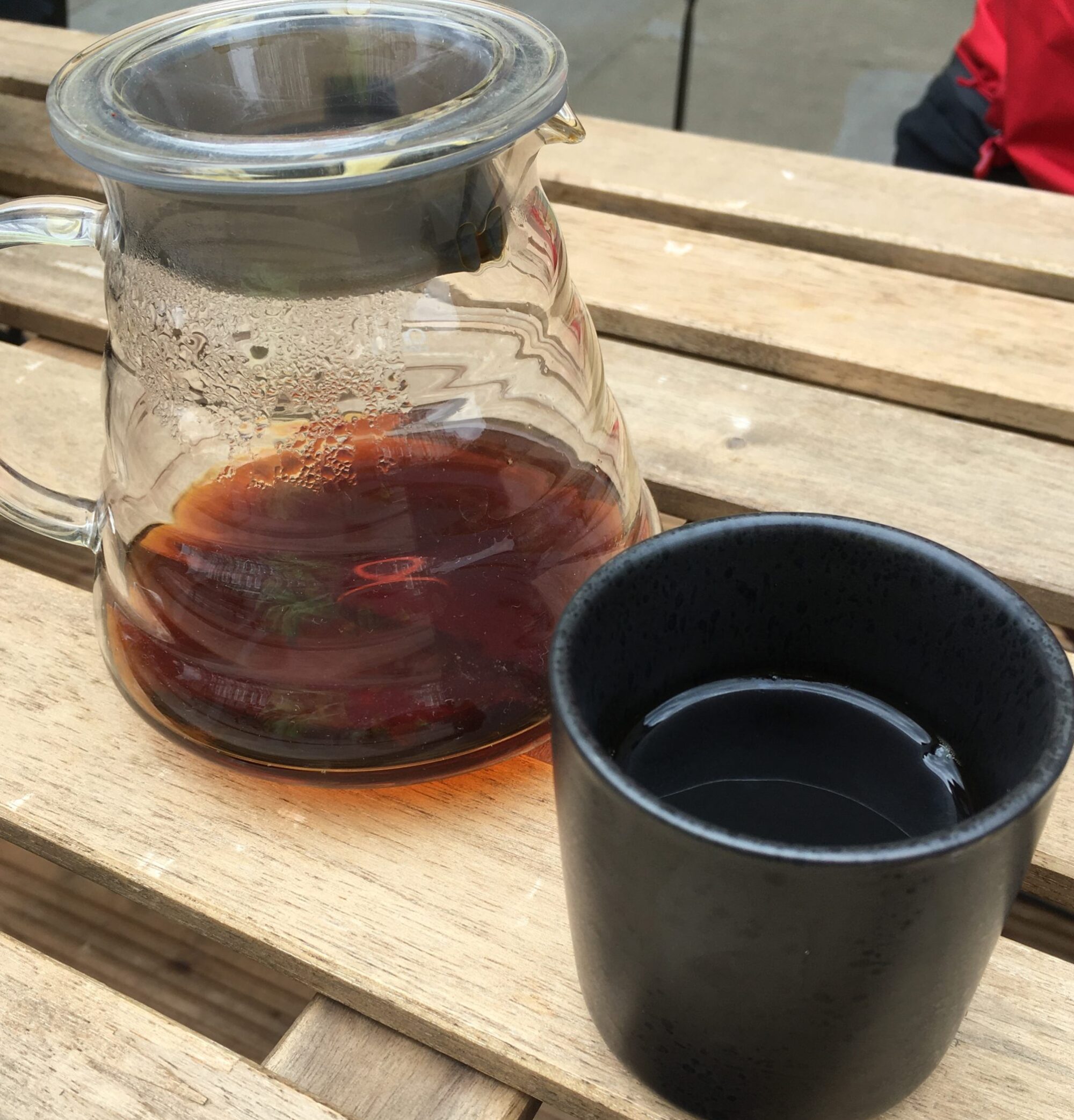
I finally got around to visiting Store St Espresso two weeks ago while visiting the nearby Institute of Making’s 3rd birthday science-outreach party. Although the café was crowded, we managed to find a place to perch while we enjoyed a soya hot chocolate, caffé latte and my V60. Beans are from Square Mile while the V60 and filter coffee options featured guest roasters. Despite the narrow frontage, there is actually plenty of seating inside and people were happy to share tables with other customers when it got particularly busy. The café is well lit with sunlight streaming in through the sky lights above (indeed, the extra electric lighting indoors seemed a bit unnecessary given the amount of sunlight coming through the windows on such a good day). On the walls of the cafe were pieces of artwork, including quite a large pencil/charcoal piece right at the back of the cafe.
I was meeting a friend for coffee before going to the science event and so thought it would be good to combine a cafe-physics review with a visit to the science. It is always interesting to hear other people’s observations of the same space that you are ‘reviewing’. In this case, I was taken by the floor which showed some very interesting crack structures but what fascinated my friend (who was enjoying her caffe-latte) was the way that the sound from the stereo was reflecting from the bare walls, floor and ceiling. While cracks and fracture processes can be very interesting, perhaps it is worth following her observations as it leads, in a round about way, back to the coffee that she was drinking.
A caffe latte and a soya hot chocolate at Store St Espresso
While studying for my physics degree, a lecturer in a course on crystallography told us an anecdote. The story concerned a physicist walking past an apple orchard. As he was walking past, he noticed that at certain points he could hear the church bells from a distant church. As he walked on, the sound of the bells faded, before suddenly, he could hear them again. The physicist went on to derive the laws of X-ray diffraction, a technique that is now used routinely in order to understand the arrangement of atoms in crystals (like salt, diamond or caffeine). X-rays are part of the electromagnetic spectrum (just like visible light) but they have a very short wavelength. The orchard had been inspirational to the physicist because, just as a crystal is a regular array of atoms, so the apple orchard is a regular array of trees; as you travel past an orchard (on the train, in a car or on foot), there are certain angles at which you can see straight through the trees, they have been planted in a 2D lattice. The church bells could only be heard at certain angles because of the way that the sound was being reflected from the multiple layers of the trees. The effect occurs because the sound made by church bells has a similar wavelength to the spacing of the trees (eg. ‘Big Ben’ chimes close to the note E, which has a wavelength of approximately 1m). The distance between atomic layers in a crystal is similar to the wavelength of the X-rays (the wavelength of X-rays frequently used for crystallography = 1.54 Å, size of the repeating structure in a salt crystal: 5.4 Å, 1 Å = 1/100000 of the smallest particle in an espresso grind). The physicist realised that the orchard affected the church bells in exactly the same way that the atoms in a crystal, be it salt, diamond or caffeine, will affect the deflection of X-rays. Suddenly, it became possible to actually ‘see’ crystal structures by measuring the angles at which the X-rays were scattered from substances.
Not quite a regular 2D lattice. By controlling the size of the bubbles and the number of layers, you can simulate the crystal structure of different metals. Seems I need more practice in making bubbles of a similar size.
We can perhaps imagine an apple orchard but what do crystals look like? Crystals can come in many forms, all they need to be is a repeating structure of atoms through the solid. Some crystals are cubic, such as salt, some are hexagonal, others form different shapes. Metals, such as that making up the shiny espresso machine in the cafe are often a certain form of cubic structure and to visualise it, we can return to my friend’s caffé latte (via some soap). Two people who were instrumental in understanding X-ray diffraction were the father and son physicists, William Henry and William Lawrence Bragg. While attempting to make a model of crystal structures, William Lawrence Bragg found that the bubbles that could be formed on top of a soap solution were a very good approximation of the sort of crystal structures observed in metals (his paper can be found here). As they form, the soap bubbles (provided they are of similar size) form a regular cubic structure on the surface of the soap solution held together by capillary attraction, a very good model for the sort of bonding that occurs in metals. By controlling the size of the bubbles, the number of layers and the pressures on the layers of the bubbles, all sorts of phenomena that we usually see in crystals (grain boundaries, dislocations etc) could be made to form in “crystals” formed from soap bubbles. Why not look for such crystal structures in the foam of your cafe latte, though be careful to see how the size of the bubbles affects the arrangement of the bubbles through the foam structure.
Sadly, I have never found a reference to the story of the physicist and the apple orchard and it may even have been apocryphal. The closest reference I can find is that W. Lawrence Bragg (after whom the laws of X-ray diffraction are named) had a “moment of inspiration” for how X-rays would ‘reflect’ from multi-layers of atoms while he was walking in an area called “The Backs” in Cambridge. If any reader of this blog does know a good reference to this story I would be very much obliged if they could tell me in the comments section (below). To this day, I have been unable to pass by an orchard (or even a palm oil estate in Malaysia) without thinking about crystal structure, X-ray diffraction and church bells!
It seems that taking time to appreciate how sound is reflected (or diffracted) from objects, either in Store St Espresso or in an apple orchard, could be a very fruitful thing to do. If you have an observation of science in a cafe that you would like to share, please let me know here.
Store St Espresso can be found at 40 Store St. WC1E 7DB
The physics of X-ray diffraction and some great bubble crystal structures can be found in the Feynman Lectures on Physics, Vol II, 30-9 onwards.
Amoret, so new it still didn’t have its name on the outside.
Amoret is a new addition to the coffee scene over in Hammersmith. Just up the road from the Hammersmith & City line entrance of Hammersmith tube station, I nearly missed this cute cafe when I walked past as it had no name on its frontage, nor did it have the chalk board that is characteristic of many cafes. Fortunately however, I had the address and so double backed to find a great little cafe. It appears that that majority of Amoret’s business comes from take-away orders although there is a small seating area at the back (it is small, when we visited in February, there were two chairs and a couple of tables/stools). If you are fortunate enough though to be able to take a seat at the back of the cafe, I would thoroughly recommend doing so. Not only can you enjoy good coffee in a nice environment, the friendly people behind the bar were very happy to chat about their coffee and cafe. Moreover, there is plenty to notice from this observation post at the back of the cafe.
When we visited, the espresso based coffee was by Campbell and Syme, with V60s that featured different guest roasters (though it seems that other roasters also regularly feature for the espressos). I had a coffee from Panama, roasted by Union, which featured the word “caramel” in its tasting notes. I have simple tastes (‘caramel’ or ‘chocolate’ descriptions always go down well) but it was a great coffee. Complementary water was available at the counter with take-away cups (and water ‘glasses’ ) that were compostable and biodegradable*. As the very friendly staff brought my coffee to the table, I noticed that the ‘table’ that I had put my water on was in fact a metal drum that sounded ‘clang’ as the cup was put down. The sound of the drum immediately suggested that the drum was hollow. We all recognise the sound of a hollow drum, it is partly about the pitch of the sound, but partly about the echoes that we hear as the sound reverberates inside the metal.
After I had enjoyed my filter! The table-drum at Amoret. Does the drum sound the same in summer?
Although it appears simple, the sound made by the drum is influenced by many aspects of the drum’s construction and surroundings. The stiffness of the metal and the atmospheric pressure affect the way that the drum’s surface vibrates, while the size of the drum and the speed of sound in air also affect the note, or pitch, that we hear. How is the sound of the drum affected by a change in its surroundings? For example, if the atmosphere in Amoret got much warmer, the speed of sound would increase, how would that affect the sound of the table-drum?
A few years ago, Professor Timothy Leighton was wondering how the properties of the atmosphere affected the sounds of musical instruments. Specifically, he wondered what instruments would sound like on other planets. Take Venus. Venus is a planet with a very dense, very hot atmosphere. The surface temperature on Venus is 457C (Earth’s average is approx 14C) while the atmospheric pressure is 90 Bar (Earth’s average: 1 Bar). As it gets hotter, the speed of sound increases and so, to a first approximation, the note made by the drum-table at Amoret will sound higher as the air gets warmer. However, the metal of the drum is also hotter on Venus (so less stiff) and the density and pressure of Venus’ atmosphere will act to further complicate things. So to start thinking about how things sound on Venus, we would be more sensible to think about a simpler instrument, such as an organ, which is only affected by the change of the speed of sound†. Take the famous case of Bach’s Toccata and Fugue in D minor. Played on Venus, the researchers found that, rather than be in D minor (293.66 Hz), it would have the pitch of F minor (at 349.23 Hz). You can hear Bach’s Toccata on Venus (Mars and Titan) here.
What about a human voice, how would a person sound on Venus (were they able to survive)? In humans, the pitch of the voice is determined by the rate of vibration of the vocal cords. So it is possible to construct a speech synthesiser to imitate human speech by modelling such a voice ‘box’. Erasmus Darwin, (grandfather to Charles) made such a device in around 1770 with wood, leather and silk‡. Darwin’s voice synthesiser could pronouce the sounds ‘p’, ‘m’, ‘b’ and ‘a’ and so ‘mama’, ‘papa’, ‘map’ and ‘pam’, which by some accounts was convincing enough to fool people into thinking there was a small child in the room. Why did people think that Erasmus’ ‘child’ was small? It turns out that just as with the drum, when we listen to people speak, we do not just register their pitch but also the echoes on their voice. Each time we make a sound, the sound travels from the vocal cords down to the lungs (where it gets reflected upwards) and up to the mouth (where it gets reflected downwards). We subconsciously listen for these echoes and, if they take a long time to appear, we deduce that the person is large (there is a greater distance between their voice box and their lungs). If the echo comes back quickly, clearly the distance between the voice box and the lungs is smaller and hence the person is smaller. Just like the drum at Amoret, the human voice is a bit more tricky to model on Venus than Erasmus Darwin’s device allowed for.
Leighton and co-author Andi Petulescu considered the question of the sound of the human voice on Venus in their 2009 paper. Firstly they said, the density of Venus’ atmosphere would make the vocal cords vibrate more slowly, so the person speaking would sound as if they had a deeper voice. But secondly, the high speed of sound on Venus would mean that those echoes that we listen for would come back very quickly, so we would perceive the speaker as being small. What does this sound like? A few years ago, a Dutch TV show set this very topic as a question for their annual quiz and answered it by one of the co-hosts singing Banarama’s “Venus” with, and without, the Venus voice changing software of Leighton. If you understand Dutch, the full clip is below. If you don’t understand Dutch but would just like to find out how you would sound on Venus while singing Banarama, forward to 7 minutes in for the version on Earth and 7m46 in for the Venus version.
It is not easy for us to travel to Venus to investigate whether Prof. Leighton was correct. It is possible for us to repeatedly visit Amoret to investigate how the coffee cups sound as they are put on the drum as the temperature changes around us. This seems a fantastic excuse to revisit to me.
Amoret is at 11 Beadon Road, W6 0EA
‡”Erasmus Darwin – A life of unequalled achievement” by Desmon King-Hele was published by Giles de la Mare Publishers (1999)
* It should be noted that ‘compostable’ plastic has a very specific definition that does not mean that it can necessarily be composted in the way that you or I would understand the term, as I described in more detail here. Nonetheless, it is definitely a significant improvement from conventional plastic and I would love to see more cafes follow suit with environmentally sound packaging.
† Of course this comes with a fair few caveats, not least the fact that the organ has to have flue pipes only. I would thoroughly recommend browsing Professor Timothy Leighton’s excellent webpage on this and other aspects of acoustics which you can find here.
Lumberjack Camberwell with the (not quite) inukshuk in the window
I came across Lumberjack last week while spending an afternoon in Camberwell looking for interesting cafes to “cafe-physics” review. I was actually on my way to a cafe further along the road when a couple of wooden structures in the window attracted my attention. Thinking that they were “Inukshuk” we decided to go in and try this new cafe. It turned out to be a good choice because, even though the structures were not in fact inuksuik, they had brought us into this lovely little cafe. We arrived shortly before closing but I still had time to enjoy a very good long black (with beans from Old Spike Roastery). Complementary water was brought over to the table. It would have been great if we had arrived just that bit earlier so that we could have had more time to properly appreciate this friendly cafe. The interior is bright and smartly decorated with wooden tables and shelving as well as plenty of seats at the back. The wooden furniture is explained by the fact that the cafe is the trading arm for London Reclaimed, a charity that provides employment and carpentry training to 16-25 year olds from SE London while making bespoke furniture from reclaimed timber. The cafe too aims to provide training and support to encourage 16-25 year olds into work and a future career. In terms of the ‘physics’ bit of this review, the interior of the cafe certainly has plenty to observe, from the pendulum like light fittings to the detail of the wood. But as this cafe is metaphorically, and in some ways literally, built on/with wood and as Lumberjack boasts on its website that “almost everything you’ll find in store, from the coffee to the furniture, are sourced as locally and homemade as possible” it is only appropriate that this cafe-physics review should focus on wood, trees and a tree very specific and local to London; the London Plane tree.
A Long Black at Lumberjack with the grain of the wood showing underneath
With their characteristic mottled bark, London Plane trees are a recognisable sight along many a London street. The bark absorbs pollutants from the street before bits of bark fall off, taking the pollution with them and leaving the tree with its mottled appearance. Their root structure and resistance to pruning or pollarding helps to ensure that (mostly) they can survive happily in the crowded confines of London pavements. They are indeed very much a tree that seems almost specially adapted to London. Yet the connection between the London Plane and London goes deeper than that. The first ever record of a London Plane tree was in the seventeenth century, just up the road from Lumberjack, in the Vauxhall Gardens of John Tradescant the Younger. The London Plane is in fact a hybrid tree, thought to be a cross between the American sycamore (first recorded in London in 1548) and the Oriental Plane (first recorded in London in the C17th). Both these trees were found in Tradescant’s gardens and it is possible that the hybrid tree, the now ubiquitous London Plane, was actually first grown in Vauxhall.
Even though London is full of Plane Trees, it is not very common to find plane wood furniture. Rather than the grain visible in the tables at Lumberjack, Plane wood shows a “lacy” structure that gives furniture made with plane a distinctive pattern. Although unsuitable for outdoor furniture, plane-wood can be used to make indoor furniture and indeed some London based cabinet makers have even documented obtaining usable timber from recently felled London Planes.
The Tradescant Tomb at St Mary’s, Lambeth
And it is this that takes us to the physics part of the cafe-physics review. Perhaps it is the areas (and the parks) that I walk through, but it seems to me that there has been a fair amount of tree felling in London over the last six months or so. Part of the reason for this must be to ensure that the trees in our parks and that line our streets are safe and not going to fall down in high winds. Many trees that fall down in high winds do so because they get uprooted. However it is also possible, in very high winds for the whole tree to snap. Indeed, when researchers mapped the wind speeds through a forested area of Southern France during a storm in January 2009 they found that when the wind speed exceeded ~40 m/s (90 miles per hour), more than 50% of the trees broke in the wind, irrespective of whether these trees were softwood (pine) or hardwood (oak). A very recent paper by a Paris-based group (published last week in the journal Physical Review E) confirmed that irrespective of the species of tree or the tree height, the trunks of trees were liable to snap at a critical wind speed. The team combined experiment and theory to establish that the critical wind speed scaled with the tree’s diameter and height. However, because trees generally treble their diameter as they double their height, the effect of the diameter change was (almost) cancelled by the height difference between trees. Surprisingly, this critical wind speed did not depend on the elasticity of the tree, so there is no difference between a softwood such as pine and a hardwood like oak or plane. The researchers calculated the critical wind speed needed to break a tree to be 56 m/s, very close to the 40 m/s observed in that January storm.
Lumberjack can be found at 70 Camberwell Church St, SE5 8QZ
If you have a cafe that you think needs a cafe physics review, please let me know. Comments always welcome, please click the box below.
Traditionally made coffee always appeals to my sense of coffee history. Coffee made its way out of Ethiopea via Turkey and the method of brewing the finely ground coffee in a ‘cezve’ or ‘briki’ is one that goes back a long way. It’s therefore always interesting when a new cafe arrives on the scene that offers “Greek” or “Turkish” coffee on its menu. Briki, in Exmouth Market, opened in May last year and so it was only going to be a matter of time before I visited to try it out. Aesthetically Briki appealed to me as soon as I walked through the door. Spacious and with the bar along one wall, there are plenty of seats available at which to slowly enjoy your coffee. The cafe itself is almost triangular and the other two walls have windows running all along them. What better way to sit and enjoy the moment (and your coffee) than to gaze out a window? Still, given that I had gone to a cafe called ‘Briki’ and that it advertised “Briki coffee” on the menu behind the bar, it was obvious that I had to try the briki coffee. The coffee was rich, flavoursome and distinctive, well worth the time taken to savour it. There was also an impressive selection of food behind the counter and the dreaded “does it contain nuts” question was met with a friendly check of the ‘allergen’ folder. I was therefore able to also enjoy the lovely (nut free) chocolate cake. Briki definitely gets a tick in the “cafes with good nut knowledge” box on my categories list.
However as I realised later, the coffee was not brewed in the traditional way but in a Beko coffee maker – a coffee maker specifically designed for optimising the brewing of Turkish coffee. The idea of the Beko is that it carefully controls and automates the entire brewing process so that you get a perfect coffee each time. But just how do you make a ‘perfect’ Turkish coffee?
A quick duckduckgo (it’s a mystery to me why has this verb failed to catch on while ‘to google’ is used so frequently) revealed two sets of instructions on how to make Turkish coffee. The first set, (including some otherwise very good coffee brewing websites) suggested ‘boiling’ the coffee repeatedly in the pot (cezve/briki). The second set, which seemed to be more specifically interested in Turkish coffee (as opposed to interested in coffee generally), were much more careful, even to the point of writing, in a very unsubtle way, “NEVER LET IT BOIL“. According to this second set of websites, the coffee in the cezve should be heated until it starts to froth, a process that begins at around 70C, far below the 100C that would be needed to boil it. Warming the cezve to 70C produces these bubbles and the lovely rich taste of the traditionally made coffee. Heating it to boiling point on the other hand destroys the aromatics* that form part of the flavour experience of coffee and therefore makes a terrible cup of coffee.
The contrasting instructions however led me to recall a discussion in Hasok Chang’s Inventing Temperature. Perhaps we all remember from school being taught how thermometers need two fixed points to calibrate the temperature scale and that these two fixed points were the boiling point and the freezing point of water. Perhaps this troubled you at the time: Just as with making coffee in a cezve, just how many bubbles do you need in order to say that the coffee (or water) is ‘boiling’? How were you supposed to define boiling? How much did it matter?
It turns out that these questions were not trivial. There is a thermometer in the science museum (in London) on which two boiling points of water are marked. The thermometer, designed by the instrument maker George Adams the Elder (1709 – 1773) marked a lower boiling point (where water begins to boil) and an upper boiling point (where the water boils vigorously). The two points differed by approximately 4C. So how is it that we now all ‘know’ that water boils at 100C? And what was wrong with Adams’ thermometer? The Royal Society set up a committee to investigate the variability of the reported boiling point of water in 1776. Careful control of the heating conditions and water containers reduced the temperature difference observed between different amounts of boiling. However, as they experimented with very pure water in very clean containers they found that things just became more complicated. Water could be heated to 120C or even higher without ‘boiling’. They had, unintentionally, started investigating the phenomenon that we now know as ‘superheating‘. Superheating occurs when water is heated to a temperature far above its boiling point without actually boiling. What we recognise as boiling is the escape of gas (which is usually a mix of air and water vapour) from the body of the water to its surface. In order to escape like this, these bubbles have to form somehow. Small bubbles of dissolved air pre-existing in the water or micro-cracks in the walls of the container enable the water to evaporate and form steam. These bubbles of gas can then grow and the water ‘boils’. If you were to try to calibrate a thermometer using very pure water in very clean containers, it is highly likely that the water would superheat before it ‘boiled’, there just aren’t the ‘nucleation’ sites in the water to allow boiling to start. The Royal Society’s committee therefore came up with some recommendations on how to calibrate thermometers in conditions that avoided superheating which meant thermometers were subsequently calibrated more accurately and superheating (and improved calibration points) could be investigated more thoroughly.
Perhaps viewed in this way there are even more parallels between Turkish coffee and physics. It has been written that “making Turkish coffee is an art form“. It is a process of practising, questioning and practising again. The Beko coffee machine automates part of the process of making Turkish coffee. When it’s done well though, Turkish coffee is far more than just the temperature control and the mechanics of heating it. There is the process of assembling the ingredients, the time spent enjoying the coffee and the atmosphere created by the cafe in which you drink it. Coffee as art in Briki is something that I would willingly spend much more time contemplating.
Briki is at 67 Exmouth Market, EC1R 4QL
“Inventing Temperature”, by Hasok Chang, Oxford University Press, 2004
*Although these aromatics are part of what gives coffee such a pleasurable taste, they decay very rapidly even in coffee that is left to stand for a while, it is this loss of the aromatics that is part of the reason that microwaving your coffee is a bad idea. A second reason involves the superheating effect, but perhaps more on that another day.

 I had been waiting for an opportunity to try the Coffee Jar for a fair while. It is not that it is in a remote location, it is in fact situated on Parkway just five minutes walk from Camden or Primrose Hill. Nonetheless it feels as if it needed a special trip to get there (and, though this is pre-empting the end of this cafe-physics review, it does deserve such a ‘special trip’). Inside, there is seating at the window and running along one wall, and although it is not the smallest of cafés, it is certainly a ‘cosy’ one. This is not intended as an estate agent’s euphemism but instead to emphasise the additional meanings of this word to convey a warmth and friendliness about the space that the Coffee Jar definitely has. So far, we have been twice (see, the ‘special trip’ is worth it!). The coffee comes from Monmouth and so unsurprisingly, on the two occasions I had a coffee there (Americano and Soya Latte), it was very well done and enjoyable. At the front of the counter are a wide selection of home made cakes and cookies. While this presentation can be awkward for allergy sufferers (nutty cakes or cakes with loose nuts on top are placed side by side with the nut free options which could give contamination issues), the cookies were very good (more on the cookies later).


