Categories
General Science history

A link between high blood pressure and drinking cold brew through a straw

Straws with viscous liquid (milkshake) in them
Drinking milkshake through a straw or two.

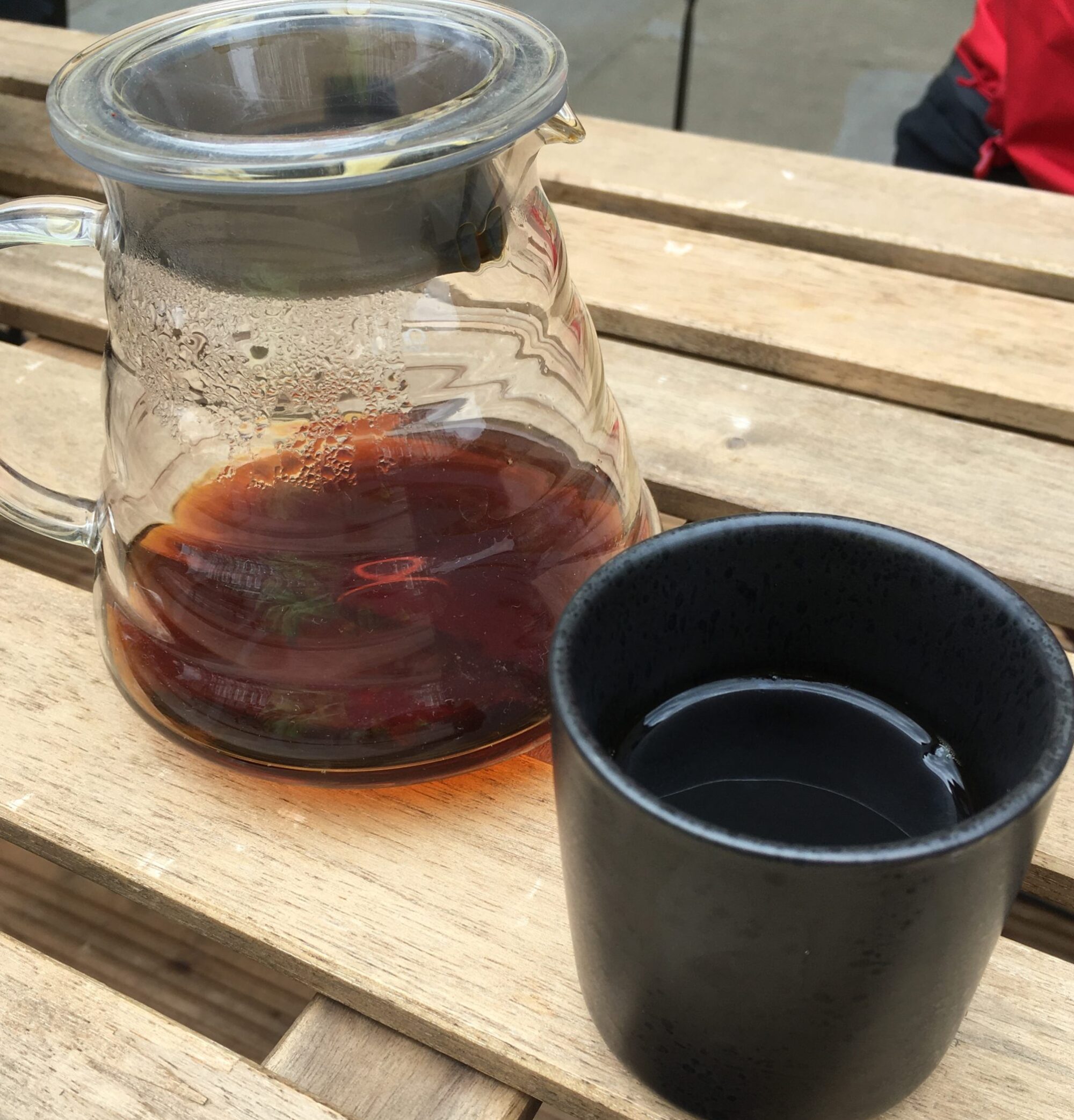
How do you drink your cold-brew? How about iced-coffee or iced-tea? Would you drink it through a straw? Maybe a smoothie or a milkshake would be ok. Perhaps you’ve noticed that you need a large straw to drink that milkshake while a small straw works for ‘thinner’ drinks. But what is the connection between this and the measurement of your blood pressure? It is not that drinking coffee gives you high blood pressure or the reverse. That question can be left for discussion on other websites. No, the question is, can drinking a milkshake through a straw give you an insight into the problems of high blood pressure caused by the build up of cholesterol?

If you are currently in a café, why not try an experiment. Get two straws and try drinking a cold drink using both of them together. It’s tricky but it is do-able, you can drink your drink. Now place one straw such that it is ‘sucking’ on the air outside the glass with the other straw still in the drink. Without cheating you can no longer ‘suck’ up that cold brew. Plugging either end of the ‘free to air’ straw enables you once again to drink your coffee. This experiment demonstrates that you are not really ‘sucking’ the liquid through the straw, rather you are generating a pressure difference between the top of the straw (a lower pressure in your mouth) and atmospheric pressure (higher pressure, around the drink) that pushes the liquid through the straw. Attempting to drink through two straws when one is open to the atmosphere cancels out that pressure difference.

2 straws
The straw on the left has a diameter of 3mm, on the right, 6mm.

Now another experiment. How do straws of different diameters affect the amount of liquid you can ‘pull’ through the straw? Try it. I have two straws in this picture, the smaller one has a diameter of 3mm, the larger one a diameter of 6mm. It takes a lot longer to drink a quantity of liquid through the smaller straw than it does the larger straw (assuming that you are drinking the same drink with each straw). For example, I drank 200ml of water in 10-12 sec with the larger straw but 26 sec with the smaller straw.

Back in the early nineteenth century two people were each investigating how liquid flowed through narrow tubes. Jean Leonard Marie Poiseuille (1797-1869) was investigating tubes of diameter 0.013-0.65mm in order to understand the flow of blood through capillaries in the body. Gotthilf Heinrich Ludwig Hagen (1797-1884) was investigating tubes between 2.3-6mm diameter (the same as the straws in the picture). Although they came to their conclusions independently, their work now forms the basis of parts of our understanding of the circulation of blood in the body†. What is now known as the Hagen-Poiseuille law states that the flow of liquid through the straw (or blood vessel) is proportional to the pressure difference between the two ends of the straw (how much you ‘suck’ so to speak) and the radius of the straw raised to the fourth power*. That is, it is the radius x radius x radius x radius. Doubling the radius of the straw results in a 2x2x2x2 (= 16) increase in flow rate.

Experimenting with the two straws does not give you quite the 16x difference that you may expect from this law perhaps partly because the flow into the straw is turbulent. If you maintained a uniform flow through the straws, you should find that the difference in flow rate between the two straws would be closer to 16x.

straw, water, glass, refraction
A straw in water, another physics-phenomenon that is worth contemplating for a while.

Of course, what applies to straws applies equally well to arteries or even the alveoli in your lungs. If your arteries get clogged by too much cholesterol, the reduction in the diameter of the artery leads to a reduced flow of the blood. A decrease in the diameter of an artery by just twenty percent more than halves the flow rate of blood through it (thereby increasing the blood pressure required to maintain ‘normal’ flow rate). Similarly the constriction of the alveoli in the lungs of asthmatics reduces the flow rate of air through the lungs in an asthma attack.

So it is not quite the fact that drinking cold-brew through a thin straw can give you high blood pressure. It is rather that thinking about how liquid moves through straws can help you to think about what is going on in your body. Those arteries of yours may be worth thinking about as you sip your cold brew this summer, whether or not you do so through a straw.


*The Hagen-Poiseuille law states that the flow rate F = ΔP.(r²)²/(8ηl) where ΔP is the pressure difference, r the radius of the straw, η is the viscosity of the liquid and l the length of the straw (or artery). Perhaps you can see why you will need a larger diameter straw to drink a milkshake.

†Blood Pressure Measurement, An Illustrated History by NH. Naqvi and MD Blaufox, Parthenon Publishing (1998)

Categories
Coffee review General Observations Science history slow

Ripples from the past at Fleet St Press

flash camera, aeropress, sand timers, coffee at Fleet St Press
Window display at Fleet St Press

As the name suggests, there is a lot of history behind the café at 3 Fleet St (the Fleet Street Press). Not only is it just around the corner from the Devereux (which was once the “Grecian” where Halley met Newton), it is a few doors down from the site of the second ever coffee house established in London (the “Rainbow” was at number 15). There is also plenty of history in the café itself. Fleet St Press operates from a listed building, considered especially noteworthy for its 1912 shop interior (ie. the café). The stained glass at the back of the shop (which was nearly the subject of this cafe-physics review) is apparently original while a sign (for “Tobacco blenders”) in the front window hints at the building’s previous use.

Inside, a row of tall stools offers seating along the wall while a large table at the front of the café offers a space to sit more comfortably to enjoy your coffee. We enjoyed a very nice long black (coffee from Caravan) and a soya hot (white) chocolate. The staff were friendly and it was a lovely space to spend a while. Keep-cups and other coffee making equipment are on sale just next to the counter and the café is just full of things to notice. It’s not just the stained glass. The window to the left of the main door has been stocked with a film camera with flash (presumably a nod to the Fleet St of old), an aeropress, a series of sand-timers and many other items of distraction. We sat at the window which had a good view towards the Royal Courts of Justice and two wonky K2 telephone boxes. Just across the passageway from the phone boxes was a post box and this got me thinking about communication and how we communicate with each other.

soy hot white chocolate
An interesting concept. A white chocolate hot chocolate made with soya milk

In an editorial to a book that rolled off one of Europe’s first printing presses, the Bishop of Aleria, Giovanni de Bussi wrote that printing could be considered an act of generosity “the act of sharing what was hoarded”*†. Since then, the newspapers of the old Fleet St have made way for coffee shops and the papers for the internet. The ‘snail mail’ post box across the road has been almost superseded by email or other forms of internet communication. The telephone box, replaced by mobile phones or Skype. Although we may feel overloaded with information, our ancestors felt the same way. Even in the 1640s it was claimed that they were living in times of a media explosion in which there were just too many books*.

So, rather than look at how the scribe gave way to the printing press, books to newspapers, letters to telegraphs and then telephones and now email, Twitter and instant messaging, perhaps it is worth dwelling a short while on what underlies all of these. Indeed, we are so used to what underlies these communication techniques that we may not even notice it.

Writing.

It may be an obvious point but none of these communication methods would have been possible were it not for writing. Given that Homo sapiens are thought to have come out of Africa some 200 000 years ago, and have been farming since 13000 – 8000 BCE, it is perhaps surprising that the first record that we have of a writing system was not until ~3500 BCE. Writing is thought to have originated in Sumer, Mesopotamia as pictographs. Phonographic writing was not developed until later. Shortly afterwards it was again ‘invented’ in Egypt (3150 BCE) and separately in China (1200 BCE) and MesoAmerica (~500BCE). Writing is a surprisingly recent phenomenon.

K2 phone boxes and a post box
The view from the window at Fleet St Press

As with the fixtures at Fleet St Press, clues from these earlier cultures pervade the space around us rather like the ghost signs of advertising past. The tobacco sign above the door is suggestive of former occupiers Weingott and Sons. Famous for their pipes, they ran a shop on the site from the mid-nineteenth century until the 1930s. Meanwhile, the writing systems of the ancients lives on both in our alphabet and in our time keeping. Even the name ‘alphabet’ resonates with the history of the Greek “alpha, beta” and the Hebrew “Aleph, Beth” (themselves originating from the Phoenician). The Babylonian number system meanwhile, which dates from around 1800 BCE and used base 60 to count (i.e. rather than 1-9, their number system counted 1-59) echoes down the ages. It is thought that remnants of this system remain both in how we count the degrees of a circle (360) and how we tell the time (60 minutes in an hour, 60 seconds in a minute).

Signs and systems that are both instantly familiar and a ghostly ripple from the people of the past.

Fleet St Press can be found at 3 Fleet St, EC4Y 1AU.

*E.L. Eisenstein, “Divine Art, Infernal Machine, the reception of printing in the West from first impressions to the sense of an ending”, University of Pennsylvania Press, (2012)

†Quote from de Bussi is as quoted in Divine Art, Infernal Machine on p 15. 

Some interesting anecdotes about the history of communication can be found in Robert Winston “Bad Ideas, An arresting history of our inventions” Bantam books, (2010),

Also recommended “A history of mathematics, from Mesopotamia to modernity”, L Hodgkin, Oxford University Press, (2005)


Categories
Coffee review General Observations Sustainability/environmental Tea

Reduce, Re-use, Recycle at Attendant

The outside of Attendant on Foley St
Attendant Coffee, Foley St

I was not initially going to do a cafe-physics review of Attendant. It wasn’t that I didn’t enjoy the coffee, I did. I had a very well prepared V60 which went very well with a lovely chocolate brownie. Nor was it that there was nothing to see at Attendant. No, it was quite the opposite. Part of the point of the Attendant seems to be its location. You see, if you were not aware of it already, Attendant is to be found in a (no-longer-used), underground, gentlemen’s toilet. Although they have been thoroughly cleaned, various fixtures (19th century urinals and cisterns) remain in place. Modern (deliberate) graffiti adorns the walls as you walk in. Understandably, there are no windows to gaze out of in this café. It is, in many ways, a very interesting place to visit and the coffee is certainly worth a visit too. However, it is difficult to do a review which is, after all, about noticing something unusual, when the former use of this space is almost shouting at you. I thought about doing a review based on how the shape of the coffee cup can influence the flavour of  the coffee that you perceive. Yet somehow, writing a review on anything other than the fact that this is a re-use of an interesting space seemed, almost, perverse. So I left it. Until that is, UK Coffee Week came along.

UK Coffee Week raises awareness and money for Project Waterfall which in turn aims to help provide clean water and sanitation for coffee growing communities. Currently, Project Waterfall works in three countries, Tanzania, Rwanda and Ethiopia. In these countries a large number of the rural population lack basic access to drinking water while a greater number do not have access to sanitation facilities. Clearly this can lead to health problems. The World Health Organisation estimates that world wide, the drinking water of 1.8m people is contaminated with faeces, while 0.5 million people per year die from diarrhoeal diseases including cholera.

Interesting glassware at the Attendant
Interesting presentation. Coffee at the Attendant.

Perhaps, while sitting in cafés or having breakfast at home, we have a tendency to take water for granted. Certainly I will admit that I can. I’m sitting here writing this enjoying a great cup of coffee with a few biscuits both of which took water to produce. Beyond the obvious water in the kettle for the coffee and the water used for the dough for the biscuits, there is the ‘hidden’ water. The water used to irrigate the coffee crops and the wheat fields or to process the coffee cherry towards the green bean stage. The water used in generating the electricity used to bake the biscuits, or roast the coffee. The water used to clean the utensils between coffee roasts/biscuit batches so that we don’t get food poisoning. The list could go on. Indeed, the UN estimates that producing 1 cup of coffee requires 140 L of water. This figure though presumably cannot include the private water needs of the individuals who work on the coffee plantations. We all need water and we all need it to be clean.

So, in thinking about our water consumption (and the water consumption of those who help us to enjoy our coffee), we can do a few things during this coffee week 2016. Firstly, we could make a donation towards the work of Project Waterfall (here) or a similar charity that is working to provide clean water and adequate sanitation to those who don’t have it. Secondly, we could take the prompt from Attendant and start to think about where our water comes from. Why from Attendant? Well if you were living on the International Space Station or, to a lesser degree, in Singapore, this question may have an obvious answer. For the rest of us, we are often a little bit removed from direct water recycling, but it’s worth looking more closely at Singapore because they have developed a water strategy that may be of use for more of us in the future.

Reclaimed water NEWater, Singapore
30% of water supplied in Singapore is ‘reclaimed’. Where does your drinking water come from?

Singapore has a population of just over 5.5m (London: 8.6m) with a land area of 719.1 km². As an island, it is surrounded by water and so you may think that water is not a problem for the inhabitants of the city-state. But the water surrounding Singapore is the salt water of the sea and so not easily converted into drinking water. While looking for a solution towards a self-sufficient water supply, Singapore decided to try the recycling route. Through a scheme called NEWater, currently 30% of Singapore’s water supply is from  ‘reclaimed’ water (for reasons that may be obvious, they avoid the word ‘recycled’). The Singaporean authorities aim to make this 55% by 2060. Waste water produced in Singapore undergoes a process of micro-filtration (which takes out suspended particles), reverse osmosis and UV disinfection before being reintroduced to the water supply system. Although most of this reclaimed water is used for industrial processes, the reclaimed water can be added to Singapore’s reservoirs so that it will go into the drinking water supply.

A similar process is used on the International Space Station but there, as it is a closed environment, it is not just the waste water that goes down the drain that is ‘reclaimed’ but the water exhaled by the astronauts and the lab animals on the station. On Earth this would evaporate into the atmosphere, contribute to cloud formation and then rain back down closing the greater water cycle in that way. On the space station, the fact that it is a closed environment means that this moisture too can be ‘reclaimed’. By recycling the water in this way, the inhabitants of the space station avoid having to require too many costly water deliveries from the Earth.

Perhaps, while drinking our coffee (or tea, or even water) today, we can take five minutes to consider where our water comes from as well as considering whether those who contribute to our brew have adequate water supplies themselves. And as it is coffee week, here is that link again to Project Waterfall (Donation button at the bottom of the main Project Waterfall page). Enjoy your coffee.

Note added August 2017: It is with some regret that I have to say that Attendant is not a good place to go if you suffer from allergies. They have started serving almond milk and (according to a Twitter Direct Message received from the Attendant Team) do not adequately clean their steam wand between drinks so as to prevent cross contamination. Their advice to me was that I “should not have any hot drinks or food at our premises as we do not operate a nut free environment at our stores”. There are many good cafes to visit if you suffer from nut allergies, but please avoid this one (or just have a black coffee and enjoy the atmosphere).


Categories
General Observations slow Tea

Happiness is a cup of coffee

stone recycling, slate, slate waterfall, geology
A cafe with a lovely space to enjoy the coffee. Taking time out at Espresso Base

If you are reading this, you clearly have access to a computer. You are also quite possibly connected through social media to friends, colleagues and others through Facebook, Twitter, Instagram or one of the other numerous ways in which we can now connect with each other. And while I would love for you to continue reading, at least for a couple of moments, I would like to ask you how often you take the opportunity to stop?  To stop and turn off your computer or the notifications on your smart phone and just look at what is around you.

This website is really about slowing down and noticing things. Since I believe that science offers a great way of seeing the connectedness of the world around us, I choose to emphasise the science that you can notice around you. It is most likely that you see the world in a different way, sharing some aspects of my point of view, disagreeing with others. However, it seems to me that slowing down and noticing your surroundings, whether you look at the science or another aspect of those surroundings, makes us in some way happier, or at least, generally, more calm. Having a coffee in a café is a great way of doing this. Whether you are interested in the café or the coffee (or indeed both), there is an awful lot to notice and to appreciate in a café. Noticing it of course does depend on keeping the smartphone (tablet or laptop) in your pocket or your bag. Personally, I find it slightly depressing when I see signs in a café saying “free wifi” (though I suspect I am in a minority on that one). And although if we are not used to it, not checking our email while having a coffee can seem to be enforced boredom, I’d hope that we soon realise that such boredom is in fact creative.

Sun-dog, Sun dog
Walking along while texting could mean that you miss seeing a sun dog

Please don’t get me wrong. It is not that I think social media are a bad thing. I have met (either ‘virtually’ or in person) some great and highly interesting people whom I would never have had the opportunity to meet were it not through Twitter/Facebook etc. Each day, I learn something new through the many people whose experience or knowledge I would otherwise never have had the opportunity to ‘tap’. However, just as sometimes it is great to have such interactions, I have found that it is also vital to have times (perhaps even a day a week) when the smartphone is kept firmly in the pocket (or at least, notifications are turned off).

In the UK, we have just got back from a long weekend. Many cafés were closed over the Easter break. Some of the café-Twitterers I follow went on a long break to the countryside (and Tweeted about it), others just turned off their social media for a few days. Elsewhere in the world you perhaps have different long weekends, Chinese New Year or Christmas. Perhaps during these holidays you manage to get a break in the countryside or by the coast. It is here that there is a link between an interesting recent study and a great use of a smartphone.  The study, by researchers at the University of Surrey and the London School of Economics, attempts to measure your ‘happiness’ while you are undertaking different activities in different locations, in urban environments, at work, or bird watching in the country.

Another great coffee outside, this time at Skylark cafe

Called the ‘mappiness‘ project, an app downloaded onto your iPhone (it is, sadly, only for iPhones), prompts the user to answer a question about their own perceived level of happiness at random instants. It then records the location of the phone (through GPS) and further asks the user to describe what they are doing. Over 1 million responses have so far been recorded through 20 000 participants. Perhaps unsurprisingly, the researchers have so far found that people tend to rate their happiness higher when they are outside, in natural environments and particularly in coastal areas. To me, it opens questions as to whether we should be attempting to quantify happiness or whether we should embrace the discussions of the humanities on this issue (less precise perhaps but by that very fact more complete and therefore more accurate). Perhaps these two approaches are complimentary. Nonetheless, the mappiness project remains an interesting study of a way in which you can use your phone in order to get a measure of where you should use your phone less.

Do get in touch and let me know what you think. Do you find it necessary to have some time out from social media or is Facebook your lifeline? Should cafés offer free wifi? Comments are always welcome (below) or you can get in touch by those two social media sites Twitter or Facebook. I do look forward to interacting with you there.


Categories
General Home experiments Observations Sustainability/environmental

Clouds in my coffee

clouds over Lindisfarne
How do clouds form?

Does your coffee appear to steam more next to a polluted road than in the countryside?

This is a question that has been bothering me for some time. Perhaps it seems an odd question and maybe it is, but it is all about how clouds form. Maybe as you read this you can glance out the window where you will see blue skies and fluffy white clouds. Each cloud consists of millions, billions, of water droplets. Indeed, according to the Met Office, just one cubic metre of a cloud contains 1 hundred million water droplets. We know something about the size of these droplets because the clouds appear white which is due to the way that particles, including water droplets, scatter sunlight. Clouds appear white because the water droplets scatter the sunlight in all directions. In contrast, the particles in a cloudless sky scatter blue light (from the Sun) more than they scatter red. Consequently, from our viewpoint, the scattered light from the clouds appears white while the sky appears blue. The sort of directionless light scattering that comes from the clouds happens when the scattering sites (ie. the water droplets) are of a size that is comparable to, or larger than, the wavelength of light. This means that the water droplets in a cloud have to be larger than about 700 nm in diameter (or approximately just less than a tenth of the size of the smallest particle in an espresso grind). The particles in the atmosphere on the other hand scatter blue light more than they scatter red light because they are smaller than the wavelength of the blue light. You can find out more about light scattering, blue skies and cloudy days, with a simple experiment involving a glass of milk, more details can be found here.

glass of milk, sky, Mie scattering
A glass of (diluted) milk can provide clues as to the colours of the clouds in the sky as well as the sky itself

So each of the one hundred million water droplets in a cubic metre of cloud is at least about a micron in diameter. We can then estimate how many water molecules make up one droplet by dividing the mass of a droplet of this size by the mass of one water molecule. This turns out to be more than 1000 million water molecules that are needed to make up one droplet of cloud. So, 1000 million water molecules are needed for each of the 100 million drops that make up one, just one, cubic metre of cloud. These numbers are truly huge.

But can so many molecules just spontaneously form into so many water droplets? Unlike a snowball, the water droplet in a cloud cannot start very small and accumulate more water, getting larger and larger until it forms a droplet of about a micron in size. Water droplets that are much smaller than about a micron are unstable because the water molecules in the drop evaporate out of it before they get a chance to form into a cloud (precise details depend on the exact atmospheric conditions). Water droplets need to come ‘ready formed’ to make the clouds which seems unlikely. So how is it that clouds can form?

Condensation on mug in CGaF
Look carefully at the rim of the mug. Do you see the condensation?

It turns out that the water droplets form by the water condensing onto something in the atmosphere. That something could be dust, or salt or one of the many other sorts of aerosol that are floating around in our skies. Just as with a cold mug filled with hot coffee, the dust in the air gives the water molecules a cold surface onto which they can condense. This sort of water droplet can ‘snowball’ into the bigger droplets that form clouds because the water is now condensing onto something and so does not evaporate off again so easily. At the heart of each water droplet in a cloud is a bit of dust or a tiny crystal of salt. Which brings me back to my question. It is much more dusty along a polluted road  than it is in the clean air of the countryside. Is this going to be enough of an effect to affect the probability of cloud formation? Does your coffee steam more as you cross the road than when you walk through the park?

It is a question that demands an experiment (and associated video). Last year, the Met Office suggested this simple experiment for observing clouds in a bottle. Unfortunately however, I have yet to make this experiment work in a way that would allow me to test whether polluted air produces thicker clouds than cleaner air. If you have any suggestions as to a good experiment (that will work on camera!) please let me know either in the comments section, by emailing me, or on Facebook. In the meanwhile, I’d be interested to know what you think, so if you think this post is about you, please let me know.


Categories
Coffee review General Observations Science history

Echoes of Bach at Amoret, Hammersmith

Amoret coffee Hammersmith
Amoret, so new it still didn’t have its name on the outside.

Amoret is a new addition to the coffee scene over in Hammersmith. Just up the road from the Hammersmith & City line entrance of Hammersmith tube station, I nearly missed this cute cafe when I walked past as it had no name on its frontage, nor did it have the chalk board that is characteristic of many cafes. Fortunately however, I had the address and so double backed to find a great little cafe. It appears that that majority of Amoret’s business comes from take-away orders although there is a small seating area at the back (it is small, when we visited in February, there were two chairs and a couple of tables/stools).  If you are fortunate enough though to be able to take a seat at the back of the cafe, I would thoroughly recommend doing so. Not only can you enjoy good coffee in a nice environment, the friendly people behind the bar were very happy to chat about their coffee and cafe. Moreover, there is plenty to notice from this observation post at the back of the cafe.

When we visited, the espresso based coffee was by Campbell and Syme, with V60s that featured different guest roasters (though it seems that other roasters also regularly feature for the espressos). I had a coffee from Panama, roasted by Union, which featured the word “caramel” in its tasting notes. I have simple tastes (‘caramel’ or ‘chocolate’ descriptions always go down well) but it was a great coffee. Complementary water was available at the counter with take-away cups (and water ‘glasses’ ) that were compostable and biodegradable*. As the very friendly staff brought my coffee to the table, I noticed that the ‘table’ that I had put my water on was in fact a metal drum that sounded ‘clang’ as the cup was put down. The sound of the drum immediately suggested that the drum was hollow. We all recognise the sound of a hollow drum, it is partly about the pitch of the sound, but partly about the echoes that we hear as the sound reverberates inside the metal.

Kettle drum at Amoret
After I had enjoyed my filter! The table-drum at Amoret. Does the drum sound the same in summer?

Although it appears simple, the sound made by the drum is influenced by many aspects of the drum’s construction and surroundings. The stiffness of the metal and the atmospheric pressure affect the way that the drum’s surface vibrates, while the size of the drum and the speed of sound in air also affect the note, or pitch, that we hear. How is the sound of the drum affected by a change in its surroundings? For example, if the atmosphere in Amoret got much warmer, the speed of sound would increase, how would that affect the sound of the table-drum?

A few years ago, Professor Timothy Leighton was wondering how the properties of the atmosphere affected the sounds of musical instruments. Specifically, he wondered what instruments would sound like on other planets. Take Venus. Venus is a planet with a very dense, very hot atmosphere. The surface temperature on Venus is 457C (Earth’s average is approx 14C) while the atmospheric pressure is 90 Bar (Earth’s average: 1 Bar). As it gets hotter, the speed of sound increases and so, to a first approximation, the note made by the drum-table at Amoret will sound higher as the air gets warmer. However, the metal of the drum is also hotter on Venus (so less stiff) and the density and pressure of Venus’ atmosphere will act to further complicate things. So to start thinking about how things sound on Venus, we would be more sensible to think about a simpler instrument, such as an organ, which is only affected by the change of the speed of sound†. Take the famous case of Bach’s Toccata and Fugue in D minor. Played on Venus, the researchers found that, rather than be in D minor (293.66 Hz), it would have the pitch of F minor (at 349.23 Hz). You can hear Bach’s Toccata on Venus (Mars and Titan) here.

Venus
The clouds of Venus photographed by Hubble. Image credit © NASA/JPL

What about a human voice, how would a person sound on Venus (were they able to survive)? In humans, the pitch of the voice is determined by the rate of vibration of the vocal cords. So it is possible to construct a speech synthesiser to imitate human speech by modelling such a voice ‘box’. Erasmus Darwin, (grandfather to Charles) made such a device in around 1770 with wood, leather and silk‡. Darwin’s voice synthesiser could pronouce the sounds ‘p’, ‘m’, ‘b’ and ‘a’ and so ‘mama’, ‘papa’, ‘map’ and ‘pam’, which by some accounts was convincing enough to fool people into thinking there was a small child in the room. Why did people think that Erasmus’ ‘child’ was small? It turns out that just as with the drum, when we listen to people speak, we do not just register their pitch but also the echoes on their voice. Each time we make a sound, the sound travels from the vocal cords down to the lungs (where it gets reflected upwards) and up to the mouth (where it gets reflected downwards). We subconsciously listen for these echoes and, if they take a long time to appear, we deduce that the person is large (there is a greater distance between their voice box and their lungs). If the echo comes back quickly, clearly the distance between the voice box and the lungs is smaller and hence the person is smaller. Just like the drum at Amoret, the human voice is a bit more tricky to model on Venus than Erasmus Darwin’s device allowed for.

Leighton and co-author Andi Petulescu considered the question of the sound of the human voice on Venus in their 2009 paper. Firstly they said, the density of Venus’ atmosphere would make the vocal cords vibrate more slowly, so the person speaking would sound as if they had a deeper voice. But secondly, the high speed of sound on Venus would mean that those echoes that we listen for would come back very quickly, so we would perceive the speaker as being small. What does this sound like? A few years ago, a Dutch TV show set this very topic as a question for their annual quiz and answered it by one of the co-hosts singing Banarama’s “Venus” with, and without, the Venus voice changing software of Leighton. If you understand Dutch, the full clip is below. If you don’t understand Dutch but would just like to find out how you would sound on Venus while singing Banarama, forward to 7 minutes in for the version on Earth and 7m46 in for the Venus version.

It is not easy for us to travel to Venus to investigate whether Prof. Leighton was correct. It is possible for us to repeatedly visit Amoret to investigate how the coffee cups sound as they are put on the drum as the temperature changes around us. This seems a fantastic excuse to revisit to me.


Amoret is at 11 Beadon Road, W6 0EA

‡”Erasmus Darwin – A life of unequalled achievement” by Desmon King-Hele was published by Giles de la Mare Publishers (1999)

* It should be noted that ‘compostable’ plastic has a very specific definition that does not mean that it can necessarily be composted in the way that you or I would understand the term, as I described in more detail here. Nonetheless, it is definitely a significant improvement from conventional plastic and I would love to see more cafes follow suit with environmentally sound packaging.

† Of course this comes with a fair few caveats, not least the fact that the organ has to have flue pipes only. I would thoroughly recommend browsing Professor Timothy Leighton’s excellent webpage on this and other aspects of acoustics which you can find here.

Categories
Coffee cup science General Home experiments Observations slow

Coffee Damping

vortices in coffee
Vortices behind a tea spoon

How often do you allow yourself to get bored? Or to sit in a cafe and take your time to enjoy your coffee properly, noticing its appearance, the smell ‘landscape’ of the cafe, pausing while you absorb the sounds of the cafe and playing with the feel of the coffee while you create vortices with your tea spoon?

If you regularly drink black coffee, you may have noticed how these vortices form more easily in the coffee once the crema has dispersed. Intuitively this may seem obvious to you, perhaps you wouldn’t even bother trying to form these vortices in a cappuccino, you’d know that they wouldn’t appear. The bubbles of the crema (or the milk in the cappuccino) quickly kill any vortex that forms behind the tea spoon (we’d technically call it ‘damping’ them). But even when we are aware of this, it is still surprising just how quickly the crema stops those vortices. Try forming a couple of vortices in a region of black coffee close to a region of crema. Indeed I thoroughly recommend ordering a good black coffee in a great cafe somewhere and just sitting playing with these vortices all the while noticing how their behaviour changes as the crema disperses.

latte art, flat white art
Latte art at The Corner One. Lovely to look at but not good for the vortices.

The damping caused by bubbles on the surface of a coffee is responsible for another phenomenon that you may have encountered in a cafe but, to be fair, are more likely to have noticed in a pub. Have you ever noticed that you are less likely to spill your cappuccino between the bar and your seat than you are your lovingly prepared filter coffee? Or perhaps, in the pub, you can get your pint of Guinness back to the table more easily than your cup of tea? (At least for the first pint of Guinness)

Back in 2014, a team investigated the damping properties of foam by controlling the size and number of bubbles on top of a liquid as it was vibrated (sloshed) about. They found that just five layers of bubbles on top of the liquid was enough to significantly damp the liquid movement as it vibrated from side to side. That is, five layers of bubbles suppressed the sloshing (try saying that after a couple of pints of Guinness). Much as I dislike emphasising the utility of a piece of science, this work has obvious implications for any application that requires the transportation of liquids such as the transport of oil containers. There is an obvious need to suppress the effect of liquid oil sloshing from side to side as it is transported by boat for example.

The foam on our latte or crema on our long black should indeed give us pause for thought as we sit in a cafe enjoying our coffee.


Categories
Coffee review General Observations

Setting standards at Brill, Exmouth Market

Brill, Exmouth Market, neon, architectural history
The neon lit “Brill” from the back of the cafe. You can also see evidence of an old arch in the brickwork, an old doorway?

Brill on Exmouth Market has quite a history. Originally a record store, it has evolved into a music shop/cafe more recently. On my recent visit, I ordered a very good Americano (beans from Officina Coffee Roasters) and although cakes were on sale, it was a small bar of Green & Blacks chocolate that appealed to me a bit more that day. It is a small cafe and so the few seats that are upstairs were occupied. This turned out to be a good thing though because I noticed a sign indicating that there were more seats downstairs, which actually meant that there was seating in a lovely little courtyard/garden at the back of Brill. Although it was originally locked (it was February and fairly dismal when I visited, who in their right mind would want to sit in the garden?), the friendly staff unlocked it and quickly cleaned one of the tables so that I could enjoy my coffee and chocolate in peace in central London. Indeed, the occasional (inevitable?) sound of sirens in the distance only served to emphasise the tranquility of the courtyard. The courtyard has four tables and a glitter-ball in the corner hanging from a tree. There was a lot to appreciate outside, both in terms of the science and the history of the place: Leaves deposited by vortices in corners of the yard with brickwork that suggested a significant re-build has occurred to this cafe.

But from my vantage point, it was the word ‘Brill’, lit up in neon lighting inside the cafe, that caught my attention. Neon lights are always interesting to me because their colour is so suggestive of the atoms that make up the light. The colour of a neon light is determined by the energy levels of the atoms that make up the light, the gas ‘neon’ shines red, hence neon lights. But if you wanted blue ‘neon’ lights you could use mercury as the vapour in the tube instead of neon, it is all about the energy levels of the atoms in the gas in the tubes.

glitter ball, disco at Brill Exmouth Market
A glitter ball in the corner of the courtyard at Brill

Under certain conditions, cadmium also emits a red light which brings us to the subject of this cafe-physics review: The definition of length. How is it that we can all agree on what ‘one metre’ is, or even one ‘inch’? Perhaps you are wondering how the red light emitted by cadmium, (or neon), relates to the definition of the metre? It’s about standards and definitions. Up until about 1960, the standard unit of length (the metre) was measured with reference to an actual, physical, metal rod kept in Paris with two scratches carved into it, one metre apart. Any arguments about the precise length of a metre could be settled by referring to the metre, this metal bar in Paris. But of course there were problems, the first of which was that the metre was in Paris. Perhaps you would think it easy to make copies? Yet in the nineteenth century this was already becoming a problem, the measurements that were being made were becoming too precise. Anders Ångstrom’s pioneering work with spectroscopy (investigation of elements by the colours that they emit/absorb) revealed a small difference between the metre kept in Uppsala (where Ångstrom was based) and that kept in Paris. Although the difference was tiny, when it was compared with what people had started to measure, it became significant. Then there was the question of the scratches: Would you measure the metre between the furthest two points of the scratch? Or the closest? Then an even worse problem was discovered: The rod was shrinking! If you’re tempted to abandon metric units and hark back to Imperial units, bear in mind that the UK Imperial Yard was shrinking even faster. No, something had to be done and that something involved changing the definition of the metre fundamentally.

neon sign, light emission
Neon signs have characteristic colours due to the electron transitions in the ionised gases

It is here that cadmium comes in to the story. Rather than use a physical length that we could all measure, the people whose job it is to define our base units decided that the definition of the metre would be with reference to the wavelength of the red light of Cadmium. I do not know why they did not want to use the red of neon lights but even with cadmium it quickly became apparent that there was a problem. The problem was that cadmium exists as several isotopes, all having a very slightly different ‘colour’ of red light that they emit. So, rather than cadmium, in 1960 they settled on the orange line of Krypton as the definition of the metre. One metre was then defined as 1650763.73 vacuum wavelengths of Krypton. That was the definition for over twenty years before the definition of the metre was updated again in 1983. It is now defined as “the length travelled by light in a vacuum during a time interval of 1/299792458 of a second”.

Perhaps it is not a definition that you or I could use, we’d probably still refer to our metre rule! Nonetheless this definition does allow people to perform experiments that need very precise and very accurate measurements of lengths. These standards are important for extremely sensitive measurements such as that needed to detect gravitational waves with the LIGO experiment, reported a few weeks ago. The neon lights at ‘Brill’ do indeed suggest a story that goes way back in time, both for the cafe and for the science.

Brill is at 27 Exmouth Market, EC1R 4QL

Spectroscopy information from “Spectrophysics”, by AP Thorne, Chapman and Hall Ltd, 1974

Categories
General Observations slow Tea

Tea Gazing

Milky Way, stars, astrophotography
The Milky Way as viewed from Nebraska. Image © Howard Edin (http://www.howardedin.com)

A recent opinion piece about last week’s announcement of the detection of gravitational waves at LIGO drew my attention to a quote from Einstein:

The most beautiful experience we can have is the mysterious. It is the fundamental emotion that stands at the cradle of true art and true science. Whoever does not know it and can no longer wonder, no longer marvel, is as good as dead, and his eyes are dimmed.

Einstein was not the only scientist to have expressed such sentiments. Many scientists have considered a sense of wonder to be integral to their practice of science. For many this has involved gazing at the heavens on a clear night and contemplating the vastness, and the beauty, of the universe. Contemplating the twinkling stars suggests the universe outside our Solar System. Watching as the stars twinkle gives us clues as to our own planet’s atmosphere. Of course, it is not just scientists who have expressed such thoughts. Immanuel Kant wrote:

“Two things fill the mind with ever-increasing wonder and awe, the more often and the more intensely the mind of thought is drawn to them: the starry heavens above me and the moral law within me.“*

light patterns on the bottom of a tea cup
Dancing threads of light at the bottom of the tea cup.

The other evening I prepared a lovely, delicate, loose leaf jasmine tea in a teapot. I then, perhaps carelessly, perhaps fortuitously, poured the hot tea into a cold tea cup. Immediately threads of light danced across the bottom of the cup. The kitchen lights above the tea cup were refracted through hot and not-quite-so-hot regions of the tea before being reflected from the bottom of the cup. The refractive index of water changes as a function of the water’s temperature and so the light gets bent by varying amounts depending on the temperature of the tea that it travels through. Effectively the hotter and cooler regions of the tea act as a collection of many different lenses to the light travelling through the tea. These lenses produce the dancing threads of light at the bottom of the cup. The contact between the hot tea and the cold cup amplified the convection currents in the tea cup and so made these threads of light particularly visible, and particularly active, that evening. It is a very similar effect that causes the twinkling of the stars. Rather than hot tea, the light from the distant stars is refracted by the turbulent atmosphere, travelling through moving pockets of relatively warm air and relative cool air. The star light dances just a little, with the turbulence of the atmosphere, this way and that on its way to our eyes.

Marcus Aurelius wrote:

Dwell on the beauty of life. Watch the stars, and see yourself running with them.Ҡ

Marcus Aurelius of course didn’t have tea. Watch the dancing lights in the tea cup and see yourself sitting with it, resting a while and then watching while dwelling on the beauty in your cup.

*Immanuel Kant, Critique of Practical Reason

†Marcus Aurelius, Meditations

Categories
Coffee review General Observations Science history Sustainability/environmental

Keeping it local at Lumberjack, Camberwell

Lumberjack coffee Camberwell
Lumberjack Camberwell with the (not quite) inukshuk in the window

I came across Lumberjack last week while spending an afternoon in Camberwell looking for interesting cafes to “cafe-physics” review. I was actually on my way to a cafe further along the road when a couple of wooden structures in the window attracted my attention. Thinking that they were “Inukshuk” we decided to go in and try this new cafe. It turned out to be a good choice because, even though the structures were not in fact inuksuik, they had brought us into this lovely little cafe. We arrived shortly before closing but I still had time to enjoy a very good long black (with beans from Old Spike Roastery). Complementary water was brought over to the table. It would have been great if we had arrived just that bit earlier so that we could have had more time to properly appreciate this friendly cafe. The interior is bright and smartly decorated with wooden tables and shelving as well as plenty of seats at the back. The wooden furniture is explained by the fact that the cafe is the trading arm for London Reclaimed, a charity that provides employment and carpentry training to 16-25 year olds from SE London while making bespoke furniture from reclaimed timber. The cafe too aims to provide training and support to encourage 16-25 year olds into work and a future career. In terms of the ‘physics’ bit of this review, the interior of the cafe certainly has plenty to observe, from the pendulum like light fittings to the detail of the wood. But as this cafe is metaphorically, and in some ways literally, built on/with wood and as Lumberjack boasts on its website that “almost everything you’ll find in store, from the coffee to the furniture, are sourced as locally and homemade as possible” it is only appropriate that this cafe-physics review should focus on wood, trees and a tree very specific and local to London; the London Plane tree.

Long Black coffee in a red cup
A Long Black at Lumberjack with the grain of the wood showing underneath

With their characteristic mottled bark, London Plane trees are a recognisable sight along many a London street. The bark absorbs pollutants from the street before bits of bark fall off, taking the pollution with them and leaving the tree with its mottled appearance. Their root structure and resistance to pruning or pollarding helps to ensure that (mostly) they can survive happily in the crowded confines of London pavements. They are indeed very much a tree that seems almost specially adapted to London. Yet the connection between the London Plane and London goes deeper than that. The first ever record of a London Plane tree was in the seventeenth century, just up the road from Lumberjack, in the Vauxhall Gardens of John Tradescant the Younger. The London Plane is in fact a hybrid tree, thought to be a cross between the American sycamore (first recorded in London in 1548) and the Oriental Plane (first recorded in London in the C17th). Both these trees were found in Tradescant’s gardens and it is possible that the hybrid tree, the now ubiquitous London Plane, was actually first grown in Vauxhall.

Even though London is full of Plane Trees, it is not very common to find plane wood furniture. Rather than the grain visible in the tables at Lumberjack, Plane wood shows a “lacy” structure that gives furniture made with plane a distinctive pattern. Although unsuitable for outdoor furniture, plane-wood can be used to make indoor furniture and indeed some London based cabinet makers have even documented obtaining usable timber from recently felled London Planes.

Tomb of the Tradescants
The Tradescant Tomb at St Mary’s, Lambeth

And it is this that takes us to the physics part of the cafe-physics review. Perhaps it is the areas (and the parks) that I walk through, but it seems to me that there has been a fair amount of tree felling in London over the last six months or so. Part of the reason for this must be to ensure that the trees in our parks and that line our streets are safe and not going to fall down in high winds. Many trees that fall down in high winds do so because they get uprooted. However it is also possible, in very high winds for the whole tree to snap. Indeed, when researchers mapped the wind speeds through a forested area of Southern France during a storm in January 2009 they found that when the wind speed exceeded ~40 m/s (90 miles per hour), more than 50% of the trees broke in the wind, irrespective of whether these trees were softwood (pine) or hardwood (oak). A very recent paper by a Paris-based group (published last week in the journal Physical Review E) confirmed that irrespective of the species of tree or the tree height, the trunks of trees were liable to snap at a critical wind speed. The team combined experiment and theory to establish that the critical wind speed scaled with the tree’s diameter and height. However, because trees generally treble their diameter as they double their height, the effect of the diameter change was (almost) cancelled by the height difference between trees. Surprisingly, this critical wind speed did not depend on the elasticity of the tree, so there is no difference between a softwood such as pine and a hardwood like oak or plane. The researchers calculated the critical wind speed needed to break a tree to be 56 m/s, very close to the 40 m/s observed in that January storm.

Lumberjack can be found at 70 Camberwell Church St, SE5 8QZ

If you have a cafe that you think needs a cafe physics review, please let me know. Comments always welcome, please click the box below.