Categories
Allergy friendly cafe with good nut knowledge Coffee review Home experiments Observations Science history

Bend it like sugar at Muni, Fulham Road

Muni Coffee, near Chelsea and Westminster hospital
Muni Coffee on Fulham Road

The area around Fulham Road and Chelsea & Westminster hospital is one that has long been fairly empty of speciality coffee establishments. Then, in June this year, Muni opened up on Fulham Road (just over 200 m from the main entrance of the hospital, in case you are visiting and looking for a good café nearby). Muni’s website emphasises its social mission, knowing the farmers they trade with by name and introducing Filipino coffee to the UK. Inside, there are plenty of tables (with more outside if you are visiting in warmer times). There is a menu on the wall behind the counter to your right as you enter, but I missed the listing of the Pandan iced tea (which would have been very interesting to try) as I was obviously not paying enough attention and instead opted for my default trying-a-new-cafe coffee, a black Americano.

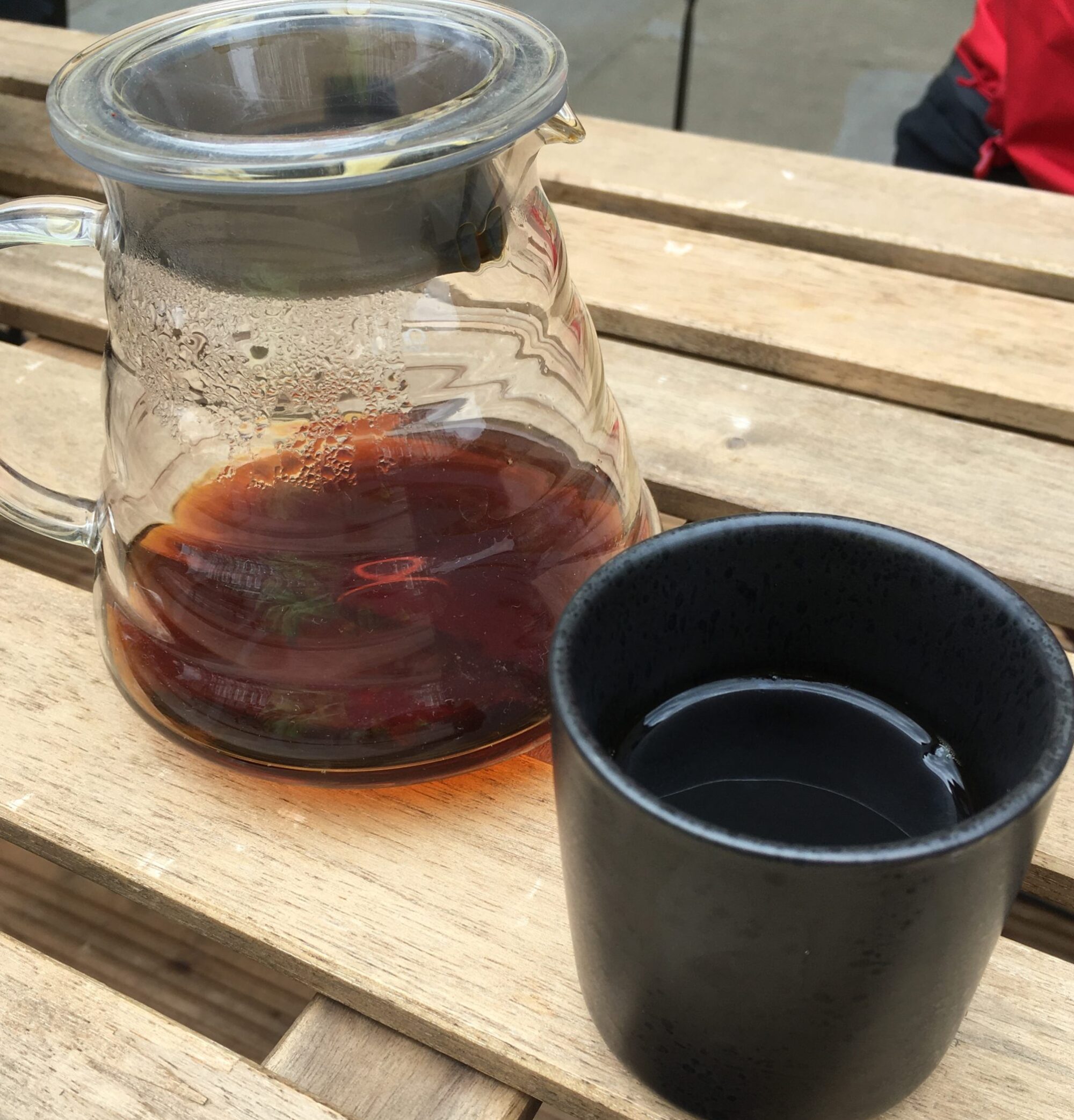
My sometimes companion in these reviews had a soya hot chocolate while I was very confident to enjoy one of the (lovely) salted caramel brownies because Muni lists all the ingredients for all of their cakes on a tablet device at the counter and so I was encouraged to double-check the ingredients list to see that there was nothing vaguely nut-related in it. A very good feature and this cafe definitely gets a tick in the “cafes with good nut knowledge” category on the right (as well as the new allergy-friendly category). As mentioned, the coffee is imported directly from the farmers in the Philippines, and roasted by Muni in North London. The black Americano I tried was fruity and flavoursome, while the beans I purchased and prepared later using a V60 produced a sweet and floral brew, perhaps with blueberry notes (but with no tasting notes on the packet, I’d be interested to see if others agree with me on this, please let me know in the comments section below).

coffee cake Muni
Coffee and nut-free salted caramel brownie at Muni

On the ceiling, wooden beams had cracked and aged creating a lovely aesthetic and taking me on a thought trail that involved aeroplane engines and heat process treatments. But then I noticed something else. As it was getting dark, the cars passing by on the busy Fulham Road were mostly using their headlights and this meant that, every so often, the edges of the windows around the door changed these headlights into a spectrum of colour. Flashes of blue, red and green as each car passed. It reminded me of Newton’s experiments in which he used a prism to first separate sunlight into its various colours before recombining it with another prism into white light. An effect that led me to think about an instrument that has been advertised as a tool to creating better coffee: the coffee refractometer.

Some of the same physics links Newton’s prism with the coffee refractometer. Perhaps you remember “Snell’s law” from school. The equation describes how much deviation light experiences as it passes from one medium (air) to another medium (glass or coffee). Light travels at different speeds through different media and the refractive index can be thought of as an indicator of the degree to which each medium slows down the light.

the door at Muni
The window at the side of the door at Muni. Rainbows of colour were produced by the headlights of cars as they went by.

For the prism, the important detail is that light is composed of many colours (which means in this context, many wavelengths) and not all wavelengths are slowed to the same degree. This means that the refractive index of the glass prism is slightly different for red light than it is for blue. Consequently, the spectrum opens up as the white light travels through the prism.

For the coffee refractometer, the important point is slightly different. Water containing dissolved solids has a slightly different refractive index than pure water. Measuring the deviation of a light beam through a drop of coffee therefore gives an idea of the concentration of “total dissolved solids” and so a guide to the extraction of coffee from the grind that you have achieved. The difference in refractive index is however quite small, if the measurements here can be relied upon, while water has a refractive index of 1.333 (at 20ºC), a well extracted coffee showed a refractive index of 1.335. We can calculate how much difference this makes to the angle that the light is deflected: Assuming light enters the drop at an angle of 30º, the angle that light is refracted in water is 22.03º, while in the coffee it is 22.00º. A small effect that would be quite difficult to measure unless you had a refractometer.

However, there is an ingredient in some people’s coffee that bends light enormously: sugar (though I do hope that no one reading this uses it in the quantities needed for the experiment below). The refractive index of water is very dependent on the total concentration of dissolved sugar it contains. Therefore you can do a really cool experiment in which a sugar solution (which has more concentrated sugar at the bottom than the top) can be seen to bend the path of a laser beam. All the equipment can be easily found at home (or purchased for not too much from hardware/office equipment shops). Let me know if you try the experiment how you get along (and if you decide to try using a refractometer to enhance your coffee brewing experience). The video was shared on youtube by the Amateur Astronomical Spectroscopy group (CAOS).

Muni coffee is at 166 Fulham Road, SW10 9PR. Just around the corner on Drayton Gardens, is the blue plaque for Rosalind Franklin who used to live at an address there.


Categories
Coffee cup science Observations Tea

Coffee: The mathematical and the beautiful

Last week, a new study was published that explored the mathematics behind brewing the perfect filter coffee.  The research, summarised here, modelled the brewing process as being composed of a quick, surface extraction from the coffee grounds, coupled with a slower brew, where the water was able to get into the interior of the coffee grind. It was an interesting study and the authors are now looking at grind shape and the effect of how you wet the grounds. However, what struck me was that the authors mentioned scanning electron microscopy (SEM) images of ground coffee. A lovely idea, what does coffee look like when magnified hundreds (or thousands) of times?

So here are a few images that I found shared under Creative Commons Licenses. I hope you find them as fascinating as I do.

1) A green coffee bean:

Green coffee bean under the microscope
A green coffee bean. Sadly no details as to magnification. Image shared under CC license from Nestle, Flickr

2) Instant Coffee

Instant coffee from Nestle
Spray dried instant coffee from the Nestle, Flickr account. Image shared under CC license.

3) Roast and ground coffee (fluorescence microscopy image)

ground coffee, fluorescence image
Ever wondered what your coffee looked like when magnified many times? This image using fluorescence microscopy is of roasted coffee. Note the similarities between this image and the following one (which has a scale bar).  Image shared under CC license from Nestle, Flickr

3b) More ground, roasted coffee, this time from Zeiss

Zeiss roast coffee
Scanning electron microscope image of roast (and ground) coffee magnified 750x. Image from Zeiss, Flickr, Todd Simpson, UWO Nanofabrication Facility. Shared under CC license. (To put the scale bar in perspective, it is the size of the smallest particles in an espresso grind. Clearly, the grind here is quite coarse).

4) Finally, an image of tea, just to keep this article tea-coffee balanced:

Green tea under the microscope
Green tea as seen under the microscope by the scientists at Nestle. Shared under CC license Nestle, Flickr.

If you come across any great images of coffee (or tea) under the microscope, please do share them. In the meanwhile, enjoy your coffee however you brew it.

Categories
Coffee cup science Coffee review Observations Science history

Ripples in the Knowledge Quarter at Pattern, Kings Cross

Pattern, coffee, Kings Cross, Kings X
Pattern Coffee, Kings Cross

In 2018, the Institute of Physics will move to Kings Cross and into what is being called the “Knowledge Quarter”, an area incorporating the British Library, the newly opened Francis Crick Institute and the University of the Arts, among others. Coffee houses have, in the past, been integral to the development of knowledge, places where scientists, artists and the generally interested would meet to discuss new ideas or groundbreaking results. So what about the cafés in Kings Cross? Where will tomorrow’s scientists, artists and the generally interested meet?

Knowing that I would be in the Kings Cross area a couple of weeks ago, I looked up the Kings Cross coffee guide by doubleskinnymacchiato and decided, for not-quite-random reasons, to try Pattern on this occasion. I had been forewarned that the first thing that I would notice would be the colourful patterns on the wall. A good call, that was indeed one of the first things you notice as you walk in. Secondly though were the hat-lampshades on the bulbs over the table at the window (visible in the photo on doubleskinnymacchiato’s review). As anyone who has met me in autumn/winter may appreciate, the lampshades immediately made me feel right at home. It was fairly crowded when I arrived in the late-morning and so I shared the bench in the window with a couple of people who seemed to be discussing history/philosophy and how to write properly referenced argumentative essays. The Americano I had ordered was brought over and, slightly self-conscious to photograph it while sharing the table, I just had to enjoy and savour the well made coffee. There is, perhaps, almost too much to notice at Pattern. But something behind me caught my eye, something that connects coffee, patterns and this café: An old style dial telephone, fixed to the counter.

telephone, dial, coffee Kings X
Patterns in the cord, patterns in the telephone. An unusual feature at Pattern, Kings Cross.

Although the history of the invention of the telephone is quite controversial, the bit that reminds me of coffee is not so contentious, it is to do with how the telephone works. Let me explain.

In the gallery the “Information Age” at the Science Museum in London, it is argued that the commercial success of the telephone was driven by the invention of the carbon microphone, simultaneously invented by David Hughes (1831-1900) and Thomas Edison (1847-1931). It is the Edison version that prompts me to think of espresso. Edison’s microphone worked by packing a cylinder of carbon granules between two metal plates. In my mind I think of Edison’s carbon microphone as similar to a perfectly tamped coffee block in a filter basket. In the microphone, one plate was fixed, the other was flexible and acted as a diaphragm. When somebody spoke into the microphone, the diaphragm would vibrate causing the carbon granules to move alternatively closer together and further apart. Carbon conducts electricity and so the resistance of the microphone changed if the carbon granules were closer together or further apart. The sound waves impacting on the diaphragm were being perfectly translated to electric current patterns that could be transmitted through the telephone lines. The packing of the carbon granules would need to be optimum to transmit the sound, just as the pressure used to press the espresso tablet needs to be just right, enough contact between coffee grains to prevent the water flowing straight through without producing a good coffee, but not so much that the water cannot percolate through the coffee tablet and what should be a lovely espresso becomes over extracted. The ground coffee pressed into the filter basket at Pattern must have fitted this optimum density very well. A well poured espresso revealing that they had achieved that optimum balance between compression and space in the espresso tablet. Good coffee, interesting physics, I’m sure the Institute of Physics will be pleased when it eventually moves to its new home with such great coffee neighbours.

IoP poster in Kings Cross
Physics is everywhere! (But coming to Kings Cross)

Although slightly off topic, a cafe-review considering telephones would not be complete without including the story about Erasmus Darwin, the Devil and his “speaking machine”. Erasmus Darwin (1731-1802) was a fairly portly man who worked hard. So it was inconvenient for him to have to go from his study to the kitchen when he wanted something to eat. Being a bit of an inventor, he installed a speaking tube in his home that connected his study to his kitchen. Desmond King-Hele in “Erasmus Darwin, A life of unequalled achievement”* described what happened next:

One day a local yokel who had arrived with a message for Darwin, was left alone in the kitchen. He was terrified when a sepulchral and authoritative voice from nowhere demanded ‘I want some coals’. Such a request could only come from the Devil, he thought, wishing to stoke up hell’s fires. The man fled and would not come near the house again.

The poor local may have been bewildered by the number of telephones and ‘voices from nowhere’ that surround us now. If you’re reading this in a café, why not look around you, notice some strange connection (the very lateral ones can be particularly fun to ponder), and then let me know what you have seen. It’s always interesting to hear the science, history and connections that people notice as they sit in cafés around.

Pattern Coffee is at 82 Caledonian Road, N1 9DN

*Desmond King-Hele, “Erasmus Darwin, A life of unequalled achievement” was published by Giles de la Mare Publishers, 1999.

Categories
Coffee review General Observations Science history slow

Science & Religion at Rag & Bone Coffee, Westminster

Rag&Bone, Rag & bone, coffee Victoria, coffee Westminster
Rag & Bone Coffee in front of St Matthew’s Church.

Can a coffee cart provide the time and space for reflection and enjoyment of a coffee just as a sit-down cafe can? In seeking an answer to this question (as well as on a quest to find more great coffee in the Victoria/Westminster area), I turned up at Rag & Bone coffee on Great Peter St. It was quiet when I arrived in the courtyard of St Matthew’s Church, and the barista took time to make me a lovely, fruity and full bodied Americano (with beans roasted by Old Spike Roastery). Obviously, there is no seating around the bar but, the church behind the cart is open everyday and offers a rare quiet spot in Victoria to sit and reflect, should you want to do so, before you buy your coffee of course! Sadly, as this is a cart and not a sit-down cafe, the cups provided are disposable, but there is nothing to stop you taking your keep-cup along in order to enjoy your coffee. Just behind the cart, a crucifix above the door of the church caught my eye. And that got me thinking about something, perhaps slightly tangential to the ordinary cafe-physics reviews of Bean Thinking, why do some people imagine there is a conflict between religion and science?

I could see how there could be a disagreement if a religion took an overly literal interpretation of a text (as can happen with disputes over evolution). Or if someone used science as an argument against ‘belief’ while failing to appreciate that science too is based on belief (albeit beliefs that we are most likely just to assume as facts without questioning: particularly that our world exists and that it can be understood). But outside those extremes, and if we look at the motivations of both religion and science, it is surely that both religion and science aim to discover or value truth. If both sincerely follow that aim there can be no real conflict, for truth cannot contradict itself.

Earth from space, South America, coffee
One planet. One home.
The Blue Marble, Credit, NASA: Image created by Reto Stockli with the help of Alan Nelson, under the leadership of Fritz Hasler

Instead the investigations of one can inform the other and help both to advance our understanding of the world. Take for example the urgent issue of climate change. Scientists, using science as a tool, can investigate and highlight areas of concern for our planet (increasing CO2 levels, rising sea temperatures, a probable increase in extreme weather events, etc) but strictly speaking, as a tool it can go no further. If a scientist then urges us to do something to mitigate climate change, they are not speaking as a ‘scientist’ but as a human being; a human being who is informed by ethical concerns. It would be perfectly logical for someone to recognise that climate change is happening while holding that there is no obligation on our current generation to do anything about it. We may find such an opinion objectionable but that is the crux of it, we have introduced values to the discussion in the form of ‘right and wrong’ and ‘good’. We have moved beyond the remit of science. Religions have had millennia to consider the human condition and what constitutes ‘good’ or ‘right’. For us to combat climate change we need not just the evidence that it is happening, but an idea of a better, or more ‘just’ world. Ethical systems are of course possible without religion, but discussion informed by religious concern can help to change ‘concern for our planet’ into the concern for and protection of ‘our common home‘.

Artemisworks photography, rosary and keyboard
Prayer beads on a keyboard.

Then there is a link between religion and science that brings us right back to Rag & Bone Coffee and St Matthew’s church yard. When St Matthew’s was built back in 1849, the area surrounding it was squalid, conditions were so bad, the area towards Victoria St. was known as the “Devil’s Acre“. The Dean of Westminster, and the new vicar of St Matthew’s recognised that, to help people out of poverty, drastic steps would need to be taken and one of these was to improve education. The Dean of Westminster died soon after St Matthew’s was built but his wife, Mary Buckland, who was also a palaeontologist, wanted to continue his work with the poor. In order to improve the conditions for those living in the slums in the Westminster area, “Mrs Buckland” established a coffee house on Old Pye St, that was cared for by the Revd. Richard Malone, vicar of St Matthew’s. The coffee house was a place where lectures were given and a library was set up. The church and people in the scientific world, worked together to help the poor of the area positively change their living conditions.

The coffee house eventually had to close but, perhaps it could be said that, in a sense, the presence of Rag & Bone coffee in the courtyard of St Matthew’s, continues this work. Although times have changed, and the area is no longer a slum, there is a different form of poverty, people who are time-poor and harassed, working in the offices that now surround the church. In this sense, Rag & Bone Coffee offers not just refreshment, but a brief time-out from the daily grind for the people who now pass by this space. As making coffee is both an art and a science, perhaps we can also say that here too, science and religion work together, with coffee, to make the world a better place.

Rag & Bone Coffee can be found in the courtyard of St Matthew’s Church, Great Peter St. SW1P 2BU.


Categories
Coffee review General Observations slow

2 years in

3D hot chocolate art on an iced chocolate, Mace, Mace KL, dogs in a chocolate
Happy birthday to me

Last weekend, Bean Thinking turned 2. So I’ve been looking back at the cafés I’ve visited over the past two years. Bean Thinking started as a way to slow down and to try to see things in a (slightly) different way, to really enjoy the coffee but also to take time to explore the stories, and the science, that can be found in different cafés. I’ve enjoyed the coffee in each café that I have visited but, as always happens, some stick in the memory a little more than others.

So I decided to pull together five cafés which, for me, had an interesting story to tell or prompted an unexpected chain of thoughts. I have sadly had to leave out some great cafés and some really fun stories (for me to think about at least). However, these five stood out. Each café introduced an unexpected bit of science to me, or had something about them that meant that slowing down and enjoying the coffee provided a really special moment. Consequently, each café features for slightly different reasons, and so rather than create a top 5 (which would be impossible anyway), I have listed them alphabetically. I hope you’ll excuse this trip down memory lane.

Amoret, Hammersmith

Kettle drum at Amoret
Coffee on a drum at Amoret

It is not every day that a well made V60 can transport you to another planet. Yet that is what happened for me at Amoret in Hammersmith. The cylindrical design of the table reminded me of a drum but the question is, why do drums make the sounds that they do? The answer to this question took me on a journey into sounds. Just how different would Bach’s famous fugue sound if played on Venus rather than Earth? And then a surreal moment as a Dutch TV station decided to take Bananarama to Venus courtesy of research conducted at Southampton University. This was all accompanied by great coffee in a very pleasant cafe, the review can be found here.

Coffee Affair, Queenstown Road,

Contemplating the floor at Coffee Affair

Where better to slow down and appreciate the moment than a place reminiscent of the geology of the South Downs that helped Charles Darwin to argue the case for his theory of evolution. Coffee Affair occupies the old ticket office at Queenstown Road station. The fixings and the floor of the café reveal evidence of the people who inhabited this space in times past. Watching the V60 being prepared, slowly, carefully, exactly, emphasises this sense of time. The result is great coffee in a place that almost forces you to step out of the speed of modern life and stop, put down the smart phone and take time to just notice. Coffee Affair was reviewed here.

Lumberjack, Camberwell,

Lumberjack coffee Camberwell
Exploring local connections at Lumberjack

There’s a strong emphasis on keeping it local at Lumberjack in Camberwell, as well as a preoccupation with all things wooden (this being an enterprise set up with London Reclaimed). So it was interesting to discover that there was a fairly local connection between Camberwell and the ultimate ‘local’ London tree, the London Plane. Not only that, but research that had been published a few weeks before I went to review Lumberjack had shown that, surprisingly, the wind speed needed to fell a tree was fairly constant at around 56 m/s, irrespective of the size or type of tree. This surprising finding was the cherry on the cake for this ultimate in local reviews (here).

Red Door, Greenwich,

vortices, turbulence, coffee cup physics, coffee cup science
Beautiful physics at Red Door

Just what would happen if you put a cup of coffee on a record player? A turntable in a corner at Red Door in Greenwich meant that not only did I start to think about this question, I decided to start some experiments to find out. The resulting physics was physically as well as scientifically beautiful. The experiments can be done by anybody with equipment that you can probably find at home (though I would recommend not using an actual turntable). It turned out to be an elegant experiment involving vortices, but as Helmholtz noticed, similar vortices form in organ pipes, the atmosphere and even in electromagnetism. Truly a beautiful piece of connected physics that I would have missed had I enjoyed my coffee ‘takeaway’. More here.

The Turkish Deli, Borough Market,

Turkish coffee
The universe in a cup of coffee at The Turkish Deli

“The universe is in a glass of wine” so said a Greek poet according to Richard Feynman, but at the Turkish Deli it is more obvious in a cup of coffee. When made properly, Turkish coffee requires at least four minutes of ‘settling time’ before it can be enjoyed. You could use this time to think about how the concentration of coffee particles changes as a function of the depth. Similar considerations led Jean Perrin to conduct experiments back in 1910 that he declared showed that “… it becomes very difficult to deny the objective reality of molecules” (which before that point had indeed been very much denied). Now that The Turkish Deli also roast and grind their own coffee on-site, there is even more reason to visit and ponder the connectedness of our coffee and our planet. The Turkish Deli was reviewed here.

With so many more cafés to explore, and things to discover, who knows what the next year or two will bring. And if you’ve got a recommendation or found a great café where you have stopped and noticed something intriguing, no matter how lateral, why not drop me an e-mail, I’d love to hear your experiences of slowing down and appreciating our coffees.


Categories
Coffee cup science Coffee review General Observations Sustainability/environmental Tea

A cup of tea for a light bulb moment at Ginger and White, Hampstead

Coffee, Ginger and White, Hampstead
Coffee at Ginger and White, Hampstead

It was late afternoon by the time we stopped by Ginger and White in Hampstead. The warm weather meant that we could enjoy time spent sitting outdoors in the little alleyway in front of the café. We had been taking a friend around the various sights (and foodie places) of London and so stopped here before heading back home. The long black, cortado and soya latte were all very well done and, while the others had enjoyed a crepe at La Creperie de Hampstead just around the corner, I took the opportunity to try the excellent banana bread on offer at Ginger and White. There was a fairly good selection of cakes on offer, but sadly those that the staff could confidently affirm were nut free were far fewer. However, the moist and tasty banana bread was a good option anyway. Coffee was roasted by Square Mile and there were also Square Mile beans available for purchase should you wish to take some home with you. While the café was fairly busy, it was nevertheless a relaxing place to sit and watch the people of Hampstead go by.

The interior of Ginger and Whites
Everything is connected. From the lights to your cup of tea.

As I was looking around, wondering what the physics part of this cafe-physics review would be, I had what you could call a “light-bulb moment”. The walls of the building opposite were reflected in the windows of the café but looking inside, I noticed the lights which appeared to be LED lightbulbs set-back into the ceiling. Along with requiring less energy to power than conventional or halogen lightbulbs, LED lightbulbs in a café offer another, more poetic advantage for the café: they have a connection to the drinks being served and particularly tea. It’s all about diffusion.

At the heart of an LED light, there are two materials that form a junction. On one side of the junction is a semiconductor material that conducts electricity by means of electrons. Electrons conduct electricity in metals and are the ‘normal’ way that we consider electrical current to  be carried. On the other side of the junction is a different semiconductor, one that still conducts electricity but this time does so with carriers called ‘holes’. You can view the electrons as having a negative charge and the holes as having a positive charge.

tea bag, tea cup, diffusion, turbulence
What happens when you put a tea bag into a cup of cold water. How long until the water becomes ‘tea’?

But what happens at the junction? Is there really a sharp barrier between these two types of material? Think about putting a tea bag in a cup of cold water, does the tea bag just sit there or does it slowly, very slowly, start to diffuse tea into the cold water? It is a similar thing for the two materials. Slowly the electrons diffuse into the hole material and the holes into the electron material. In fact, mathematically, the same equations describe the process in the junction as in the tea cup. But unlike tea, in the LED, the holes and electrons have an electric charge associated with them and so, as they diffuse away from the junction, they set up an electric field across the junction. It is this electric field that eventually stops any further diffusion of electrons or holes across the junction and sets up the conditions necessary for LEDs to emit light. It would be like having a tea bag that diffuses tea into the cup until it is perfectly brewed and no further.

Of course, there is much more than this to understanding LEDs. If you’re interested, there is further information here. I find it fascinating however that what happens in your tea cup, is also happening on many different scales in many places in the universe. And of course, in the lighting of cafés and coffee houses around the world.

Ginger and Whites is at 4a-5a Perrins Court, NW3 1QS


Categories
General Observations slow Sustainability/environmental Tea

Environmentalism through V60s

Is there a parallel between trying to live more sustainably and the art, or science, of coffee appreciation?

San Sebastian via Aeropress
Enjoying a coffee prepared in an Aeropress at Alchemy

Consider the way that we experience our coffees. Who would not wish that more people took time to enjoy great coffees, perhaps single-origin pour-overs, precisely measured and lovingly made, obviously without milk. But we know from experience that not everyone is ready to take the risk of trying a new café and paying that bit extra for a coffee they do not know. Our own coffee journey may illustrate this point. My student days were filled with supermarket (cheapest brand) instant and machine coffee (20p between lectures). Slowly I graduated (quite literally, a well known chain opened close to the university in my final year) to grande lattes, flavoured with nutmeg and similar drinks. A smaller chain introduced me to macchiatos and black coffees before I found a start-up roasting company on the internet and suddenly my mornings were transformed with the fragrance of freshly roasted and freshly ground, aromatic and lovely coffee.

Each step I took introduced me to better, more interesting coffees. New coffee roasters opened offering different levels of roast and different types of bean. Great independent cafés started up which featured coffees brewed in new and innovative ways (the Aeropress was only invented in 2005). Social media and more traditional friend circles introduced me to people who really take time to savour their coffee and which in turn has enabled me to grow in my own coffee appreciation. Would I have jumped from instant to pour-over? Probably not. And yet, I know that I am still on a coffee-appreciation journey: There is still so much more to learn, so many new things to experience, it is a journey I’m very happy to have embarked upon.

kettle, V60, spout, pourover, v60 preparation
How much CO2 does over-filling your kettle really produce?

So what is the link with environmentalism or indeed science? Well, how many times have you heard that if only we filled the kettle just to the correct amount, we would save so many tonnes of carbon dioxide emissions annually? A counter argument points out that given how much pollution we are actually responsible for, merely correctly filling the kettle (or avoiding takeaway cups) is going to have negligible environmental benefit. It is here that I think that the analogy comes in.

It is true that, when you tot up your daily energy consumption, the use of a kettle is not a very big part of it*. For me, even when I overestimated my kettle use (and underestimated the energy costs involved in transporting the kettle/coffee etc. to my kitchen as this became difficult to estimate), my energy use coming from the kettle was only 2% of my daily average. If I only considered the energy consumption due to electricity per day, of course the contribution of the kettle would be higher but it is still not that big a deal.

Over-boiling the kettle does not seem to make that much of a difference when compared to the difference we will have to make in order to limit climate change. Which takes us to the very valid argument that “if everyone does a little, we’ll achieve only a little”†. But, is it worth being just a little bit more optimistic on this? Let’s bring in the coffee.

Earth from space, South America, coffee
One planet. One home.
The Blue Marble, Credit, NASA: Image created by Reto Stockli with the help of Alan Nelson, under the leadership of Fritz Hasler

It is all too easy to breeze through life not considering our environmental actions, I’d argue that this is the instant coffee stage. As we start to become more aware of the environment, we perform small actions (buying – and of course reusing – a keepcup, only filling the kettle just-so). That’s great, we’re drinking pumpkin-spice lattes. It may not be the best coffee we can get but we are enjoying it. Analogously, as we increase our environmental awareness (and subsequent responsibility) we seem to find that small things become more enjoyable, and even more rewarding. The effort involved in trying to improve our environmental behaviour brings benefits in terms of the amount we enjoy or the appreciation of the things that we have. The small step brought about by considering our kettle use, enables us to make the larger steps that are necessary to behave more environmentally. Trying to make big changes quickly may, in some ways be great (it would indeed be better if everyone appreciated single-origin pour-overs without milk), but it is unlikely to work. To my mind, even if people really started to appreciate good pumpkin-spice lattes that would be a step away from the horrors of instant and towards a better future!

But is an environmental pumpkin spice latte enough? Can I say that I now behave in a properly sustainable and environmental way? Sadly not. Exactly as with the coffee, I am far too aware that I’m on a sustainability journey: There is still so much more to learn, so many new things to experience, it is a journey I’m very happy to have embarked upon. Some do a lot better with the environmentalism, some are still drinking instant coffee, but small steps help us to make the large steps that are going to be needed. Back in the 1990s, as more people began drinking flavoured, grande lattes, so it became possible for the small independent cafes to open up and improve the coffees on offer. We need to move on from pumpkin spice environmentalism, let’s hope we make the steps soon enough.

*You can easily calculate your own energy use with the guidance in David MacKay’s excellent book “Sustainable Energy – without the hot air” that he made fully available online (click the link). In a series of easy steps and estimates that you can make, he helps you to calculate your average daily energy consumption (which can be translated, if you so wished, to a personal carbon dioxide emissions calculation). I would highly recommend going through and looking at your own consumption to see how big an effect, for you personally, over-filling the kettle is.

† Quote from “Sustainable Energy – without the hot air” by David MacKay, UIT Cambridge Ltd, 2009

Categories
Coffee review General Observations slow Sustainability/environmental Tea

Environmentalism inside and out at Farmstand, Covent Garden

Farmstand Drury Lane
Farmstand on Drury Lane

How can we live sustainably, buying locally, being mindful of our ecological footprint and still drink coffee? A recent trip to Farmstand on Drury Lane revealed a café conscious of its environmental responsibilities, somewhere that is trying to help us to make a difference while still enjoying good food and great coffee. Is it possible for us to have our coffee and drink it? The people behind Farmstand certainly seem to think so.

The bare brick walls inside the spacious Farmstand have a certain rustic charm that serves to emphasise the environmental concerns of the café. A focus on local, free range meat and GM free vegetables means that this is definitely a place to be considered when looking for a lunch spot (though on this occasion, we only tried the coffee). Coffee is obviously not locally grown but is roasted by Workshop which is, relatively speaking, just down the road. Tea meanwhile comes from Postcard teas, just up the street. Water is complementary and is provided on tap so as to reduce plastic waste. The service was friendly and with such a bright and airy feel it is a very pleasant space to enjoy an Americano (though I imagine it is fairly crowded at lunchtimes). However, the Americano was served in a take-away cup (when I specified I was staying in). After a bit of digging on their website, I discovered that they use compostable and/or recyclable packaging sourced from London Bio Packaging. However, as it is not easy to either recycle nor to compost cups in regular waste collection (including recycling collections), it would be interesting to know details of how they dispose of their cups so as to know how they reconcile this with the otherwise careful environmental policy.

Interior vertical gardening
Green wall inside Farmstand

As you enter the café, there is a staircase on the left hand side. Potted plants are fixed to the railings making what seems to be almost a miniature green wall. A great way to get houseplants into a small space, this seemed a small scale example of the green walls that are starting to pop up around our cities. Green walls are vertical gardens. They can be grown either with climbing plants or with a second structure on the wall that supports the hundreds of plants. Along with an aesthetic appeal (certainly true of the structure at Farmstand), these green walls have environmental benefits too.

A big environmental problem in cities is particulate pollution from exhausts. Specifically, particulate matter that is less than 10 μm diameter (think Turkish coffee grind) can irritate the lungs and cause health problems for the city’s inhabitants. Particulates less than 2.5 μm diameter are even more dangerous to health. Worldwide, in 2012, 3.7 million early deaths were associated with poor air quality. In London, a 2010 study showed that approximately 4000 deaths per year were the result of exhaust fumes. Which brings us to the first reason that green walls in cities may be such a good thing: Plants adsorb the pollutants.

Green wall Singapore
A green wall at the Ocean Financial Centre in Singapore, Image shared under cc license (attrib. share alike) by smuconlaw.

Over a three month period, a study by Imperial College showed that a single green wall on Edgware Road tube station had removed 515 g of particulate matter from the atmosphere. Using a mix of plants on the wall was found to increase the air turbulence around the wall and so increase the adsorption of the pollutants. Of course, different plants performed differently (in terms of their ability to remove particulate matter from the air). One of the plants on the wall (Convolvulus cneorum) could take out up to 2.73±0.16 g/m² of particulate matter*. On the other hand, another plant on the wall (Hedera helix) took out much less, removing only 0.28±0.02 g/m². However, we know Hedera helix by another name: Ivy. And ivy plants can produce a lot of foliage per plant very quickly. Convolvulus cneorum on the other hand, is a small plant with small leaves. While its efficiency could be very high, the amount of pollution it can remove may not be as great as an ivy plant, purely as a consequence of its leaf size.

Which brings us to questions of aesthetics and practicality. The wall at Edgware Road is planted with many different types of plant in order to produce an effect that reduces pollution while also being good to look at. Similar walls have sprouted up all over the world. However, for short term projects that require a large amount of foliage quickly, planting ivy can be a good option as a pollutant remover. Some of the temporary structures built along Park Lane for the Crossrail project are now covered with ivy. Although I had initially thought that this was due to a lack of weeding, it turns out that this is part of a step towards pollution reduction in our cities (modelling data has indicated that these green walls can reduce the local particulate pollution by 10-20% depending on the geometry of the wall and the plant species growing).

A small step perhaps, but one that is definitely in the right direction. The green wall at Farmstand could therefore be said to illustrate the idea that if we are to make a difference to our external world, we must start by reforming our own interior one. We need to make green walls not green wash and we can start by paying attention to what we plant inside and out.

Farmstand is at 42 Drury Lane, WC2B 5AJ

*The study looked at particulate matter between 2.5 µm and 10µm diameter (i.e. PM(2.5)-PM(10)).


Categories
Coffee review General Observations

A sense of history at Lundenwic, Aldwych

Lundenwic Aldwych coffee
The bar at Lundenwic

Of all the senses, our sense of smell is probably the one that is most likely to evoke memories that can take us right back to our childhood. One whiff of something as we walk past a café can, almost magically, transport us back many years and to a quite different time and place. This aspect of our sense of smell was brought home to me a few weeks ago on a visit to Lundenwic in Aldwych.

Lundenwic was the Anglo-Saxon name for the settlement that was located between what is now Covent Garden and Aldwych. As time progressed and the population of Lundenwic decreased, the site became known as the old-settlement (Aldwic), from which we get the name Aldwych*. Lundenwic is also the name of a (relatively) new cafe that has opened up near the corner of Aldwych with Drury Lane (incidentally, originally called the Via de Aldwych*). The upstairs seating area is quite small but with Caffeine magazines on hand, and plants dotted around, as well as the bar, there is plenty to watch and to notice while savouring your coffee. The espresso based coffee is sourced from Workshop while the filter option (V60 based) features different guest beans. On the day of our visit there were two filter options available. Opting for the Kenya Kagoumoini AA, I waited for my coffee to be prepared while my cafe-physics review companion had a late lunch of a cheese and ham toasty which quickly filled this small café with the aroma of cooking cheese. The tasting notes for the coffee stated that I should expect “rhubarb and raspberry lemonade”, and while the taste was certainly of lemonade, the aroma seemed to me quite different, almost spicy.

Lundenwic coffee
Kenyan coffee, freshly brewed appealed to all five senses, but each in different ways.

The cooking cheese and the memories evoked by the smells, along with this difference between the smell and the taste of the coffee, suggested that smell ought to be the subject of this cafe-physics review. Indeed, smell turns out to be a very interesting sense. The nerve cells relating to smell are the only type of nerve cell that can regenerate†. It is this ability of these nerve cells to regenerate that recently helped a previously paralysed man to walk again. Nerve cells from his nose were transplanted into his spinal cord where they helped in the regeneration of his spinal cord (for reasons that are not yet fully understood).

But what about those smells in the coffee? That special aroma, that you breathe in and appreciate immediately after you have brewed your cup is due to a fantastic mix of over 1000 volatile aroma chemicals. If you let your coffee stand, those chemicals evaporate off, which means that the just-brewed aroma starts to change. One of the most important chemicals for this coffee aroma is called 2-furfurylthiol. It has been shown that the concentration of 2-furfurylthiol in the coffee decreases by a factor of 4 over the course of an hour‡.  Even after as little as twenty minutes or so, the concentration of these complex aroma molecules starts to decrease significantly and so if you, (horror of horrors), were to let your coffee cool overnight and then zap it in the microwave in the morning, you would no longer regain that freshly-brewed smell that may have attracted you to the coffee in the first place.

durian skins and seeds
What was left after a session eating durian on a durian farm in Penang, Malaysia

This may also be the reason that the coffee at Lundenwic tasted differently to how it smelled. By inhaling the aroma and then tasting the coffee without exhaling (and so pushing the aroma back through the nose), our nerves are sensitive to different sensations. Although we may experience this while tasting many foods, occasionally it is crucial. A few years ago, Hasbean coffee were selling a very unusual coffee. The coffee, from Indonesia was called “Sidikalang”. Looking back at Hasbean’s “Inmymug” video, it is clear that it was very difficult for Hasbean’s Stephen Leighton to come up with tasting notes for the coffee which, in the end was compared with “durian”. The aroma of durian has been described as “turpentine and onions garnished with a gym sock” and yet in South East Asia it is known as the King of Fruits and is highly sought after for its taste. The aroma chemicals found in durian have recently been analysed (by the same group as studied the aroma of coffee). Nonetheless, the inclusion of “durian” in the tasting notes was extremely accurate (and did result in an amusing, if unconventional, attempt at opening one of the fruits in the video). It was accurate not only in terms of the experience of the taste/smell combination of that coffee. The actual taste and smell of the coffee was very similar to that of durian. A very unusual and interesting coffee that I have never yet had the opportunity to experience again.

However, to return to Lundenwic, how do the (lovely and inviting) smells that emanate from that café compare with the smells of the area that had been Aldwych before 1905 (when Aldwych was built, demolishing the slums that had existed there)? Some museums, such as the Canterbury Tales (in Canterbury), use the aromas (odours?) of medieval life to give visitors some idea as to what life was like in years gone by. Recalling a childhood visit to that museum, I would suggest that the smell of freshly brewed coffee and melting cheese is an almost unquantifiable improvement.

Truly we could say that at Lundenwic, it is time to wake up and smell the coffee.

Lundenwic is at 45 Aldwych, WC2B 4DR

*The London Encyclopaedia, 3rd Ed, MacMillan publishers, 2008.

†”On Food and Cooking: The science and lore of the kitchen”, Harold McGee, George Allen & Unwin publishers, 1988.

‡The coffee had been held at 80C in a thermos flask for the duration of the experiment. It may be expected that as your coffee cooled down, the volatile aroma molecules would evaporate more slowly than the time indicated in this study.


Categories
Coffee cup science General Home experiments Observations

Coffee, chaos and computing

Have you ever noticed drops of coffee skipping across the surface of your coffee as you have been preparing a V60? Or watched as globules of tea dance on the resonating surface of a take-away dragged across a table top? The dancing drops can be seen in this video of coffee being prepared in a V60:

These droplets are the result of some fascinating physics. Although we have encountered them on the Daily Grind before (here and here), the more physicists study them, the more surprises they throw up. While the droplets can be considered particles, they are guided around the coffee pot by the surface waves they create as they bounce. In a sense they are a macroscopic example of wave-particle coexistence. There is a significant temptation to explore whether they have relevance for the concept in quantum physics of wave-particle duality. But another aspect of this wave-particle coexistence has recently been shown to produce a different and unexpected connection. A connection between chaos and computing. And as you can create these droplets in coffee, perhaps we could say a connection between coffee, chaos and computing.

floating, bouncing drops
Drops of water can be stable on the water’s surface for much longer than 1 minute if you put the water on a loudspeaker, more info on how to create these at home here.

It is fairly simple to create these surface droplets in coffee at home. The secret to getting stable droplets on the surface is to create a vibration, a wave, on the surface of the coffee liquid. The droplets that then form on (or are introduced to) the surface ‘bounce’ on this wave. If you wanted to create surface droplets reliably at home, you would put your coffee on a loud speaker. I suspect that the reason that they appear in a V60 is that the first drops set up a standing wave on the surface of the coffee that acts to support later drops as they encounter the surface. If anyone has a different theory, please do let me know.

But how is it possible that these bouncing droplets connect chaos theory and computing? It is a consequence of the way that the globules of coffee on the surface interact with the waves that guide them around the coffee. Consider for one moment a particle bouncing around a confined space (the traditional example is of a ball on a billiards table). On an ordinary table, the billiard ball will behave quite predictably, start it off aimed roughly at the side of the table and it will bounce in an easily describable way. But if you make the ends curved or put circular objects in the middle of the table for the ball to bounce off, small differences in initial direction can result in large differences in the final path of the ball (for more details and an animation see here). The billiard ball behaves chaotically, and the initial path cannot be found from the final position, there is no way to re-trace the path of the ball, it is not “time-reversible”.

science in a V60
A still from the video above showing three drops of coffee on the surface.

The droplet bouncing on the liquid surface appears to move chaotically, just as the billiard ball on a circular table. However, unlike the billiard ball, the droplet is not a mere particle, but a particle linked to a self-generated surface wave. Each time the droplet bounces on the surface, it creates a small wave, like ripples on a pond. The path taken by the droplet is a complex interaction between this self-generated wave, the vibration keeping the droplet bouncing and the droplet itself. This means that if you are able to shift the phase of the bounce by 180º (meaning, that rather than bounce on an upward motion of the surface, the drop bounces on a downward motion or vice versa), the bouncing droplet not only reverses the direction it travels in, it retraces its path. Rather than behave as the chaotic billiard ball, the path taken by the seemingly chaotic globule of coffee can be exactly reversed.

Which is where the link with computing comes in. It is as if each “bounce” of the droplet “writes” information on the surface of the coffee in the form of a wave. The subsequent bounces “read” the information while the reversal of the direction of the bouncing droplet “erases” the stored information by creating a surface wave opposite to the initial one. The authors of the recent paper suggest that “in that sense [the walking droplet can] be termed as a wave Turing machine”, giving the final link to computing.

Whether or not this turns out to be useful for computing is, to me, almost irrelevant. What is interesting is that such a simple phenomenon, that anyone who makes pour-over coffee should have seen fairly often, is linked to such complex, and fundamental physics. If you would like to read more, there is a great summary article here while the actual paper is here.