Categories
Coffee review General Observations Science history

Echoes of Bach at Amoret, Hammersmith

Amoret coffee Hammersmith
Amoret, so new it still didn’t have its name on the outside.

Amoret is a new addition to the coffee scene over in Hammersmith. Just up the road from the Hammersmith & City line entrance of Hammersmith tube station, I nearly missed this cute cafe when I walked past as it had no name on its frontage, nor did it have the chalk board that is characteristic of many cafes. Fortunately however, I had the address and so double backed to find a great little cafe. It appears that that majority of Amoret’s business comes from take-away orders although there is a small seating area at the back (it is small, when we visited in February, there were two chairs and a couple of tables/stools).  If you are fortunate enough though to be able to take a seat at the back of the cafe, I would thoroughly recommend doing so. Not only can you enjoy good coffee in a nice environment, the friendly people behind the bar were very happy to chat about their coffee and cafe. Moreover, there is plenty to notice from this observation post at the back of the cafe.

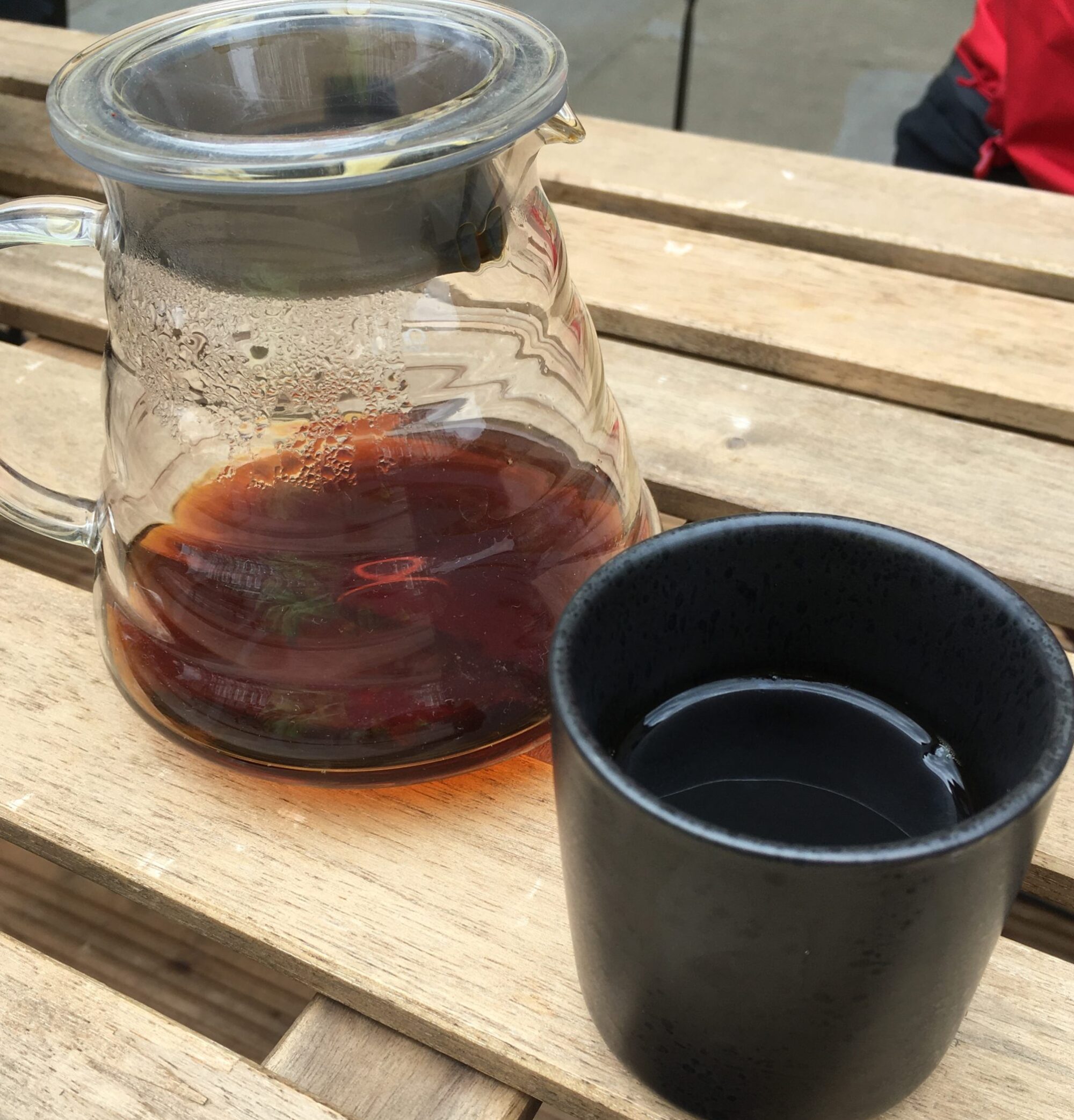
When we visited, the espresso based coffee was by Campbell and Syme, with V60s that featured different guest roasters (though it seems that other roasters also regularly feature for the espressos). I had a coffee from Panama, roasted by Union, which featured the word “caramel” in its tasting notes. I have simple tastes (‘caramel’ or ‘chocolate’ descriptions always go down well) but it was a great coffee. Complementary water was available at the counter with take-away cups (and water ‘glasses’ ) that were compostable and biodegradable*. As the very friendly staff brought my coffee to the table, I noticed that the ‘table’ that I had put my water on was in fact a metal drum that sounded ‘clang’ as the cup was put down. The sound of the drum immediately suggested that the drum was hollow. We all recognise the sound of a hollow drum, it is partly about the pitch of the sound, but partly about the echoes that we hear as the sound reverberates inside the metal.

Kettle drum at Amoret
After I had enjoyed my filter! The table-drum at Amoret. Does the drum sound the same in summer?

Although it appears simple, the sound made by the drum is influenced by many aspects of the drum’s construction and surroundings. The stiffness of the metal and the atmospheric pressure affect the way that the drum’s surface vibrates, while the size of the drum and the speed of sound in air also affect the note, or pitch, that we hear. How is the sound of the drum affected by a change in its surroundings? For example, if the atmosphere in Amoret got much warmer, the speed of sound would increase, how would that affect the sound of the table-drum?

A few years ago, Professor Timothy Leighton was wondering how the properties of the atmosphere affected the sounds of musical instruments. Specifically, he wondered what instruments would sound like on other planets. Take Venus. Venus is a planet with a very dense, very hot atmosphere. The surface temperature on Venus is 457C (Earth’s average is approx 14C) while the atmospheric pressure is 90 Bar (Earth’s average: 1 Bar). As it gets hotter, the speed of sound increases and so, to a first approximation, the note made by the drum-table at Amoret will sound higher as the air gets warmer. However, the metal of the drum is also hotter on Venus (so less stiff) and the density and pressure of Venus’ atmosphere will act to further complicate things. So to start thinking about how things sound on Venus, we would be more sensible to think about a simpler instrument, such as an organ, which is only affected by the change of the speed of sound†. Take the famous case of Bach’s Toccata and Fugue in D minor. Played on Venus, the researchers found that, rather than be in D minor (293.66 Hz), it would have the pitch of F minor (at 349.23 Hz). You can hear Bach’s Toccata on Venus (Mars and Titan) here.

Venus
The clouds of Venus photographed by Hubble. Image credit © NASA/JPL

What about a human voice, how would a person sound on Venus (were they able to survive)? In humans, the pitch of the voice is determined by the rate of vibration of the vocal cords. So it is possible to construct a speech synthesiser to imitate human speech by modelling such a voice ‘box’. Erasmus Darwin, (grandfather to Charles) made such a device in around 1770 with wood, leather and silk‡. Darwin’s voice synthesiser could pronouce the sounds ‘p’, ‘m’, ‘b’ and ‘a’ and so ‘mama’, ‘papa’, ‘map’ and ‘pam’, which by some accounts was convincing enough to fool people into thinking there was a small child in the room. Why did people think that Erasmus’ ‘child’ was small? It turns out that just as with the drum, when we listen to people speak, we do not just register their pitch but also the echoes on their voice. Each time we make a sound, the sound travels from the vocal cords down to the lungs (where it gets reflected upwards) and up to the mouth (where it gets reflected downwards). We subconsciously listen for these echoes and, if they take a long time to appear, we deduce that the person is large (there is a greater distance between their voice box and their lungs). If the echo comes back quickly, clearly the distance between the voice box and the lungs is smaller and hence the person is smaller. Just like the drum at Amoret, the human voice is a bit more tricky to model on Venus than Erasmus Darwin’s device allowed for.

Leighton and co-author Andi Petulescu considered the question of the sound of the human voice on Venus in their 2009 paper. Firstly they said, the density of Venus’ atmosphere would make the vocal cords vibrate more slowly, so the person speaking would sound as if they had a deeper voice. But secondly, the high speed of sound on Venus would mean that those echoes that we listen for would come back very quickly, so we would perceive the speaker as being small. What does this sound like? A few years ago, a Dutch TV show set this very topic as a question for their annual quiz and answered it by one of the co-hosts singing Banarama’s “Venus” with, and without, the Venus voice changing software of Leighton. If you understand Dutch, the full clip is below. If you don’t understand Dutch but would just like to find out how you would sound on Venus while singing Banarama, forward to 7 minutes in for the version on Earth and 7m46 in for the Venus version.

It is not easy for us to travel to Venus to investigate whether Prof. Leighton was correct. It is possible for us to repeatedly visit Amoret to investigate how the coffee cups sound as they are put on the drum as the temperature changes around us. This seems a fantastic excuse to revisit to me.


Amoret is at 11 Beadon Road, W6 0EA

‡”Erasmus Darwin – A life of unequalled achievement” by Desmon King-Hele was published by Giles de la Mare Publishers (1999)

* It should be noted that ‘compostable’ plastic has a very specific definition that does not mean that it can necessarily be composted in the way that you or I would understand the term, as I described in more detail here. Nonetheless, it is definitely a significant improvement from conventional plastic and I would love to see more cafes follow suit with environmentally sound packaging.

† Of course this comes with a fair few caveats, not least the fact that the organ has to have flue pipes only. I would thoroughly recommend browsing Professor Timothy Leighton’s excellent webpage on this and other aspects of acoustics which you can find here.

Categories
Coffee cup science General Home experiments Observations slow

Coffee Damping

vortices in coffee
Vortices behind a tea spoon

How often do you allow yourself to get bored? Or to sit in a cafe and take your time to enjoy your coffee properly, noticing its appearance, the smell ‘landscape’ of the cafe, pausing while you absorb the sounds of the cafe and playing with the feel of the coffee while you create vortices with your tea spoon?

If you regularly drink black coffee, you may have noticed how these vortices form more easily in the coffee once the crema has dispersed. Intuitively this may seem obvious to you, perhaps you wouldn’t even bother trying to form these vortices in a cappuccino, you’d know that they wouldn’t appear. The bubbles of the crema (or the milk in the cappuccino) quickly kill any vortex that forms behind the tea spoon (we’d technically call it ‘damping’ them). But even when we are aware of this, it is still surprising just how quickly the crema stops those vortices. Try forming a couple of vortices in a region of black coffee close to a region of crema. Indeed I thoroughly recommend ordering a good black coffee in a great cafe somewhere and just sitting playing with these vortices all the while noticing how their behaviour changes as the crema disperses.

latte art, flat white art
Latte art at The Corner One. Lovely to look at but not good for the vortices.

The damping caused by bubbles on the surface of a coffee is responsible for another phenomenon that you may have encountered in a cafe but, to be fair, are more likely to have noticed in a pub. Have you ever noticed that you are less likely to spill your cappuccino between the bar and your seat than you are your lovingly prepared filter coffee? Or perhaps, in the pub, you can get your pint of Guinness back to the table more easily than your cup of tea? (At least for the first pint of Guinness)

Back in 2014, a team investigated the damping properties of foam by controlling the size and number of bubbles on top of a liquid as it was vibrated (sloshed) about. They found that just five layers of bubbles on top of the liquid was enough to significantly damp the liquid movement as it vibrated from side to side. That is, five layers of bubbles suppressed the sloshing (try saying that after a couple of pints of Guinness). Much as I dislike emphasising the utility of a piece of science, this work has obvious implications for any application that requires the transportation of liquids such as the transport of oil containers. There is an obvious need to suppress the effect of liquid oil sloshing from side to side as it is transported by boat for example.

The foam on our latte or crema on our long black should indeed give us pause for thought as we sit in a cafe enjoying our coffee.


Categories
Coffee review General Observations

Setting standards at Brill, Exmouth Market

Brill, Exmouth Market, neon, architectural history
The neon lit “Brill” from the back of the cafe. You can also see evidence of an old arch in the brickwork, an old doorway?

Brill on Exmouth Market has quite a history. Originally a record store, it has evolved into a music shop/cafe more recently. On my recent visit, I ordered a very good Americano (beans from Officina Coffee Roasters) and although cakes were on sale, it was a small bar of Green & Blacks chocolate that appealed to me a bit more that day. It is a small cafe and so the few seats that are upstairs were occupied. This turned out to be a good thing though because I noticed a sign indicating that there were more seats downstairs, which actually meant that there was seating in a lovely little courtyard/garden at the back of Brill. Although it was originally locked (it was February and fairly dismal when I visited, who in their right mind would want to sit in the garden?), the friendly staff unlocked it and quickly cleaned one of the tables so that I could enjoy my coffee and chocolate in peace in central London. Indeed, the occasional (inevitable?) sound of sirens in the distance only served to emphasise the tranquility of the courtyard. The courtyard has four tables and a glitter-ball in the corner hanging from a tree. There was a lot to appreciate outside, both in terms of the science and the history of the place: Leaves deposited by vortices in corners of the yard with brickwork that suggested a significant re-build has occurred to this cafe.

But from my vantage point, it was the word ‘Brill’, lit up in neon lighting inside the cafe, that caught my attention. Neon lights are always interesting to me because their colour is so suggestive of the atoms that make up the light. The colour of a neon light is determined by the energy levels of the atoms that make up the light, the gas ‘neon’ shines red, hence neon lights. But if you wanted blue ‘neon’ lights you could use mercury as the vapour in the tube instead of neon, it is all about the energy levels of the atoms in the gas in the tubes.

glitter ball, disco at Brill Exmouth Market
A glitter ball in the corner of the courtyard at Brill

Under certain conditions, cadmium also emits a red light which brings us to the subject of this cafe-physics review: The definition of length. How is it that we can all agree on what ‘one metre’ is, or even one ‘inch’? Perhaps you are wondering how the red light emitted by cadmium, (or neon), relates to the definition of the metre? It’s about standards and definitions. Up until about 1960, the standard unit of length (the metre) was measured with reference to an actual, physical, metal rod kept in Paris with two scratches carved into it, one metre apart. Any arguments about the precise length of a metre could be settled by referring to the metre, this metal bar in Paris. But of course there were problems, the first of which was that the metre was in Paris. Perhaps you would think it easy to make copies? Yet in the nineteenth century this was already becoming a problem, the measurements that were being made were becoming too precise. Anders Ångstrom’s pioneering work with spectroscopy (investigation of elements by the colours that they emit/absorb) revealed a small difference between the metre kept in Uppsala (where Ångstrom was based) and that kept in Paris. Although the difference was tiny, when it was compared with what people had started to measure, it became significant. Then there was the question of the scratches: Would you measure the metre between the furthest two points of the scratch? Or the closest? Then an even worse problem was discovered: The rod was shrinking! If you’re tempted to abandon metric units and hark back to Imperial units, bear in mind that the UK Imperial Yard was shrinking even faster. No, something had to be done and that something involved changing the definition of the metre fundamentally.

neon sign, light emission
Neon signs have characteristic colours due to the electron transitions in the ionised gases

It is here that cadmium comes in to the story. Rather than use a physical length that we could all measure, the people whose job it is to define our base units decided that the definition of the metre would be with reference to the wavelength of the red light of Cadmium. I do not know why they did not want to use the red of neon lights but even with cadmium it quickly became apparent that there was a problem. The problem was that cadmium exists as several isotopes, all having a very slightly different ‘colour’ of red light that they emit. So, rather than cadmium, in 1960 they settled on the orange line of Krypton as the definition of the metre. One metre was then defined as 1650763.73 vacuum wavelengths of Krypton. That was the definition for over twenty years before the definition of the metre was updated again in 1983. It is now defined as “the length travelled by light in a vacuum during a time interval of 1/299792458 of a second”.

Perhaps it is not a definition that you or I could use, we’d probably still refer to our metre rule! Nonetheless this definition does allow people to perform experiments that need very precise and very accurate measurements of lengths. These standards are important for extremely sensitive measurements such as that needed to detect gravitational waves with the LIGO experiment, reported a few weeks ago. The neon lights at ‘Brill’ do indeed suggest a story that goes way back in time, both for the cafe and for the science.

Brill is at 27 Exmouth Market, EC1R 4QL

Spectroscopy information from “Spectrophysics”, by AP Thorne, Chapman and Hall Ltd, 1974

Categories
General Observations slow Tea

Tea Gazing

Milky Way, stars, astrophotography
The Milky Way as viewed from Nebraska. Image © Howard Edin (http://www.howardedin.com)

A recent opinion piece about last week’s announcement of the detection of gravitational waves at LIGO drew my attention to a quote from Einstein:

The most beautiful experience we can have is the mysterious. It is the fundamental emotion that stands at the cradle of true art and true science. Whoever does not know it and can no longer wonder, no longer marvel, is as good as dead, and his eyes are dimmed.

Einstein was not the only scientist to have expressed such sentiments. Many scientists have considered a sense of wonder to be integral to their practice of science. For many this has involved gazing at the heavens on a clear night and contemplating the vastness, and the beauty, of the universe. Contemplating the twinkling stars suggests the universe outside our Solar System. Watching as the stars twinkle gives us clues as to our own planet’s atmosphere. Of course, it is not just scientists who have expressed such thoughts. Immanuel Kant wrote:

“Two things fill the mind with ever-increasing wonder and awe, the more often and the more intensely the mind of thought is drawn to them: the starry heavens above me and the moral law within me.“*

light patterns on the bottom of a tea cup
Dancing threads of light at the bottom of the tea cup.

The other evening I prepared a lovely, delicate, loose leaf jasmine tea in a teapot. I then, perhaps carelessly, perhaps fortuitously, poured the hot tea into a cold tea cup. Immediately threads of light danced across the bottom of the cup. The kitchen lights above the tea cup were refracted through hot and not-quite-so-hot regions of the tea before being reflected from the bottom of the cup. The refractive index of water changes as a function of the water’s temperature and so the light gets bent by varying amounts depending on the temperature of the tea that it travels through. Effectively the hotter and cooler regions of the tea act as a collection of many different lenses to the light travelling through the tea. These lenses produce the dancing threads of light at the bottom of the cup. The contact between the hot tea and the cold cup amplified the convection currents in the tea cup and so made these threads of light particularly visible, and particularly active, that evening. It is a very similar effect that causes the twinkling of the stars. Rather than hot tea, the light from the distant stars is refracted by the turbulent atmosphere, travelling through moving pockets of relatively warm air and relative cool air. The star light dances just a little, with the turbulence of the atmosphere, this way and that on its way to our eyes.

Marcus Aurelius wrote:

Dwell on the beauty of life. Watch the stars, and see yourself running with them.Ҡ

Marcus Aurelius of course didn’t have tea. Watch the dancing lights in the tea cup and see yourself sitting with it, resting a while and then watching while dwelling on the beauty in your cup.

*Immanuel Kant, Critique of Practical Reason

†Marcus Aurelius, Meditations

Categories
Coffee review General Observations Science history Sustainability/environmental

Keeping it local at Lumberjack, Camberwell

Lumberjack coffee Camberwell
Lumberjack Camberwell with the (not quite) inukshuk in the window

I came across Lumberjack last week while spending an afternoon in Camberwell looking for interesting cafes to “cafe-physics” review. I was actually on my way to a cafe further along the road when a couple of wooden structures in the window attracted my attention. Thinking that they were “Inukshuk” we decided to go in and try this new cafe. It turned out to be a good choice because, even though the structures were not in fact inuksuik, they had brought us into this lovely little cafe. We arrived shortly before closing but I still had time to enjoy a very good long black (with beans from Old Spike Roastery). Complementary water was brought over to the table. It would have been great if we had arrived just that bit earlier so that we could have had more time to properly appreciate this friendly cafe. The interior is bright and smartly decorated with wooden tables and shelving as well as plenty of seats at the back. The wooden furniture is explained by the fact that the cafe is the trading arm for London Reclaimed, a charity that provides employment and carpentry training to 16-25 year olds from SE London while making bespoke furniture from reclaimed timber. The cafe too aims to provide training and support to encourage 16-25 year olds into work and a future career. In terms of the ‘physics’ bit of this review, the interior of the cafe certainly has plenty to observe, from the pendulum like light fittings to the detail of the wood. But as this cafe is metaphorically, and in some ways literally, built on/with wood and as Lumberjack boasts on its website that “almost everything you’ll find in store, from the coffee to the furniture, are sourced as locally and homemade as possible” it is only appropriate that this cafe-physics review should focus on wood, trees and a tree very specific and local to London; the London Plane tree.

Long Black coffee in a red cup
A Long Black at Lumberjack with the grain of the wood showing underneath

With their characteristic mottled bark, London Plane trees are a recognisable sight along many a London street. The bark absorbs pollutants from the street before bits of bark fall off, taking the pollution with them and leaving the tree with its mottled appearance. Their root structure and resistance to pruning or pollarding helps to ensure that (mostly) they can survive happily in the crowded confines of London pavements. They are indeed very much a tree that seems almost specially adapted to London. Yet the connection between the London Plane and London goes deeper than that. The first ever record of a London Plane tree was in the seventeenth century, just up the road from Lumberjack, in the Vauxhall Gardens of John Tradescant the Younger. The London Plane is in fact a hybrid tree, thought to be a cross between the American sycamore (first recorded in London in 1548) and the Oriental Plane (first recorded in London in the C17th). Both these trees were found in Tradescant’s gardens and it is possible that the hybrid tree, the now ubiquitous London Plane, was actually first grown in Vauxhall.

Even though London is full of Plane Trees, it is not very common to find plane wood furniture. Rather than the grain visible in the tables at Lumberjack, Plane wood shows a “lacy” structure that gives furniture made with plane a distinctive pattern. Although unsuitable for outdoor furniture, plane-wood can be used to make indoor furniture and indeed some London based cabinet makers have even documented obtaining usable timber from recently felled London Planes.

Tomb of the Tradescants
The Tradescant Tomb at St Mary’s, Lambeth

And it is this that takes us to the physics part of the cafe-physics review. Perhaps it is the areas (and the parks) that I walk through, but it seems to me that there has been a fair amount of tree felling in London over the last six months or so. Part of the reason for this must be to ensure that the trees in our parks and that line our streets are safe and not going to fall down in high winds. Many trees that fall down in high winds do so because they get uprooted. However it is also possible, in very high winds for the whole tree to snap. Indeed, when researchers mapped the wind speeds through a forested area of Southern France during a storm in January 2009 they found that when the wind speed exceeded ~40 m/s (90 miles per hour), more than 50% of the trees broke in the wind, irrespective of whether these trees were softwood (pine) or hardwood (oak). A very recent paper by a Paris-based group (published last week in the journal Physical Review E) confirmed that irrespective of the species of tree or the tree height, the trunks of trees were liable to snap at a critical wind speed. The team combined experiment and theory to establish that the critical wind speed scaled with the tree’s diameter and height. However, because trees generally treble their diameter as they double their height, the effect of the diameter change was (almost) cancelled by the height difference between trees. Surprisingly, this critical wind speed did not depend on the elasticity of the tree, so there is no difference between a softwood such as pine and a hardwood like oak or plane. The researchers calculated the critical wind speed needed to break a tree to be 56 m/s, very close to the 40 m/s observed in that January storm.

Lumberjack can be found at 70 Camberwell Church St, SE5 8QZ

If you have a cafe that you think needs a cafe physics review, please let me know. Comments always welcome, please click the box below.


Categories
Coffee cup science General Home experiments Observations slow

Coffee ring bacteria

coffee ring, ink jet printing, organic electronics
Why does it form a ring?

We have all seen them: Dried patches of coffee where you have spilled some of your precious brew. The edge of the dried drop is characteristically darker than the middle. It is as if the coffee in the drop has migrated to the edge and deposited into a ‘ring’. It turns out though that these coffee rings are not just an indication that you really ought to be cleaning up a bit more often. Coffee rings have huge consequences for the world we live in, particularly for consumer electronics. Various medical and diagnostic tests too need to account for coffee ring effects in order to be accurate. Indeed, coffee rings turn up everywhere and not just in coffee. Moreover, the physics behind coffee rings provides a surprising connection between coffee and the mathematics of bacteria growth. To find out why, we need to quickly recap how coffee rings form the way they do.

When you spill some coffee on a table it forms into droplets. Small bits of dust or dirt or even microscopic cracks on the table surface then hold the drop in the position. We’d say that the drop is pinned in position.

artemisdraws, evaporating droplet
As the water molecules leave the droplet, they are more likely to escape if they are at the edge than if they are at the top. Illustration by artemisdraws.com

As the drop dries, the water evaporates from the droplet. The shape of the drop means that the water evaporates faster from the edges of the drop than from the top (for the reasons for this click here). But the drop is stuck (pinned) in position and so cannot shrink but instead has to get flatter as it dries. As the drop gets squashed, water flows from the centre of the drop to the edges. The water flow takes the coffee particles with it and so carries them to the edge of the drop where they deposit and form into a ring; the coffee ring. You can see more of how coffee rings form in the sequence of cartoons below and also here.

However in this quick explanation, we implicitly assumed that the coffee particles are more or less spherical, which turns out to be a good assumption for coffee. The link with the bacteria comes with a slightly different type of ‘coffee’ ring. What would happen if we replaced the spherical drops of coffee particles with elliptical or egg shaped particles? Would this make any difference to the shape of the coffee rings?

Artemisdraws
As water evaporates from A, the drop gets flatter. Consequently, the coffee flows from A to B forming a ring. Illustration by artemisdraws.com

In fact the difference is crucial. If the “coffee” particles were not spherical but were more elliptical, the coffee ring does not form. Instead, the elliptical particles produce a fairly uniform stain (you can see a video of drying drops here, yes someone really did video it). The reason this happens is in part due to a pretty cool trick of surface tension. Have you ever noticed how something floating on your coffee deforms the water surface around it? The elliptical particles do the same thing to the droplet as they flow towards the edge. (Indeed, the effect is related to what is known as the Cheerios effect). This deformation means that, rather than form a ring, the elliptical particles get stuck before reaching the edge and so produce a far more uniform ‘coffee’ stain when the water dries.

E Coli on a petri dish
A growing E. Coli culture. Image courtesy of @laurencebu

By videoing many drying droplets (containing either spherical or elliptical particles), a team in the US found that they could describe drying drops containing elliptical particles with a mathematical equation called the Kardar-Parisi-Zhang equation (or KPZ for short). The KPZ equation is used to describe growth process such as how a cigarette paper burns or a liquid crystal grows. It also describes the growth of bacterial colonies. Varying the shape of the elliptical particles in the drying drop allows scientists to test the KPZ equation in a controllable way. Until the team in the US started to ask questions about how the coffee ring formed, it was very difficult to test the KPZ equation by varying parameters in it controllably. Changing the shape of the particles in a drying drop gives us a guide to understanding the mathematics that helps to describe how bacterial colonies grow. And that is a connection between coffee and bacteria that I do not mind.

As ever, please leave any comments in the comments section below. If you have an idea for a connection between coffee and an area of science that you think should be included on the Daily Grind, or if you have a cafe that you think deserves a cafe-physics review, please let me know here.

Categories
cafe with good nut knowledge Coffee review General Observations Science history slow

Coffee as an art at Briki, Exmouth Market

exterior of Briki coffee London
Briki London on the corner of Exmouth Market

Traditionally made coffee always appeals to my sense of coffee history. Coffee made its way out of Ethiopea via Turkey and the method of brewing the finely ground coffee in a ‘cezve’ or ‘briki’ is one that goes back a long way. It’s therefore always interesting when a new cafe arrives on the scene that offers “Greek” or “Turkish” coffee on its menu. Briki, in Exmouth Market, opened in May last year and so it was only going to be a matter of time before I visited to try it out. Aesthetically Briki appealed to me as soon as I walked through the door. Spacious and with the bar along one wall, there are plenty of seats available at which to slowly enjoy your coffee. The cafe itself is almost triangular and the other two walls have windows running all along them. What better way to sit and enjoy the moment (and your coffee) than to gaze out a window? Still, given that I had gone to a cafe called ‘Briki’ and that it advertised “Briki coffee” on the menu behind the bar, it was obvious that I had to try the briki coffee. The coffee was rich, flavoursome and distinctive, well worth the time taken to savour it. There was also an impressive selection of food behind the counter and the dreaded “does it contain nuts” question was met with a friendly check of the ‘allergen’ folder. I was therefore able to also enjoy the lovely (nut free) chocolate cake. Briki definitely gets a tick in the “cafes with good nut knowledge” box on my categories list.

image from British Museum website
Folio 109b from an album of paintings showing Turkish sultans and court officials. Kahveci. A youth who serves coffee. He is holding a cup in each hand, circa 1620.
© The Trustees of the British Museum

However as I realised later, the coffee was not brewed in the traditional way but in a Beko coffee maker – a coffee maker specifically designed for optimising the brewing of Turkish coffee. The idea of the Beko is that it carefully controls and automates the entire brewing process so that you get a perfect coffee each time. But just how do you make a ‘perfect’ Turkish coffee?

A quick duckduckgo (it’s a mystery to me why has this verb failed to catch on while ‘to google’ is used so frequently) revealed two sets of instructions on how to make Turkish coffee. The first set, (including some otherwise very good coffee brewing websites) suggested ‘boiling’ the coffee repeatedly in the pot (cezve/briki). The second set, which seemed to be more specifically interested in Turkish coffee (as opposed to interested in coffee generally), were much more careful, even to the point of writing, in a very unsubtle way, “NEVER LET IT BOIL“. According to this second set of websites, the coffee in the cezve should be heated until it starts to froth, a process that begins at around 70C, far below the 100C that would be needed to boil it. Warming the cezve to 70C produces these bubbles and the lovely rich taste of the traditionally made coffee. Heating it to boiling point on the other hand destroys the aromatics* that form part of the flavour experience of coffee and therefore makes a terrible cup of coffee.

The contrasting instructions however led me to recall a discussion in Hasok Chang’s Inventing Temperature. Perhaps we all remember from school being taught how thermometers need two fixed points to calibrate the temperature scale and that these two fixed points were the boiling point and the freezing point of water. Perhaps this troubled you at the time: Just as with making coffee in a cezve, just how many bubbles do you need in order to say that the coffee (or water) is ‘boiling’? How were you supposed to define boiling? How much did it matter?

Cezve, ibrik, Turkish Coffee Creative Commons license
Cezve, image © http://www.turkishcoffee.us

It turns out that these questions were not trivial. There is a thermometer in the science museum (in London) on which two boiling points of water are marked. The thermometer, designed by the instrument maker George Adams the Elder (1709 – 1773) marked a lower boiling point (where water begins to boil) and an upper boiling point (where the water boils vigorously). The two points differed by approximately 4C.  So how is it that we now all ‘know’ that water boils at 100C? And what was wrong with Adams’ thermometer? The Royal Society set up a committee to investigate the variability of the reported boiling point of water in 1776. Careful control of the heating conditions and water containers reduced the temperature difference observed between different amounts of boiling. However, as they experimented with very pure water in very clean containers they found that things just became more complicated. Water could be heated to 120C or even higher without ‘boiling’. They had, unintentionally, started investigating the phenomenon that we now know as ‘superheating‘. Superheating occurs when water is heated to a temperature far above its boiling point without actually boiling. What we recognise as boiling is the escape of gas (which is usually a mix of air and water vapour) from the body of the water to its surface. In order to escape like this, these bubbles have to form somehow. Small bubbles of dissolved air pre-existing in the water or micro-cracks in the walls of the container enable the water to evaporate and form steam. These bubbles of gas can then grow and the water ‘boils’. If you were to try to calibrate a thermometer using very pure water in very clean containers, it is highly likely that the water would superheat before it ‘boiled’, there just aren’t the ‘nucleation’ sites in the water to allow boiling to start. The Royal Society’s committee therefore came up with some recommendations on how to calibrate thermometers in conditions that avoided superheating which meant thermometers were subsequently calibrated more accurately and superheating (and improved calibration points) could be investigated more thoroughly.

Perhaps viewed in this way there are even more parallels between Turkish coffee and physics. It has been written that “making Turkish coffee is an art form“. It is a process of practising, questioning and practising again. The Beko coffee machine automates part of the process of making Turkish coffee. When it’s done well though, Turkish coffee is far more than just the temperature control and the mechanics of heating it. There is the process of assembling the ingredients, the time spent enjoying the coffee and the atmosphere created by the cafe in which you drink it. Coffee as art in Briki is something that I would willingly spend much more time contemplating.


Briki is at 67 Exmouth Market, EC1R 4QL

“Inventing Temperature”, by Hasok Chang, Oxford University Press, 2004

*Although these aromatics are part of what gives coffee such a pleasurable taste, they decay very rapidly even in coffee that is left to stand for a while, it is this loss of the aromatics that is part of the reason that microwaving your coffee is a bad idea. A second reason involves the superheating effect, but perhaps more on that another day.


Categories
General Home experiments Observations Science history Tea

Caustic Coffee

A post that applies equally to tea, just swap the word “tea” for “coffee” throughout!

A cusp caustic in an empty mug of coffee
Have you seen this line?

Look deep into your coffee. Do you see the secrets of the cosmos being revealed? Well, neither do I usually but there is something in your coffee that could be said to have ‘cosmic implications’ and I’m sure it’s something that you’ve seen hundreds of times.

Now, admittedly it is easier to see this effect if you put milk in your coffee. Imagine drinking your (milky) coffee with a strong light source (the Sun, a lightbulb) behind you. You see that curved line of light that meets in a cusp near the centre of the cup? You can see various photos of it on this page. Yes, it is indeed the reflection of the light from the curved mug surface but it is far from just that. It is what prompted a professor at Duke University to say “It’s amazing how what we can see in a coffee cup extends into a mathematical theorem with effects in the cosmos.” To understand why, perhaps it is worth reflecting a bit more on our coffee.

The shape of the curve is called a ‘cusp’  and the bright edge is known as a ‘caustic’. It is fairly easy to play with the angle of the cup and the light so that you can see the first cusp curve but you can go further and create caustics that are the result of multiple reflections. Such multiple reflections can give heart shaped curves or “cardioids” so, in a certain sense adding milk to your coffee is good for (seeing) the heart.

caustic in a cup of tea or coffee
A cusp reflection is just visible in a cup of (soya) milk tea

Caustics were first investigated by Huygens and Tschirnhaus in the late 17th century. Mathematically, the cusp curve is termed an epicycloid, you can draw one by tracing the shape made by a point on the circumference of a circle rotating around a second circle, as this graphic from Wolfram mathematics demonstrates. There is a lot of maths in milky coffee. But just how is it that these curves reveal the “Cosmos in a cup of coffee“? It turns out that once you start to see caustics you start to see them everywhere. Caustics are not just going to be formed on the inside of your coffee mug, they can be formed by light waves getting bent by ripples on the surface of a stream or even by gravity, in a phenomenon known as “gravitational lensing”.  Gravitational lensing is when a massive object, such as a black hole or a galaxy, bends the light travelling past it so that it acts analogously to a lens in optics (but a very big one). It is this last type of caustic that prompted the headline quoted above. In a series of papers published in the Journal of Mathematical Physics, Arlie Petters of Duke University and coworkers calculated how light from distant objects was focussed through gravitational lensing and the effects of caustics. Their predictions (and in particular any exceptions to their predictions) could lead to a new way to search for the elusive dark matter, which is thought to contribute to much of the Universe’s mass. They are now waiting for the Large Synoptic Survey Telescope (LSST) to start mapping the sky in order to test their theories.

multiple caustics from multiple LEDs
Multiple light sources are being reflected in this cup.

Before concluding this discussion of cosmic coffee, it is worth taking another look at the mathematician Tschirnhaus. As well as maths, he was known for his philosophy and his chemistry. In fact, it seems that he was responsible for the invention of European porcelain. As noted elsewhere, it has been argued that it was the ability of Europeans to start making their own porcelain that explained the rapid rise in consumption of tea and coffee during the eighteenth century in Europe. Interestingly, one of the tools that allowed Tschirnhaus to succeed in manufacturing porcelain in Dresden where others elsewhere failed was his use of “burning mirrors” to focus the heat and to achieve higher furnace temperatures than were otherwise available. He was using those caustics that he and others had so thoroughly studied mathematically in order to produce the type of cup in which we most often encounter the easiest caustics. A lovely little ‘elliptical’ story on which to end this Daily Grind.

In order to see the caustics in your coffee, it is necessary that the coffee reflects the light incident on it. Meaning, you need to add milk to your coffee. I knew there had to be a good reason to add milk to coffee at some point. Please do share your photos of caustics in your coffee either here or on Facebook or Twitter.


Categories
Coffee review Observations Science history

Planet Earth is blue (or is it) at Ground Control, Clerkenwell

Ground Control, outside the cafe
Ground Control on Amwell St

Ground Control is a small little cafe on Amwell St. If you are in the Angel/Clerkenwell area it is well worth stopping by this interesting cafe which serves a variety of Ethiopian coffees. Of course they offer the normal espresso, Americano etc. type drinks but if you want to sample their coffee properly, I think it best to try one of their coffees prepared with a V60. Tasting notes are shown on the menu on the wall. Being fairly small, there aren’t that many tables, however if you are lucky enough to get one of the two tables at the window, you will find plenty around you to look at without resorting to checking your phone while you enjoy your coffee. Behind one of the tables at the window is a set of shelves with coffee beans (presumably for sale). Behind the other table is a picture of a lady holding a jug and a basket. Vibrantly coloured circular patterns form the backdrop behind her.

coffee mosaic, colour perception
The coffee mosaic at Ground Control

The picture (shown on the left) has a flow to it, you are almost drawn into the movement of the picture. This movement comes from the many, differently coloured, coffee beans that have been used to make the picture. Each bean is orientated slightly differently so that the lines through the bean flow with the picture, rather than the beans being mere individual pieces of a mosaic. The circular patterns, the lines of her shirt, all of these are produced by orientating coffee beans this way or that. The mosaic is also richly colourful. Many of the colours stand out, but some, arranged next to each other, appear more subdued. How do we see the colours of a picture? How much of our colour perception is due to the pigment of the paint, how much due to the lighting, and how much is due to the individual colouration of the neighbouring beans?

An artist known for his unusual use of colour was Georges Seurat (1859-1891). Seurat developed the technique of pointillism in which small dots of varying colours are painted next to each other. Viewed from a distance, the colour seen by the viewer may be quite different from the multitude of differently coloured dots perceived close up. As with the coffee bean mosaic, direction was given to Seurat’s work through the orientation of the painted dots. Seurat had based his technique on the state-of-the-art science of the day. One of the scientists whose work on colour theory influenced Seurat’s artistic development was Ogden N. Rood, a physicist who’s 1879 book “Modern Chromatics” he seems to have read (in its French translation)*. Rood had carefully distinguished between two types of colour mixing, that of mixing coloured lights and that of mixing pigments. Mixing pigments had been used by all of the old masters. It is the process by which paints are mixed to produce a new paint colour. Rood however showed that if small dots of colour were painted adjacently, when the painting is viewed from a distance such that the eye cannot distinguish the two dots individually but rather mixes them in the eye, the colour produced is that of mixing coloured lights, not coloured pigments. As he explained, colour mixing through adding light of different colours was an additive process, colour mixing through combining pigments was subtractive. More about colour theory and colour mixing can be found here.

Pointillism Seurat
Georges Seurat, 1859 – 1891
The Channel of Gravelines, Grand Fort-Philippe
1890, Oil on canvas, 65 x 81 cm, Bought with the aid of a grant from the Heritage Lottery Fund, 1995, NG6554
http://www.nationalgallery.org.uk/paintings/NG6554

In the late 1880s, Seurat was criticised for relying “unduly on scientific formulae”, though he himself seems to  have viewed his use of science merely as a guide, a way to help control the colour and light seen by the viewer*. The colours that we perceive can be affected by the colours they are adjacent to, as evidenced by many optical illusions. Yet even when everybody is looking at the same photo, we do not necessarily all see the same colour (I saw it as white and gold).

There is indeed a lot to the science of colour perception and some great fun that can be had with it. Seurat was aware of some of this and used science to understand how to best paint his paintings. Note how the (pointillist) border of the Seurat painting pictured on the right is a different colour at the top, do you think that affects how your eye perceives the top compared to the bottom of this painting?

Starting tomorrow, light and colour are to be combined in a three day “Lumiere festival” across London. The event looks as if it will take full advantage of the effects of different methods of colour mixing. If you are outside London, sorry! If you are lucky enough to be in London over the weekend, more details of what looks to be a fascinating science/art/experience event can be found here.


Ground Control is at 61 Amwell Street, EC1R 1UR

*”Seurat and the Science of Painting” by William Innes Homer was published by MIT press in 1964

Ordinarily I would have left the title of this post as a type of puzzle to see if anyone got the link (some posts on the Daily Grind have such puzzles, I’ve no idea whether I’m the only one who understands some of them). However, given that he passed away two days ago, here’s a rendition of David Bowie’s Space Odyssey (which is referenced in the title) sung by Cdr Chris Hadfield:


Categories
General Home experiments Observations Tea

Bouncing Coffee

floating, bouncing drops
Water droplets ‘floating’ on a bath of water (actually they bounce rather than float).

Perhaps you remember the video about how to ‘float’ coffee droplets on water posted on the Daily Grind a few weeks ago? The video featured an experiment that you could do at home in which droplets of water (or coffee, or even, if you were feeling adventurous, tea) could be made to stay as spherical droplets on the surface of a shallow dish of water for minutes at a time. Of course there were a few tricks: The water had soap added to it (10ml of soap to 100ml of water) and the shallow dish was on a loudspeaker which was playing music at the time. The whole experiment was very pretty. But hopefully as well as appreciating the aesthetics, you were asking ‘how’ and ‘why’? Why does the addition of soap mean that these globules of liquid appear to float on the liquid surface? And is the rumour you have heard about a connection with quantum physics true?

Well it turns out that people have known about these floating droplets for over a hundred years but why they behave as they do is still being investigated. It is another case of cutting-edge science appearing in your coffee cup*. So it’s worth taking a look at what is going on and why we needed to add soap and vibration for the droplets to remain stable on the water surface.

lilies on water, rain on a pond, droplets
When it rains, the rain drops don’t float on the pond

It seems to appeal to common sense and to everyday experience that if we drop a droplet onto a bath of water, the droplet will merge with the water and become part of the bath. After all, when we bring two drops that we have dripped on a table close to each other, at a certain distance between the two drops, they appear to touch and then rapidly merge into one big droplet (try it). And when it rains onto a pond, we don’t see lots of spherical droplets hovering over the surface of the pond! We know that it is the attractive van der Waals forces that bring the two drops together and then the effects of surface tension that minimise the surface area of the drops so that they become one big drop. So how is it that we can get a droplet to remain, as a droplet, on the surface of a bath of water?

How to bounce water droplets on a water surface

It could be said that the answer can be pulled out of thin air: Before the drops can merge, the air that separates them has to escape from the area between the droplet and the water bath. If the droplet can somehow be made to bounce back upwards before the air separating the droplet from the bath becomes thin enough for the two liquids to combine, the air could be made into a cushion to keep pushing the droplet upwards. This is why the experiment needs to be done with a vibrating dish of water, each time the surface vibrates upwards it is providing the drop with an acceleration upwards that overcomes gravity, like a miniature trampoline: The droplet is not floating, it is bouncing.

So why soap? We all know that the addition of soap decreases the surface tension of the water. But that is not why the addition of soap helps to stabilise the drops in this instance. No, soap has another effect and that is to increase the surface viscosity (and surface elasticity) of the water. Think about the air between the droplet and the dish. As the droplet bounces down (ie. the distance between droplet and water becomes a minimum), the air gets squeezed out of the layer between the droplet and the bath. On the other hand, as the droplet reaches its peak height, air will rush into the gap between the drop and the bath. If the liquid is not very viscous (eg. water), as the air rushes in (or gets squeezed out), it will combine with the liquid and form a turbulent layer on the surface of the droplet. If the viscosity is increased, the air cannot ‘entrain’ the liquid as the droplet bounces and so the drop keeps its shape more easily and is more stable. Soap increases the surface viscosity of the droplet and so helps with this effect. However soap also increases the surface elasticity and makes it harder for the air to flow out of the layer separating the drop from the bath. It is because soap does multiple things to the water (or coffee) that more recent studies have focussed on liquids with controllable viscosity but minimal surfactant effects, i.e. silicone oils. It is just that if you want it to work with coffee, it is easier to add the soap to get the experiment to work.

An “un-cut” video of coffee on water shows how tricky it can be to actually get these drops to be stable on the surface of the water.

Which leaves the quantum link. The experiment shown in the videos show single droplets (or droplet patterns) stabilised by vibrations caused by music. If instead of music you use fixed frequencies to excite resonances through the speakers, it is possible to get the droplet to resonate in a controlled way and, at a certain point, it will move. As the droplet moves, it appears to be guided by the vibrations of the liquid underneath the drop, it is a particle guided by a ‘pilot wave’. It turns out that such walking droplets show behaviour reminiscent of the ‘wave particle duality‘ found in quantum physics where particles (such as electrons and other sub-atomic particles) can be described both as particles and as waves. You can find a video describing the similarities between these bouncing droplets and quantum effects here.


* Ok, so you may not want to add soap to your coffee to see this effect but actually I first observed it in a milky tea. Adding milk to the coffee/tea would increase its viscosity which makes the observation of the bouncing droplets more likely. The ‘milk’ used in the video was actually soya milk which did not appear to increase the viscosity sufficiently to allow the droplets to bounce on the surface without soap.