Categories
Coffee review General Observations

A sense of history at Lundenwic, Aldwych

Lundenwic Aldwych coffee
The bar at Lundenwic

Of all the senses, our sense of smell is probably the one that is most likely to evoke memories that can take us right back to our childhood. One whiff of something as we walk past a café can, almost magically, transport us back many years and to a quite different time and place. This aspect of our sense of smell was brought home to me a few weeks ago on a visit to Lundenwic in Aldwych.

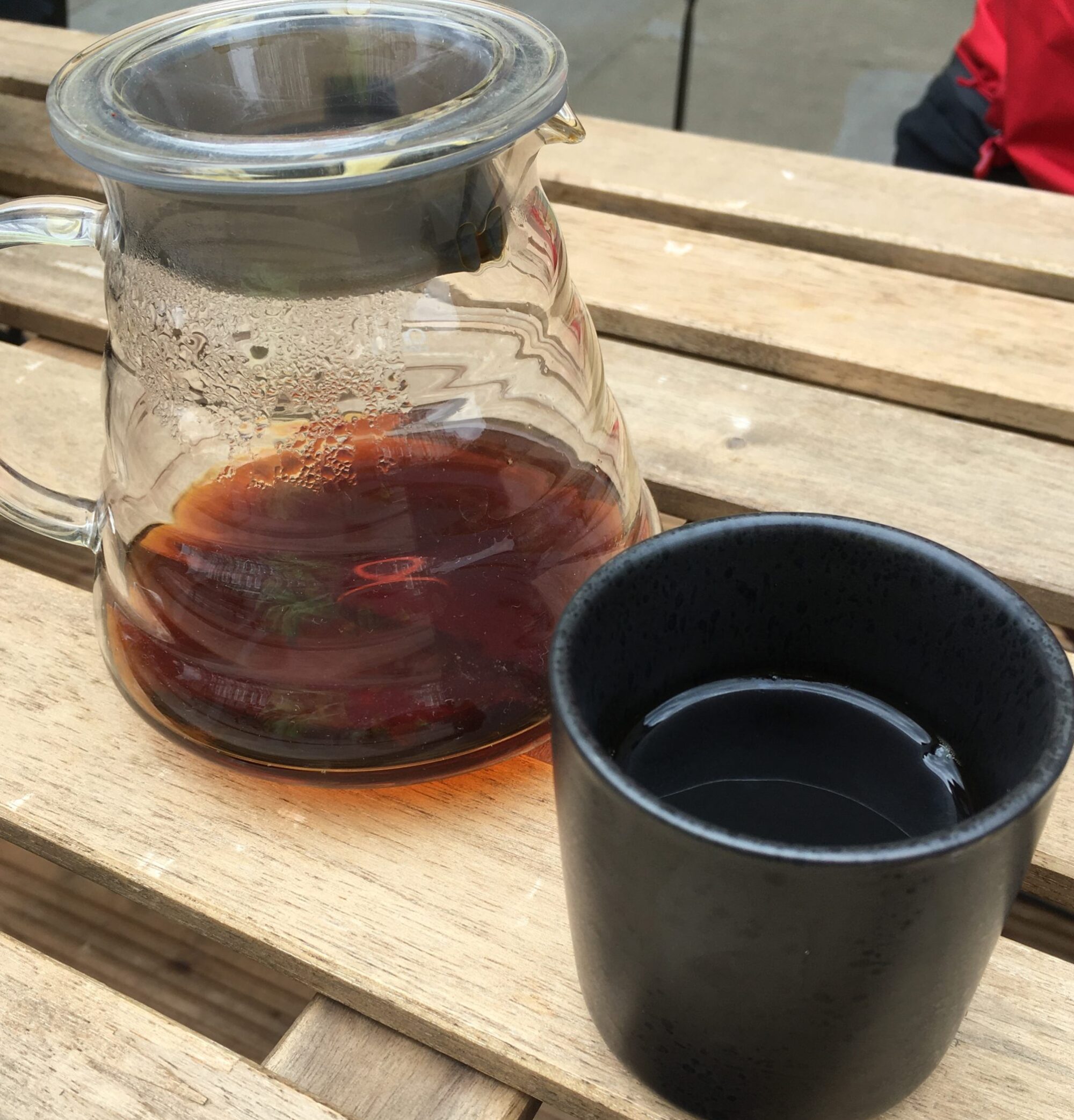
Lundenwic was the Anglo-Saxon name for the settlement that was located between what is now Covent Garden and Aldwych. As time progressed and the population of Lundenwic decreased, the site became known as the old-settlement (Aldwic), from which we get the name Aldwych*. Lundenwic is also the name of a (relatively) new cafe that has opened up near the corner of Aldwych with Drury Lane (incidentally, originally called the Via de Aldwych*). The upstairs seating area is quite small but with Caffeine magazines on hand, and plants dotted around, as well as the bar, there is plenty to watch and to notice while savouring your coffee. The espresso based coffee is sourced from Workshop while the filter option (V60 based) features different guest beans. On the day of our visit there were two filter options available. Opting for the Kenya Kagoumoini AA, I waited for my coffee to be prepared while my cafe-physics review companion had a late lunch of a cheese and ham toasty which quickly filled this small café with the aroma of cooking cheese. The tasting notes for the coffee stated that I should expect “rhubarb and raspberry lemonade”, and while the taste was certainly of lemonade, the aroma seemed to me quite different, almost spicy.

Lundenwic coffee
Kenyan coffee, freshly brewed appealed to all five senses, but each in different ways.

The cooking cheese and the memories evoked by the smells, along with this difference between the smell and the taste of the coffee, suggested that smell ought to be the subject of this cafe-physics review. Indeed, smell turns out to be a very interesting sense. The nerve cells relating to smell are the only type of nerve cell that can regenerate†. It is this ability of these nerve cells to regenerate that recently helped a previously paralysed man to walk again. Nerve cells from his nose were transplanted into his spinal cord where they helped in the regeneration of his spinal cord (for reasons that are not yet fully understood).

But what about those smells in the coffee? That special aroma, that you breathe in and appreciate immediately after you have brewed your cup is due to a fantastic mix of over 1000 volatile aroma chemicals. If you let your coffee stand, those chemicals evaporate off, which means that the just-brewed aroma starts to change. One of the most important chemicals for this coffee aroma is called 2-furfurylthiol. It has been shown that the concentration of 2-furfurylthiol in the coffee decreases by a factor of 4 over the course of an hour‡.  Even after as little as twenty minutes or so, the concentration of these complex aroma molecules starts to decrease significantly and so if you, (horror of horrors), were to let your coffee cool overnight and then zap it in the microwave in the morning, you would no longer regain that freshly-brewed smell that may have attracted you to the coffee in the first place.

durian skins and seeds
What was left after a session eating durian on a durian farm in Penang, Malaysia

This may also be the reason that the coffee at Lundenwic tasted differently to how it smelled. By inhaling the aroma and then tasting the coffee without exhaling (and so pushing the aroma back through the nose), our nerves are sensitive to different sensations. Although we may experience this while tasting many foods, occasionally it is crucial. A few years ago, Hasbean coffee were selling a very unusual coffee. The coffee, from Indonesia was called “Sidikalang”. Looking back at Hasbean’s “Inmymug” video, it is clear that it was very difficult for Hasbean’s Stephen Leighton to come up with tasting notes for the coffee which, in the end was compared with “durian”. The aroma of durian has been described as “turpentine and onions garnished with a gym sock” and yet in South East Asia it is known as the King of Fruits and is highly sought after for its taste. The aroma chemicals found in durian have recently been analysed (by the same group as studied the aroma of coffee). Nonetheless, the inclusion of “durian” in the tasting notes was extremely accurate (and did result in an amusing, if unconventional, attempt at opening one of the fruits in the video). It was accurate not only in terms of the experience of the taste/smell combination of that coffee. The actual taste and smell of the coffee was very similar to that of durian. A very unusual and interesting coffee that I have never yet had the opportunity to experience again.

However, to return to Lundenwic, how do the (lovely and inviting) smells that emanate from that café compare with the smells of the area that had been Aldwych before 1905 (when Aldwych was built, demolishing the slums that had existed there)? Some museums, such as the Canterbury Tales (in Canterbury), use the aromas (odours?) of medieval life to give visitors some idea as to what life was like in years gone by. Recalling a childhood visit to that museum, I would suggest that the smell of freshly brewed coffee and melting cheese is an almost unquantifiable improvement.

Truly we could say that at Lundenwic, it is time to wake up and smell the coffee.

Lundenwic is at 45 Aldwych, WC2B 4DR

*The London Encyclopaedia, 3rd Ed, MacMillan publishers, 2008.

†”On Food and Cooking: The science and lore of the kitchen”, Harold McGee, George Allen & Unwin publishers, 1988.

‡The coffee had been held at 80C in a thermos flask for the duration of the experiment. It may be expected that as your coffee cooled down, the volatile aroma molecules would evaporate more slowly than the time indicated in this study.


Categories
Coffee cup science General Home experiments Observations

Coffee, chaos and computing

Have you ever noticed drops of coffee skipping across the surface of your coffee as you have been preparing a V60? Or watched as globules of tea dance on the resonating surface of a take-away dragged across a table top? The dancing drops can be seen in this video of coffee being prepared in a V60:

These droplets are the result of some fascinating physics. Although we have encountered them on the Daily Grind before (here and here), the more physicists study them, the more surprises they throw up. While the droplets can be considered particles, they are guided around the coffee pot by the surface waves they create as they bounce. In a sense they are a macroscopic example of wave-particle coexistence. There is a significant temptation to explore whether they have relevance for the concept in quantum physics of wave-particle duality. But another aspect of this wave-particle coexistence has recently been shown to produce a different and unexpected connection. A connection between chaos and computing. And as you can create these droplets in coffee, perhaps we could say a connection between coffee, chaos and computing.

floating, bouncing drops
Drops of water can be stable on the water’s surface for much longer than 1 minute if you put the water on a loudspeaker, more info on how to create these at home here.

It is fairly simple to create these surface droplets in coffee at home. The secret to getting stable droplets on the surface is to create a vibration, a wave, on the surface of the coffee liquid. The droplets that then form on (or are introduced to) the surface ‘bounce’ on this wave. If you wanted to create surface droplets reliably at home, you would put your coffee on a loud speaker. I suspect that the reason that they appear in a V60 is that the first drops set up a standing wave on the surface of the coffee that acts to support later drops as they encounter the surface. If anyone has a different theory, please do let me know.

But how is it possible that these bouncing droplets connect chaos theory and computing? It is a consequence of the way that the globules of coffee on the surface interact with the waves that guide them around the coffee. Consider for one moment a particle bouncing around a confined space (the traditional example is of a ball on a billiards table). On an ordinary table, the billiard ball will behave quite predictably, start it off aimed roughly at the side of the table and it will bounce in an easily describable way. But if you make the ends curved or put circular objects in the middle of the table for the ball to bounce off, small differences in initial direction can result in large differences in the final path of the ball (for more details and an animation see here). The billiard ball behaves chaotically, and the initial path cannot be found from the final position, there is no way to re-trace the path of the ball, it is not “time-reversible”.

science in a V60
A still from the video above showing three drops of coffee on the surface.

The droplet bouncing on the liquid surface appears to move chaotically, just as the billiard ball on a circular table. However, unlike the billiard ball, the droplet is not a mere particle, but a particle linked to a self-generated surface wave. Each time the droplet bounces on the surface, it creates a small wave, like ripples on a pond. The path taken by the droplet is a complex interaction between this self-generated wave, the vibration keeping the droplet bouncing and the droplet itself. This means that if you are able to shift the phase of the bounce by 180º (meaning, that rather than bounce on an upward motion of the surface, the drop bounces on a downward motion or vice versa), the bouncing droplet not only reverses the direction it travels in, it retraces its path. Rather than behave as the chaotic billiard ball, the path taken by the seemingly chaotic globule of coffee can be exactly reversed.

Which is where the link with computing comes in. It is as if each “bounce” of the droplet “writes” information on the surface of the coffee in the form of a wave. The subsequent bounces “read” the information while the reversal of the direction of the bouncing droplet “erases” the stored information by creating a surface wave opposite to the initial one. The authors of the recent paper suggest that “in that sense [the walking droplet can] be termed as a wave Turing machine”, giving the final link to computing.

Whether or not this turns out to be useful for computing is, to me, almost irrelevant. What is interesting is that such a simple phenomenon, that anyone who makes pour-over coffee should have seen fairly often, is linked to such complex, and fundamental physics. If you would like to read more, there is a great summary article here while the actual paper is here.


Categories
General Home experiments Observations Science history Tea

Coffee and Pluto

Three billion miles away, on an object formerly known as the planet Pluto (now sadly demoted to the dwarf planet Pluto), there exists a plain of polygonal cells 10-40 km across, extending over a region of about 1200 km diameter. Last year, the New Horizons mission photographed this region and these strange shapes (see photo) as the probe flew past Pluto and its moon Charon. But what could have caused them, and perhaps more importantly for this website, can we see the same thing closer to home and specifically in a cup of coffee? Well, the answer to those questions are yes and probably, so what on Earth is happening on Pluto?

Plutonian polygons
What is causing these strange polygons on the surface of Pluto. Image © NASA

Pluto moves in an highly elliptical orbit with an average distance to the Sun of 5.9 billion km (3.7 billion miles). Each Pluto year is 248 Earth years but one day on Pluto is only 6½ Earth days. As it is so far from the Sun, it is very cold on Pluto’s surface, somewhere between -238 to -218 ºC. The polygons that were photographed by New Horizons are in the ‘Sputnik Planum’ basin where the temperatures are at the lower end of that scale, somewhere around -238 ºC. At this temperature, nitrogen gas (which makes up 78% of the Earth’s own atmosphere) has not just liquified, it has solidified; turned into nitrogen ice. These polygons are made of solid nitrogen.

But solid nitrogen is a very odd type of solid and in fact, at the temperatures on Pluto’s surface, solid nitrogen is expected to flow with a very high viscosity (like an extremely gloopy liquid). And it is this fact that is the clue to the origin of the odd polygons (and the link to fluids like coffee). Pluto is not just a cold dead rock circling the Sun, but instead it has a warm interior, heated by the radioactive decay of elements in the rocks making up Pluto. This means that the base of the nitrogen ice in the Sputnik Planum basin is being heated and, as two groups writing earlier this summer in Nature showed, this leads to the nitrogen ice in the basin forming convection currents. The warmer nitrogen ‘ice’ at the bottom of the basin flows towards the surface forming convection patterns. It is these nitrogen convection cells that appear as the polygons on the surface of Pluto.

Rayleigh Benard cells in clouds
Rayleigh-Benard cells in cloud structures above the Pacific showing both closed and open cell structures. Image © NASA image by Jeff Schmaltz, LANCE/EOSDIS Rapid Response

Of course, convection occurs in coffee too, we can see it when we add milk to the coffee and watch the patterns form or by observing the dancing caustics in a cup of tea. So why is it that we see stable polygons of nitrogen on the surface of Pluto but not coffee polygons on the surface of our coffee? The first point to note is the time-scale. Although the polygons on Pluto are moving, they are doing so much more slowly than the liquid movement in a cup of tea or coffee, at a rate of only a few cm per year. But secondly, the type of convection may be different. Although both of the papers in Nature attributed the polygons on Pluto to convection, they differed in the type of convection that they considered was happening. McKinnon et al., suggest that the viscosity of the nitrogen on Pluto is much greater on the surface of the basin than in the warmer interior and so the surface flows far more slowly. This leads to cells that are much wider than they are deep. We would not expect such a drastic change in the viscosity of the coffee between the (cool) top and (warm) bottom of the cup! In contrast, Trowbridge et al., think that the cells are Rayleigh-Bénard convection cells,  circular convection cells that form such that the cells are as wide as they are deep. This sort of convection is seen in a coffee cup as well as in the sky on cloudy days: On the Earth, clouds often form at the top (or bottom) of Rayleigh-Benard cells, where hot humid air meets cold dry air (more info here). But to form cells that you can see in your coffee (such as are on the surface of Pluto) you would need the coffee to be in a fairly thin layer and heated from below. You would also need some way of visualising the cells, either with an infra-red camera or with powder suspended in the liquid, it would be hard I think to see it in coffee alone. However, you can see these cells in cooking oil as this video shows:

As well as providing the link to the coffee, the different types of convection on the surface of Pluto hypothesised by Trowbridge and McKinnon have consequences for our understanding of the geology of Pluto. If the cells are formed through Rayleigh-Bénard convection (Trowbridge), the basin has to be as deep as the cells are wide (meaning the basin has to be 10-40km deep with nitrogen ice). If McKinnon is correct on the other hand, the basin only needs to be 3-6 km deep. It is easy to imagine that an impact crater could cause a shallow crater such as that needed for McKinnon’s mechanism. A deeper crater would create another puzzle.

If you do manage to heat coffee (or tea) from below and form some lovely Rayleigh-Bénard cells while doing so I’d love to see the photos or video. Please do contact me either by email, Facebook or Twitter. Otherwise, if you just enjoy watching the patterns form on your coffee, it’s worth remembering that there could be an entire cosmos in that cup.

Categories
General Science history

Super cold brew

Cold brew coffee with ice
Cold brew coffee served with ice. Image from pixabay.com

How cold do you drink your cold brew? Poured over ice? As an experimental physicist who works with liquid nitrogen (& helium), I was initially quite intrigued to learn of nitro cold brew coffee. Could it be coffee that somehow uses liquid nitrogen to fast-cool it, what would that do to the taste? You would expect liquid nitrogen (at -196ºC) to rapidly cool the coffee below its freezing point, after all, it is how Heston Blumenthal makes ice cream. To make a drink-able cold-brew with liquid nitrogen would require great skill, especially given the potential health risks. It would be another situation where you may well ask yourself, “what’s the point?”

However, it turned out that the reality was far more mundane, gaseous nitrogen is passed through cold brew coffee to create a drink with a silky mouthfeel. A smooth drink that comes straight from the tap just like stout. Such a drink is going to behave as an ordinary liquid and chilled only to the point that it is kept in the vat. The novelty would presumably come from the mouthfeel introduced by the many tiny bubbles distributed through the drink. Just as with water, if you cooled the nitro-brew below its freezing point it would solidify and form coffee cubes. No real difference to get excited about. But what if there was a very different sort of liquid, a “super liquid”, that didn’t behave like water, coffee or even liquid nitrogen but one that could leak through solid cups?

Superfluid helium is such a liquid. Like water, oil or even liquid nitrogen, when you cool helium (the same gas that is in party balloons)∗, it becomes an ordinary (but very cold) liquid at -269ºC. But unlike those liquids, when you cool it further, below -271ºC, it does something very odd indeed. It becomes a superfluid in which the liquid moves with zero friction or equivalently, zero viscosity (honey is very viscous, water is very much less so).  And it is because of these properties that it can do some astonishing things such as stream through cracks in containers that were thought impermeable (see the video at 0:52m), or even climb the walls of the container it is in (1:13m)!


To explain the behaviour of superfluid helium it is necessary to use quantum mechanics. Indeed, Fritz London (1900-1954) is said to have described both superfluidity and superconductivity (which happens in solids) as “quantum mechanisms on a macroscopic scale”. At the heart of the theory of superfluidity is the idea that the helium atoms fall into the lowest energy ground state possible, a Bose-Einstein condensate. To form a Bose-Einstein condensate, the particles (atoms of helium) have to  be bosons rather than fermions. All particles in nature can be categorised as either bosons or fermions. The difference between the two types comes from another quantum property of particles, the spin. Spin is related to the angular momentum of the particles and, this being quantum mechanics, can take only discrete values, either whole number or half integer numbers.

cold brew, doublemacbex
Another photo of cold brew coffee, this time from Bex Walton (flickr) – note the condensation around the rim, much could be said about that. Image CC licensed.

Bosons are particles with integer values for spin, fermions are particles with half integer values. Most of the elementary particles you will have heard of are fermions: electrons, protons, neutrons, they’re all fermions. Some particles however, such as the photon (the particle of light) are bosons. Helium 4 atoms are effectively composite bosons, because of the combination of 2 protons, 2 neutrons and 2 electrons that make up the atom. When you add their individual (half-integer) spins, you will get an integer spin, hence a boson not a fermion. The distinction is important because while bosons can share a lowest energy state (the Bose-Einstein condensate), fermions cannot. Quantum mechanically, no two identical fermions can share an energy level (the Pauli exclusion principle), so you can never get to a state where all the fermions are in the lowest energy state. There are practical, every day consequences of this for us, such as the way metals such as copper conduct electricity and heat, the fact that the electrons in the metal are fermions turns out to be crucial for us to understand how metals ‘work’. In contrast, the fact that the helium atoms are in the lowest energy state in super-fluid helium means that the ‘liquid’ behaves very strangely indeed.

We seem to have come a long way from the idea of a cold coffee. But perhaps next time, if someone offers you a “super cold brew” take a moment to think of the physicists who get to play with some real super cold superfluids†. Hope you enjoy the video.


*Technically it is Helium 4 that becomes superfluid at 2.2 K (-271ºC). The rarer isotope, Helium 3, does not become superfluid until much lower temperatures and even then, the superfluidity has some very special properties.

†Although I do get to work with liquid helium (and although it is mostly helium 4), I work at the relatively ‘hot’ temperatures at about -269C. At this temperature the interest is not so much in the liquid helium itself but its use as a coolant for other materials.


Categories
Coffee review General Observations Science history slow Sustainability/environmental

Life at the Coffee Jar

CoffeeJar_exteriorI had been waiting for an opportunity to try the Coffee Jar for a fair while. It is not that it is in a remote location, it is in fact situated on Parkway just five minutes walk from Camden or Primrose Hill. Nonetheless it feels as if it needed a special trip to get there (and, though this is pre-empting the end of this cafe-physics review, it does deserve such a ‘special trip’). Inside, there is seating at the window and running along one wall, and although it is not the smallest of cafés, it is certainly a ‘cosy’ one. This is not intended as an estate agent’s euphemism but instead to emphasise the additional meanings of this word to convey a warmth and friendliness about the space that the Coffee Jar definitely has. So far, we have been twice (see, the ‘special trip’ is worth it!). The coffee comes from Monmouth and so unsurprisingly, on the two occasions I had a coffee there (Americano and Soya Latte), it was very well done and enjoyable. At the front of the counter are a wide selection of home made cakes and cookies. While this presentation can be awkward for allergy sufferers (nutty cakes or cakes with loose nuts on top are placed side by side with the nut free options which could give contamination issues), the cookies were very good (more on the cookies later).

As befits the name, hand painted jars and coffee mugs decorate the end of the tables (and can be purchased should you wish). Individual art pieces decorate the walls while the window is painted with a scene that is somehow mirrored (shadowed?) in the ink prints on the take-away cups. All in all, there is plenty to notice in this “cosy” space. And so it took a fairly long time before I noticed the fish that was dangling above my head.
robot fisherman, robot fisherwoman, coffee jar camden
Apologies for the blurry photo but you can see the robot fisherman on the shelf.

Yes, this seemed an odd thing to me too, so I checked and indeed, a wooden fish was suspended on a string from something hidden on the shelf above my seat. At this point, an opportunity arose to go and sit at the window and so I was able to turn and look properly at the cause of the suspended wooden fish which was actually a toy robot. It just gets more surreal. But indeed, on the shelf above the seats against the wall was a toy robot fishing, a wooden fish hanging at the end of his (her?) line.

A robot that is fishing can prompt a large number of questions which seem to me to be at the intersection of science and philosophy. To what extent has automation improved our lives? Is it a good or a bad thing to use robots in jobs traditionally done by humans? Moving away from robots and towards computers, what about artificial intelligence? Much has been written about artificial intelligence in recent years. There is some angst about whether robots will come to take-over the world with an ability to think that far surpasses our human ability. Alternatively, there are people who look to artificial intelligence with the hope that it will help us drive cars or investigate pollution or all manner of other (to a greater or lesser degree) useful things. One test that has been suggested as a way of establishing whether any particular computer, or artificial intelligence, can think is the Turing test proposed in 1950 by Alan Turing. A prize set up to reward the first computer “chatbot” that could reliably mislead human judges into thinking that it was itself a human (the Loebner prize) has so far not been won (a prize is awarded each year for the most convincing chatbot but so far, none has been so reliably convincing as a human to win the top, “gold” prize).
soya latte at the coffee jar camden
Unusually I had a soya latte.

But the robot on the shelf was not represented as thinking but as fishing, an occupation that is associated with relaxation. This robot was not just thinking, it was taking time out to relax; it was represented as being alive and sentient. This prompts a rather different question to that of merely intelligence: At what point do we say that something is living? How can we define life? As could perhaps be expected, NASA has taken some time to consider this question. As they say on their website:

“Comparing the semantic task [of defining life] to the ancient Hindu story of identifying an elephant by having each of six blind men touch only the tail, the trunk, or the leg, what answer a biologist might give can differ dramatically from the answer given by a theoretical physicist.”

Which may make you wonder well, what would a theoretical physicist say about how we could define life? Erwin Schrödinger (1887-1961) had a very interesting, physics-based, definition of life. Although he is now perhaps more famous for his equation or his cat, in 1944 he wrote a book called “What is Life” (opens as pdf). To very briefly summarise, the argument goes that the tendency of all inanimate objects is towards equilibrium. A hot cup of coffee will lose heat to its immediate environment and so reach the same temperature as its surroundings, a small amount of blue food colouring at the bottom of a glass of water will eventually colour the entire glass a paler blue. To be alive is to defer this state of equilibrium for to achieve equilibrium is the same thing as death. Schrödinger argued that rather than merely consume energy, living things consumed negative entropy from their food-stuff. Entropy is a quantity introduced with the theory of thermodynamics. It is often taken as a measure of the order in a system (though there are caveats to that). The second law of thermodynamics states that for a closed system, the entropy of the system will either increase or stay the same. This suggests that to avoid equilibrium, or equivalently to avoid death, the living thing must consume order (or negative entropy) and somehow stave off this tendency to maximum entropy. To answer the objection that it would be easy to consume negative entropy by eating diamonds (which are highly ordered crystals) and so therefore that there has to be more to life than this, Schrödinger expanded on the thermodynamics of his argument. That bit gets quite technical and so is another reason that, if you are interested, it is worth getting hold of the book.


So to return to one of the first questions but phrase it in a slightly different way. Could a robot cookie maker replace the “home-made” cookies that were on offer in the Coffee Jar? It turns out that this is a subject that my often-times cafe-physics review companion (let’s call them J) has quite an opinion about. We visited the Coffee Jar twice partly because of the cookies! It seems to me that J would not have been impressed by the cookies were they robotically mass manufactured. There was something very appealing in the home made quality of them. So, there we go, one of the questions answered neither scientifically nor philosophically but on the very reasonable basis that home made cookies taste and look better. Do let me know if you agree if and when you visit the Coffee Jar.
The Coffee Jar is at 83 Parkway, NW1 7PP
“What is life?” Erwin Schrödinger, Cambridge University Press, first published 1944, my edition published 2013
Categories
General Observations slow Sustainability/environmental

Plastic free coffee?

a take away cup
There’s plenty of plastic in coffee & it’s not just in the obvious take-away cups.

So we’ve probably all done it, walked into a coffee shop and purchased a take-away coffee while in a rush to get elsewhere. It’s the moment that our desired commitment to environmentally responsible behaviour clashes with our (briefly stronger) desire for sustenance on the move. Using a keep-cup (or similar) would avoid this bit of single-use plastic but even so, is this the only plastic that you encounter when you enjoy a coffee? Actually, once you start to notice it, you will find single-use plastic in a number of surprising places.

An initiative called “Plastic Free July” aims to raise awareness of the pervasiveness of single-use plastic as well as to challenge us to do something about it. So, partly as an educational exercise, I signed up to the Plastic Free July, not because plastic is always bad, (there are arguably some very good, even environmental, reasons to use plastic, see below) but because plastic is a substance that takes a long time to break down once discarded and we use it so often even without thinking. So, before revealing just how easy – or hard – it has been to eliminate single use plastic from everyday life for the past couple of weeks, it’s worth taking a look at the problems, benefits and occurrence of plastic in our lives. Particularly while we are enjoying a tea or coffee.

Some definitions

Plastic comes in many forms and Plastic Free July does not aim to avoid all of them. It is single use plastic that is the concern: Bits of plastic wrapping, plastic bags, aroma valves. Things that are used once and then discarded. Can you avoid using these, even for one week or even just one day? Why not sign up and commit yourself to trying to find out.

Plastic Problems

Earth from space, South America, coffee
One planet. One home.
The Blue Marble, Credit, NASA: Image created by Reto Stockli with the help of Alan Nelson, under the leadership of Fritz Hasler

Two of the major issues with our use of plastics are the problems of littering and that of degradability, particularly when that litter finds its way into the oceans. Between 60-80% of marine litter is plastic. It can cause the deaths of marine life not just through its being eaten (thereby causing internal injury or malnutrition), but also by entangling sea creatures and so causing death through drowning or other injury. Moreover, the bits of plastic that float around our oceans can provide a home to various micro-organisms transporting them around the world to areas of the planet that they would not ordinarily have been able to reach.

Nor is it just a problem for the oceans. Plastic takes many centuries to decompose and although there are plastics that decompose more quickly (oxo-biodegradable and compostable, more details below), clearly there is a need to reduce the amount of plastic we throw away. A further problem with plastics is that their manufacture requires the use of a limited resource. 4-5% of global petroleum production is used for the manufacture of plastic∗. But nor is it just petroleum products, the thing that makes carrier bags opaque is an additive called TiO2. It is therefore somewhat sobering to realise that 25% of the plastics manufactured in the US are used in packaging* and 37% of the plastics produced are for disposable items. Clearly we have room to live less wastefully here.

Why it’s not all bad

paper bag roasted coffee
Is it better to swap to paper packaging? It may depend on what problem you’re trying to solve.

Although there is a big problem with plastic waste, a different environmental problem has arguably benefited from our use of plastic packaging: The greenhouse effect. Consider the way that ground coffee is often sold in a supermarket. Frequently the coffee comes in metallised plastic packaging complete with plastic air-valve (or aroma valve). Alternatively, coffee can be packaged in a steel can (as used by a well known coffee roasting blend). Steel is 100% recyclable and so is good for the degradability/litter problem. However it is heavy and cylindrical. This means that to transport an equivalent amount of coffee in steel cans costs more, both in terms of economic and environmental costs, than the lighter, less bulky plastic of the alternative*.

What about paper packaging? It is interesting that even here, the situation is not clear-cut. A study concerning the greenhouse gas emissions involved with the manufacture and transportation of different sorts of shopping bag had what may be a surprising conclusion. In order to achieve a lower CO2 footprint than a standard plastic shopping bag re-used once as a bin-liner, a paper shopping bag would have to be re-used 4x while a cloth bag would have to be re-used a staggering 173x. You may well argue (as I have) that it is still better, environmentally, to buy your coffee in paper packaging, but if thinking purely in terms of the CO2 emissions, you may want to try to find a way to re-use the coffee bag a few times.

Lastly, the litter and degradation problem need not be insurmountable. In recent years, various manufacturers have sought to make plastic degrade more rapidly than ordinary plastic. Oxo-biodegradable plastic has additives in it that, when exposed to UV light, eg. from the Sun, help the (otherwise perfectly ordinary) plastic to completely biodegrade. The process takes a controllable amount of time that can even be as little as 2 years. Compostable plastic too is being developed but there should be caveats on the name. “Compostable” is defined as “industrially compostable” (meaning it degrades if held at a steady 58C), it does not necessarily mean that it composts in your compost heap.

There’s plastic in my coffee?

air valve, plastic, environmental coffee packaging
Aroma valves: are they worth the environmental cost?

So, we’re aware of the problem and want to do something about it but how much is single use plastic really a problem for coffee (or tea) drinkers? Take-away cups are the obvious source of single-use plastic, but plastic can be found in many places as we enjoy our brew. If we are having coffee in a café (even if it is not take out), how about the spoon for the sugar, plates for the cakes or even wrapping around the chocolate bars? If you drink your coffee with milk (cow, soy or almond) it will often come in plastic bottles, yes these could be recycled but would it be better if they were made from something else? (It is an interesting fact that more plastic was sent for recycling in the UK than was used by consumers†).

An easy way of reducing your plastic use would be to use your own mug as a take-away cup (keep-cups for example are designed to be of the correct size for the cafe industry). And there may even be other advantages to you in bringing along your own cup: For Danny S Parker, taking along his own cup for his coffee allows him to better enjoy the coffee, as he says “If you choose a wide mouth cup… the involvement of the nose in the taste on the tongue will accentuate flavour and enjoyment.” Reducing your plastic consumption could mean that even a take-away coffee can provide a moment to enjoy your brew.

What about if you only ever drank coffee at home? Where’s the plastic there? Well, how do you buy your coffee? Do you buy from a coffee roaster that insists on using bags with ‘aroma valves’? These valves cannot be recycled currently and so inevitably contribute to plastic waste. Is this packaging really necessary for the way that you buy your coffee? (See here for an interesting taste comparison of coffee stored in bags with/without aroma valves). Meanwhile, the coffee itself is frequently supplied in a metallised plastic packaging, does the roaster you buy from try to minimise the environmental cost by using recycled/oxo-bio/compostable/paper packaging? Why not ask them?

And tea drinkers, you do not get away with it! There’s plastic involved in tea drinking too. Tea bags are often supplied in cardboard packaging that is then wrapped in plastic, and even loose leaf tea can come in paper bags with plastic windows or metallised plastic bags. Worryingly, even tea bags themselves can occasionally be made of a plastic material that does not break down in a composting bin‡. Plastic truly gets everywhere.

An honest appraisal of how my plastic free July has gone so far

San Sebastian via Aeropress
Giving up plastic can mean taking the opportunity to enjoy your coffee properly.

So, nearly halfway through July and my attempts at being “plastic-free” are mixed. Some things are relatively easy to change, a metal tea strainer and loose leaf tea replaced the tea bags when they ran out. The coffee I use at home comes in paper packaging from Roasting House. Other things such as bottles of shampoo could be replaced by shampoo bars (like a bar of soap only for shampoo). Even the soy milk I use at home was easily exchanged for a home-made oat-milk.

However, some things have been difficult. Shopping particularly is not very plastic-free friendly. Although there is advice on taking containers with you in order to buy meat, fish or cheese from the counter in a plastic-free way, I am not sure that this would work in my local supermarket and anyway, they have to weigh the meat/fish/cheese which will involve them putting it on a plastic bag on the scales. Just because I do not walk away with plastic in my hand does not mean that I am not responsible for its use. Cooking oil too frequently comes in plastic bottles and, given the increased weight and therefore transportation costs involved in glass packaging, perhaps this is an example of a good use of plastic. An attempt to move away from aluminium-lined, plastic tube toothpaste to plastic-free tooth tabs has been complicated by the fact that the tooth-tabs are supplied in a plastic bottle. And I’m afraid that I am partial to a bottle of beer occasionally even though they do have plastic lined metal caps.

So, my plastic-free July has been a bit mixed but certainly not single use plastic free (so far). But, it has been worth it in order to really see just how ubiquitous single-use plastic is in our day to day living. Is it possible for you to cut down just a little bit on the plastic that you use every day? Why not sign up to Plastic Free July and see where your challenges lie.

If you are already signed up to Plastic Free July or if you are trying to live in a plastic-reducing way generally I’d love to hear how it’s going. Also if you have an opinion on the use of plastic in the coffee industry (either in cafes or by roasters) do let me know.

*Plastics and the Environment, AL Andrady (Ed), Wiley-Interscience, 2003

† The study was done in 2006.

‡ I was alerted to this initially by a friend’s comment that certain pyramid-type tea bags never seemed to break down on their compost heap.

Categories
General Observations slow Tea

The process or the cup?

effect of motivation on experience of pleasure while drinking coffee
Are you a hedonist or a utilitarian when it comes to drinking coffee?

Which part of the process of making and drinking coffee do you enjoy most? How do you rate the importance of smell, taste, touch (even hearing and sight) to the enjoyment of the process of brewing your cup?

It appears that your answer to this question may well be affected by your motivation for drinking your coffee in the first place. Last year, a group of researchers from Switzerland published a study that investigated whether the reason that you drank coffee (i.e. either for sensory enjoyment or just for the caffeine kick) influenced your enjoyment of the experience of making and drinking the coffee.

The researchers looked at how the participants in the study rated their own levels of enjoyment and satisfaction as they progressed through four stages of making coffee.

  1. Water heating
  2. Jar handling*
  3. Cup preparation
  4. Cup drinking

The 60 participants were divided into two groups of 30, those who drank coffee for enjoyment (the hedonists), and those who drank for stimulation (the utilitarians). After checking that both groups of participants rated their levels of pleasure and satisfaction similarly before the experiment started (they did), the participants were repeatedly interrupted while they made their coffee and asked to rate their levels of enjoyment and the importance that they attached to different sensory experiences (smell, sight, touch etc).

Kettle drum at Amoret
A very enjoyable coffee, but which part of the process of making and drinking coffee do you enjoy most?

After stage 4, when both groups had finally managed to drink their coffees, both groups reported similar levels of enjoyment, satisfaction etc. The difference came in the process. Overall, the group that were drinking the coffee purely for stimulation found the experience of making coffee less pleasant than the group who drank coffee because they enjoyed it. Meaning, those that drank coffee because they liked the taste seemed to enjoy the entire process of making and then drinking the coffee more than those who were just looking for a pick-me-up. Moreover, the ‘hedonists’ also attached more importance to the satisfaction of the smell and the taste of the coffee than did the ‘utilitarians’. Interestingly though, vision played an important role throughout the whole process for both groups of participants.

So how much we enjoy the process of making coffee depends on why we are drinking coffee in the first place. What about you? How do you rate the time that you spend brewing your coffee (I think that we can extrapolate this to tea too)? Are you a hedonist, a utilitarian or somewhere in between and does it matter? Please share your thoughts either here, on FB, or on Twitter.


*The study was performed at the Nestlé Research Centre so presumably used instant, hence the ‘jar’. Does this affect the conclusions of the study for ‘speciality’ coffee drinkers? Are you a utilitarian speciality coffee drinker who nonetheless enjoys the entire process? Please share your thoughts in the comments section below.

Categories
General Observations slow

Mint infusions

blue tits, mint water, mint infusion, mint leaves in water
Mint in a glass of water. Do other species appreciate a mint aroma too?

Very often, in a café, there will be a jug of mint infused water sitting in a corner, offered as a complimentary accompaniment to the coffee. A fragrant way of ‘refreshing our palate’. Mint is one of many aromatic plants that we use to scent our rooms or freshen our breath. But are we the only species that uses mint and similar aromatics such as lavender in this way? Do other animals appreciate the aroma that a freshly plucked mint leaf can provide?

A few weeks ago (in mid-spring in the northern hemisphere), I noticed some odd bird behaviour going on just outside the window. A blue tit (Cyanistes caeruleus) had landed on the edge of a pot of mint and was busy tearing leaves off the plant that was growing just outside. We watched as the bird hopped around to the other side of the pot, tearing off the younger, fresher leaves. What on earth was it up to?
the blue tits didn't get this one
A sprig of mint growing in a pot.

A quick use of duckduckgo (or google if you’d prefer), revealed a surprising answer (or at least further questions) to this odd behaviour. It would appear that blue tits have been observed to pick mint, lavender and curry plant leaves and use them to line their nest. Moreover, individual blue tits have a preference for different plants. Some females (it appears to be the female that collects the leaves) prefer mint, some lavender, and presumably some prefer curry. There is even a video from “Springwatch” that filmed this behaviour in a blue tit nest a few years ago (link is here). Similar behaviour has been observed in some other bird species such as the Starling (Sturnus vulgaris) but not in other, related bird species such as coal tits or great tits. So what could be driving this behaviour, is it, as the BBC said in its headline “aromatherapy”?

This image is copyrighted gardensafari.net
Does this blue tit prefer mint or lavender?
Image used with permission and © Gardensafari.net (thanks)

According to research, in fragranced nests, the number of bacteria/pathogens on the chicks was significantly reduced compared with non-scented nests. The chicks also seemed healthier, not only did they have a higher red blood cell count, they grew faster. What remains unclear is the reason that this should be so. Is it that the mint is anti-bacterial? Or is it, as suggested in the programme Springwatch, that the smell can perhaps relax the immune system of the birds allowing them to “put more effort into their growth”. Moreover, how did the birds first know how to pick these plants? How did this behaviour spread?

There is always a risk that we anthropomorphise other animals and consider that they appreciate aromatherapy when they are not doing so. There is however an alternative risk that we reduce animals almost to biological automata that manifest different behaviours purely for the biological advantage it gives them (as if they know that in advance). These questions are too far outside my ‘specialist’ area, for me to attempt to consider on Bean Thinking. However, as an ‘interested observer’ I can still appreciate and wonder at the interesting sights that five minutes spent observing our surroundings can provide. I will also enjoy the feeling it brings to know that we are sharing the mint on the window sill with the blue tits and their chicks.
Have you ever observed similar behaviour by birds in your neighbourhood? What birds around the world share our preference for mint? Comments are always welcome either here or on Facebook or Twitter.


Categories
Coffee review General Home experiments Observations

A pebble puzzle at The Lanes Coffee House, Brighton

The Lanes Coffee House Brighton, Coffee Brighton
The Lanes Coffee House, Brighton

Hidden somewhere deep in “The Lanes” in Brighton is a great little café that goes by the (somewhat appropriate) name “The Lanes Coffee House“. The Lanes is a set of old, narrow streets that form quite a maze, a great place to explore if you are a visitor to Brighton. There are two entrances to The Lanes Coffee House, which is fortunate as we may not have found the ‘front’ entrance while wandering aimlessly around a few weeks ago. With plenty of seats inside, and a few at the back, The Lanes Coffee House has a lot to notice if you like to sit in a café, enjoying your coffee, without the distractions of your phone or laptop. Pictures by a local artist decorate the walls, with each picture featuring a Brighton scene and The Lanes Coffee House in a “Where’s Wally” type format. A window opens up to the narrow lane outside and there is also plenty to notice inside the café where we enjoyed an Americano and Soya hot chocolate. Sadly on the day that we tried The Lanes there weren’t any nut-free cakes at the counter and so, as compensation, we had to have a bag of fudge.

We sat at a table on which there was a tiny metal bucket that was used for holding sugar (see picture). With Brighton being a sea-side town, this immediately conjured up images of sandcastles and picnic sandwiches. The only problem with this image of course is the fact that Brighton has a pebble beach rather than a sandy one. So rather than think about sandcastles I got thinking about something slightly different: If you were to partially fill a bucket with some sand, put a stone from the beach in the bucket and then fill the rest of the bucket with sand, how could you easily retrieve that stone without fishing around in the sand for it?

missing a spade but it is a bucket
Bucket with sugar at The Lanes

This question came up, in a slightly different way, in a paper published nearly 30 years ago called “Why the Brazil nuts are on top“. That paper dealt with the question of why, in a package of mixed nuts, the Brazil nuts (i.e. the largest nuts) were frequently found to be on top when the package was opened. Termed, the “Brazil nut effect”, it turns out that this question is not just an odd bit of physics but has relevance to the packaging industry and earthquake dynamics. If you were to shake the bucket of sand containing that one pebble, the stone would rise up through the sand, eventually coming to the surface. The question is, what is driving this ‘anti-gravity’ type behaviour? Why do the heavy objects rise to the top?

Obviously, being a coffee website, to do the experiment with sand and a stone is a bit, well, dull. So, using dried, used, grounds (well, what do you do with your used coffee grounds?) and a green coffee bean*, I repeated the experiment on a smaller scale, in a shot glass. I put the green bean at the bottom of the shot glass and then covered it with coffee grounds (up to half way up the shot glass). To prevent too much mess, I covered the shot-glass with a piece of clingfilm. In order to avoid too much vertical shaking, the glass was hit repeatedly from the side in order to ‘shake’ it. It took 40 seconds of vigorous shaking but the green bean eventually started to poke above the surface. The heavy large bean had moved up through the glass upon being shaken, just as the Brazil nuts end up on top in a bag of mixed nuts. Just how had that happened?

Brazil nut effect
Now you see it, after shaking the green bean rises to the surface

It turns out that there are several things going on. Firstly, as the 1987 paper discussed, the small grains of sand (or ground coffee) can fall into voids under the large Brazil nut/stone/coffee bean. This has the effect of pushing the nut/stone/coffee bean upwards until it reaches the surface. The coffee bean could move down through the grounds but this would require the collective movement of a large number of coffee grounds under the bean to form a void large enough for the bean to fall into, something that is fairly unlikely. So the coffee bean will move up, the coffee grounds will move down. Then there is an effect that is more familiar to coffee drinkers, convection. The idea here is that although all the particles in the glass (or bucket) can move upwards as the container is shaken, only the small particles can move down again through the small voids created at the sides of the container. Rather like the movement of milk in a hot coffee, this again has the effect that the small particles push the larger particle up.

After this though things start to get more complicated. Along with what has been termed “the inverse Brazil nut effect”, it seems that air pressure may play a role in the Brazil nut effect. Who knew that Brazil nuts could be so complicated! Perhaps though, to finish our train of thought on The Lanes we could turn this effect into a non-physics, almost allegorical, meditation? If we, as a society, are collectively shaken enough, can small, individual actions do what at first seems impossible? I wouldn’t want to push the analogy too far, but it does seem an interesting problem on which to dwell for a further five minutes while you are sipping on your long black (or, as this is officially the first day of summer, your cold brew).

(If you’d rather think about the physics of sandcastles, you can find out more about them here).

*The green coffee bean came from a jute coffee sack that had been given to me by Amoret coffee for my composting worms. Thanks Amoret!

The Lanes Coffee House is at 59D Ship Street Brighton, BN1 1AE


Categories
General slow Sustainability/environmental

Beautiful coffee

beauty in a coffee, coffee beauty
Interference patterns on bubbles in a coffee cup.

In the UK Science Museum’s library there is a book, written in 1910, by Jean Perrin called “Brownian Movement and Molecular reality”. To some extent, there is nothing surprising about the book. It describes a phenomenon that occurs in your coffee cup and the author’s own attempts to understand it. Nonetheless, this little book is quite remarkable. It is perhaps hard, from our perspective in 2016, to imagine that at the time of Perrin’s work, the idea of the existence of molecules in water was still controversial. It was even debated whether it was legitimate to hypothesise the existence of molecules (which were, almost by definition, un-detectable). However, none of that is really relevant to the question confronting today’s Daily Grind. Today, the question is how can this book help us to find beauty in a coffee cup?

What does a one hundred year old book have to do with finding beauty in a coffee cup? Perrin received the Nobel Prize in 1926 for his work establishing the molecular origins of Brownian motion and, associated with it, his determination of the value of Avogadro’s constant. It is perhaps why he wrote the book. (The experiment that he used to do this is described in a previous Daily Grind article that can be found here.) It is in his description though, both of the theory and the experiments involving Brownian motion that this little book is relevant for today. One word repeatedly crops up in Perrin’s description of Brownian motion. It comes up when he describes the theory. It comes up when he describes other people’s experiments. It comes up when he describes bits of the maths of the theory. The word? Beautiful*.

Michael Polanyi
Michael Polanyi,
by Elliott & Fry, vintage print, (1930s),
Thanks to National Portrait Gallery for use of this image.

Throughout history, many scientists have recognised, and worked for, the beauty that they see in the science around them. In a 2007 TED talk, Murray Gell-Mann said

“What is striking and remarkable is in fundamental physics a beautiful or elegant theory is more likely to be right than a theory that is inelegant.”

So it is interesting that, although we may agree that scientific theories can be “beautiful” or “elegant”, we do not seem to have a way of quantifying what precisely beauty is. It is similar for those things that are beautiful that we find in every day life. The beauty of a sunset, or the way the light catches the ripples on the surface of a lake, these are things that we recognise as beautiful without being able to articulate what it is about them that makes them so. Instead we recognise beauty as something that strikes us when we encounter it. Elaine Scarry has talked about this as a “de-centering” that we experience when we come across beauty. Scarry writes that, when we encounter the beautiful:

“It is not that we cease to stand at the center of the world, for we never stood there. It is that we cease to stand even at the center of our own world”.¹

It is therefore quite concerning that she goes on to suggest that conversations about beauty (of paintings, poems etc) have been banished from study in the humanities “…we speak about their beauty only in whispers.”¹ This does not seem to have happened yet in science where it is still common to hear about a beautiful equation or an elegant experiment. But is there a creeping ‘ideological utilitarianism” in the scientific community? According to Michael Polanyi ²

“Ideological utilitarianism censures Archimedes today for speaking lightly of his own practical inventions and his passion for intellectual beauty, which he expressed by desiring his grave to be marked by his most beautiful geometrical theorem, is dismissed as an aberration.”²

While we may recoil from this sentiment, what do we write (or expect to read) in grant applications, scientific papers, popular science or even scientific outreach? How often is the utility of a piece of research emphasised rather than its elegance?

Earth from space, South America, coffee
Does an appreciation of beauty help with a wider understanding of justice and environmental concerns?
The Blue Marble, Credit, NASA: Image created by Reto Stockli with the help of Alan Nelson, under the leadership of Fritz Hasler

Another interesting question to ponder is whether our ability to appreciate (and discuss) beauty has wider ramifications. As many others have argued before her, Scarry suggests that the appreciation of the beauty in the world connects with our sense of justice¹. Recently the Pope too, in his great environmental encyclical, Laudato Si’ wrote³:

“If someone has not learned to stop and admire something beautiful, we should not be surprised if he or she treats everything as an object to be used and abused without scruple.”

Could it be true that part of the motivation that we need to change our ecological habits or stimulate our search for wider social justice is enhanced by our ability to slow down and appreciate the beautiful, wherever and whenever we find it?

So to return to our coffee. Is there something, anything, about our coffee or our tea that gives us such a radical de-centering experience? Can we, like Jean Perrin, appreciate the subtle beauty of the molecular interactions in our cup? Do we appreciate the moment as we prepare our brew? Or are we ideological utilitarians, seeing in our cup just another caffeine fix?


* Technically, the book in the Science Museum Library is a translation of Perrin’s work by Frederick Soddy. It is possible that it is Soddy’s translation rather than Perrin’s work itself that uses the word ‘beautiful’ repeatedly. It would be interesting to read Perrin’s book in its original French.

I would like to take this opportunity to say thank you to the Science Museum Library for being such a valuable resource and to the staff at the library for being so helpful.


“Brownian movement and molecular reality”, Jean Perrin, translated by F. Soddy, Taylor and Francis Publishers (1910)

1 Elaine Scarry, “On Beauty and Being Just”, Duckworth Publishers, 2006

2 Michael Polanyi, “Personal Knowledge, towards a post-critical philosophy” University of Chicago Press, 1958

3 §215 Laudato Si’, Pope Francis, 2015