Categories
General Home experiments Observations Science history slow

Theme on a V60

bloom on a v60
V60 bubbles. There is much to be gained by slowing down while brewing your coffee.

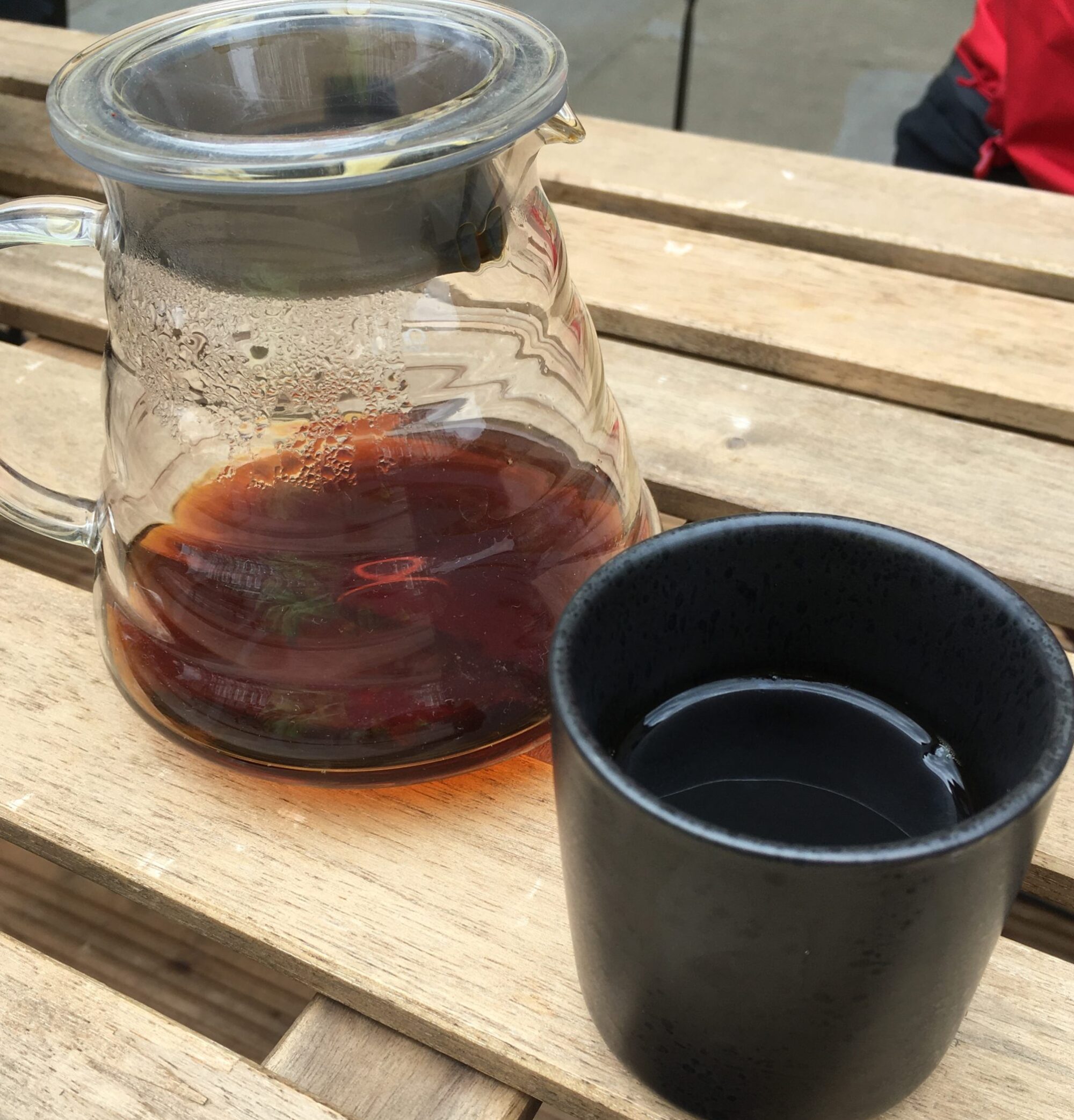
Preparing a coffee with a pour-over brewer such as a V60 is a fantastic way to slow down and appreciate the moment. Watching anti-bubbles dance across the surface as the coffee drips through, inhaling the aroma, hearing the water hit the grind and bloom; a perfect brewing method for appreciating both the coffee and the connectedness of our world. The other week, while brewing a delightful Mexican coffee from Roasting House¹, I noticed something somewhat odd in the V60. Having placed it on the kitchen scales and, following brewing advice, measured the amount of coffee, I poured the first water for the bloom and then slowly started dripping the coffee through. Nothing unusual so far and plenty of opportunity to inhale the moment. But then, as I poured the water through the grind, I noticed the scales losing mass. As 100g of water had gone through, so the scales decreased to 99g then 98g and so on. It appeared the scales were recording the water’s evaporation.

science in a V60
Bubbles of liquid dancing on the surface of a brewing coffee.

It is of course expected that, as the water evaporates, so the mass of the liquid water left behind is reduced. This was something that interested Edmond Halley (1656-1742). Halley, who regularly drank coffee at various coffee houses in London including the Grecian (now the Devereux pub), noted that it was probable that considerable weights of water evaporated from warm seas during summer. He started to investigate whether this evaporating vapour could cause not only the rains, but also feed the streams, rivers and springs. As he told a meeting of the Royal Society, these were:

“Ingredients of a real and Philosophical Meteorology; and as such, to deserve the consideration of this Honourable Society, I thought it might not be unacceptable, to attempt, by Experiment, to determine the quantity of the Evaporations of Water, as far as they arise from Heat; which, upon Tryal, succeeded as follows…”²

Was it possible that somehow Halley’s demonstration of some three hundred years ago was being replicated on my kitchen scales? Halley had measured a pan of water heated to the “heat of summer” (which is itself thought provoking because it shows just how recent our development of thermometers has been). The pan was placed on one side of a balance while weights were removed on the other side to compensate the mass lost by the evaporating water. Over the course of 2 hours, the society observed 233 grains of water evaporate, which works out to be 15g (15 ml) of water over 2 hours. How did the V60 compare?

Rather than waste coffee, I repeated this with freshly boiled water poured straight into the V60 that was placed on the scales. In keeping with it being 2017 rather than 1690, the scales I used were, not a balance, but an electronic set of kitchen scales from Salter. The first experiment combined Halley’s demonstration with my observation while brewing the Mexican coffee a couple of weeks back. The V60 was placed directly on the scales and 402g of water just off the boil was poured into it. You can see what happened in the graph below. Within 15 seconds, 2 g had evaporated. It took just a minute for the 15g of water that Halley lost over 2 hours (with water at approximately 30 C) to be lost in the V60. After six minutes the rate that the mass was being lost slowed considerably. The total amount lost over 12 minutes had been 70g (70ml).

evaporation V60 in contact with scales
A V60 filled with 400g of water just off the boil seemed to evaporate quite quickly when placed directly on the scales.

Of course, you may be asking, could it be that the scales were dodgy? 70g does seem quite a large amount and perhaps the weight indicated by the scales drifted over the course of 12 minutes. So the experiment could be repeated with room temperature water. Indeed there did appear to be a drift on the scales, but it seemed that the room temperature water got moderately heavier rather than significantly lighter. A problem with the scales perhaps but not one that explains the quantity of water that seems to have evaporated from the V60.

control
Hot water (red triangles) loses more mass than room temperature water (grey squares).

Could the 70g be real? Well, it was worth doing a couple more experiments before forming any definite conclusions. Could it be that the heat from the V60 was affecting the mass measured by the electronic scales? After all, the V60 had been placed directly on the measuring surface, perhaps the electronics were warming up and giving erroneous readings. The graph below shows the experiment repeated several times. In addition to the two previous experiments (V60 with hot water and V60 with room temperature water placed directly on the scales), the experiment was repeated three more times. Firstly the V60 was placed on a heat proof mat and then onto the scales and filled with 400g of water. Then the same thing but rather than on 1 heat proof mat, three were placed between the kitchen scales and the V60. This latter experiment was then repeated exactly to check reproducibility (experiment 4).

You can see that the apparent loss of water when the V60 was separated from direct contact with the scales was much reduced. But that three heat proof mats were needed to ensure that the scales did not warm up during the 12 minutes of measurement. Over 12 minutes, on three heat proof mats, 14g of water was lost in the first experiment and 17g in the repeat. This would seem a more reasonable value for the expected loss of water through evaporation out of the V60 (though to get an accurate value, we would need to account for, and quantify the reproducibility of, the drift on the scales).

V60 Halley
The full set: How much water was really lost through evaporation?

Halley went on to estimate the flow of water into the Mediterranean Sea (which he did by estimating the flow of the Thames and making a few ‘back of the envelope’ assumptions) and so calculate whether the amount of water that he observed evaporating from his pan of water at “heat of summer” was balanced by the water entering the sea from the rivers. He went on to make valuable contributions to our knowledge of the water cycle. Could you do the same thing while waiting for your coffee to brew?

Let me know your results, guesses and thoughts in the comments section below (or on Twitter or Facebook).

¹As this was written during Plastic Free July 2017, I’d just like to take the opportunity to point out that Roasting House use no plastic in their coffee packaging and are offering a 10% discount on coffees ordered during July as part of a Plastic Free July promotion, more details are here.

²E Halley, “An estimate of the quantity of vapour….” Phil. Trans. 16, p366 (1686-1692) (link opens as pdf)

Categories
Allergy friendly cafe with good nut knowledge Coffee cup science Coffee review Home experiments Observations Tea

Coffee chemistry at Estate Office Coffee

Could it really be true that the tables were reclaimed school science desks? I had read a review of Estate Office Coffee by Beanthere.at on London’s Best Coffee that had made this surprising claim (together with favourable comments about the coffee and cakes). Like a red flag to a bull, a visit was inevitable. Would there be any clues left on the tables as reminders of the past history? In the absence of many photos of the interior of the café, my mind wandered to images of long wooden benches like the physics labs in my old school. I imagined enjoying a coffee at such a bench, seated on a wooden stool, my feet not able to reach the ground. So when I arrived outside the cute little building, I was a bit puzzled as to how a whole lab could fit inside! Going in, my images of rows of coffee-table-lab-benches were metaphorically thrown out the window. Instead, a set of modern looking (small) tables were arranged so that several groups of 2-4 people could sit and enjoy their coffee together or individually. A lovely, friendly, space for conversation with friends but not quite the lab I had imagined. The counter, which was on the right as we entered, had a great array of muffins and cakes arranged on it which proved irresistible (and they knew which allergens were in which cake, so a definite tick in the ‘allergy friendly’ café box). The coffee (from Allpress espresso) was also very good and we ‘retired’ to a table to enjoy coffee and cake together.

interior Estate Office Coffee
Clearly science labs have changed since I was at school! The tables in Estate Office Coffee are reclaimed lab benches.

Although warm that day, sitting near the window was a very pleasant way of slowing down and noticing things. Moreover, the local history that is framed on the wall near the door, provided an interesting diversion for understanding how this quirky building came to be (and to survive in its present form). Copies of Caffeine magazine were also lying around adding to the large number of things that you could think about rather than revert to checking your phone. Finally though, curiosity got the better of me and I asked, were the tables really old school science lab benches? The helpful barista wasn’t absolutely sure and so texted the owner to enquire. Fairly quickly an answer came back: yes indeed, the wood had been reclaimed and used to be laboratory benches. Either school science labs have changed a bit since I attended or the tables have undergone a refurbishment as well as a reclaim, but nonetheless what a feature! Together we looked underneath the tables and noticed the parallel grooves running along the underside of the wood. What were they used for? Pens? Drainage channels for spilt chemicals? The mind boggled. But then returning to our table, we noticed that despite the lovely varnish and careful refurbishment, our table showed evidence of previous science lab use. Two circular stains as if the wood varnish had been etched by a strong acid. Immediately this took me back to experiments-gone-wrong with a home chemistry set but then it set off a whole different thought train through a slightly lateral connection to acidity and coffee.

table detail, inside Estate Office Coffee
Evidence of a past life?
Two rings in the varnish on one of the tables at Estate Office Coffee.

The issues and science associated with acidity in coffee have been discussed many times elsewhere and so if you would like to follow that train of thought you can do so here or here. Instead, I was reminded that the Arrhenius definition of acidity was that of a substance that, when in solution, increased the concentration of H+ ions in the water. For reasons that will become clear, this reminded me of stories I had heard of expert coffee-tasters who always use the same spoon when cupping coffee. Were there actually very good reasons that these coffee tasters always insist on using their own, same spoon, in every cupping session?

The connection between acidity and the spoons used for cupping comes via the ability of substances to gain or lose electrons to become ions. In the case of acids, the ion is H+ but different elements form their ionic counterparts more or less easily. This means that it is easier to take two electrons from the element copper (Cu) to form Cu2+ than it is to remove one electron from gold (Au) to form Au+. The ‘ability’ of a substance to gain (or lose) electrons is measured by the standard electrode potential. A few years ago, a group at the Institute of Making investigated whether different teaspoons made from different metals tasted different. In a blind taste test involving 32 participants, not only did they find that the spoons tasted different (as measured by bitter, metallic, strong etc), those metals that were more likely to form ionic species in solution (as indicated by the standard electrode potential) consistently tasted more bitter and more metallic than the rest: copper and zinc teaspoons tasted metallic, chrome and stainless steel tasted the least.

coffee at EOC Streatham
The important thing is how this tastes. What is the influence of cup size, shape, colour on your perception of the taste of coffee?

What was more interesting though was that the investigators then turned to the question: does the type of spoon used influence the taste of a substance? Although they investigated ice cream rather than coffee, the tastes they were looking at (bitter, sweet, salty, sour) are very relevant to coffee tasting. Again, the authors did a study involving a series of blind taste tests, this time involving 30 participants. Again, the teaspoons used were identical to each other apart from the fact that each had been electroplated with a different metal (gold, copper, zinc or stainless steel). Again there appeared to be a dependence between the taste of the substance (ice cream) and the standard electrode potential of the metal used for the spoon. When the ice cream (which had been separately flavoured to be more salty, bitter, sweet, sour or left plain) was blind-tasted with zinc or copper spoons, the ice cream was consistently rated more bitter than when tasted with stainless steel spoons. But there was more, it seemed that the sweetness of sweet ice cream was enhanced by the copper and zinc spoons. Indeed, copper and zinc spoons seemed generally to enhance the dominant taste of the ice cream (sweet became more sweet, salty more salty etc). Although spoons made of these two metals were also rated as tasting metallic, the most pleasant blind-tested ice cream-spoon combination was the sweet ice cream tasted with the copper or zinc spoons.

So it would appear that the material that the spoon is made from could influence our perception of the taste of the food or drink we consume with it. The taste of coffee could be influenced by the type of metal spoon that is used to taste it with. Other studies have emphasised the psychological importance to taste of the appearance or weight of the spoon. For consistent cupping therefore, it may very well be a good idea to stick to your favourite spoon.

However, this seems an area in which anyone can do a bit of kitchen-top coffee science experimentation. Have you blind taste tested several coffees? What about different coffees with different spoons? For those who cup coffee regularly it would be fascinating to hear your thoughts on the influence of the spoon on the taste of coffee. For those of you new to coffee cupping, you can find a how-to at the bottom of this post and then please do share your experiences. In the meanwhile, you may be pleased to return in our imaginative journey to Estate Office Coffee where a great tasting coffee can be enjoyed in a non-metallic cup and where you may additionally pause to ponder the influence of your surrounding environment on the pleasure you derive from your coffee.

Estate Office Coffee can be found at 1 Drewstead Road, Streatham, SW16 1LY


Categories
Coffee review General Observations

Batch and CrO2 (Streatham)

coffee in Streatham
Batch & Co, Streatham Hill

A short while ago, on the advice of London’s Best Coffee (and Beanthere.at), I headed along to Streatham to try a couple of cafés including Batch & Co along Streatham Hill Road. The café is quite modern and cubic with plenty of tables at which to sit and enjoy some good coffee and food. Another interesting recommendation from these sites to add to the list. The counter is on the left as you enter and there was a good selection of cakes on offer that day. Is it possible to have too much cake in one day? Sadly, possibly it is and so, as I had already had my fill of cake at a previous café, I kept with just an Americano (roasted by Caravan). Tap water (infused with mint) was available at each table which was greatly appreciated on such a hot day as the one on which we visited.

There were many things to notice in Batch and Co. The street/bus sign above the counter, the large selection of books in the corner (what a shame the seats next to the shelves had been occupied already!), the corrugated zinc walls and then, the cassette tapes on the tables. What a blast from the past. Sadly these tapes were no longer being used to store music but instead as table number indicators. Now ordinarily, I think these cafe-physics reviews should be the sort of science that is accessible to everybody, the sort of observation that anyone could make. But today, today the temptation is just too great, because these cassette tapes are linked to something that is being researched in an obscure but very novel effect that just happens to be an area of research for me. So today, I hope you will stay with me as I take you from Batch & Co to a very odd effect that happens when things (cassette tapes) get very cold.

coffee and cassette tape in Batch and Co
Coffee and tape. Who knew how special the tape material would be?

Those cassette tapes used to work by writing and reading magnetic information. So the actual tape bit needs to be a magnetic material. The first generation of tapes were made with ferric oxide (Fe2O3) but later, and seemingly better, music tapes used chromium dioxide, CrO2, as the tape material. Nowadays the technology of tape cassettes has been superseded by other media but the material CrO2 lives on, it turns out it is a very odd type of material.

Just like iron, chromium dioxide is magnetic, which is why it was used in tapes. But chromium dioxide is a very special type of magnet in that it is what is known as a fully spin polarised magnetic material. To understand what that means, it’s helpful to compare it with iron or copper or indeed, any other metallic material that you can think of. Metals conduct electricity because the electrons in them are free to move from one contact to another and hence carry a current. Electrons are negatively charged particles but they also have a property called “spin”. Although spin is associated with angular momentum (rotation), it is fundamentally a quantum mechanical property of subatomic particles and so shouldn’t be thought of as being about the electron’s rotation on its axis (rather like the Earth rotates). Indeed, it seems that this quantum mechanical property of “spin” is something that is very hard to pin down, even amongst physicists (see here). So instead, generally speaking, we just think about spin having two ‘directions’: spin up and spin down.

tape supporting a table, Batch and Co
An alternative use for a cassette tape. Poor tape.

Ordinarily, the electron spin doesn’t have that much effect on how much current the metal can carry (its ‘resistance’). Indeed for most metals, the number of spin up electrons is roughly equal to the spin down ones. However this is not true of chromium dioxide. Although it is a metal, all of the electrons that conduct the electricity through it are of one spin type. All the electrons are either ‘spin up’ or they are all ‘spin down’. This is spin polarisation. It is something that could never happen in copper.

There are many reasons that this could be interesting, both technologically and purely from the perspective of it being quite beautiful physics. What turns it from interesting to a really big question though is what happens when chromium dioxide interacts with another set of materials, superconductors.

Superconductors are materials that can carry large amounts of current with zero electrical resistance. This property makes them great for things like MRI machines in hospitals where large magnetic fields require the sort of currents superconductors can carry easily. How they are able to do this gets a bit complicated but what is crucial for this subject is the fact that to conduct a supercurrent they need to have zero spin polarisation: they need to have equal numbers of spin up and spin down electrons. (If you are interested in how superconductors superconduct you can read more about them here and here).

cassette tape at Batch and Co
Who knew that this tape was so special?

Now imagine, you have a wire of a superconductor such as very cold niobium (all spins are equal) that you connect to a wire (or a tape) of chromium dioxide (only one spin possible). You may think that if you tried to pass an electrical current down that connection there would be a problem. And you would be right: To conduct electricity, there have to be equal numbers of spin up and spin down electrons on the superconductor side but only one spin type can get through to the chromium dioxide side. There would be an electrical traffic jam. Which is all very logical and reasonable but it isn’t what happens. Instead, for reasons that we still do not understand, not only does the electrical current get through the connection, the chromium dioxide itself becomes superconducting through its proximity to the superconductor. By itself it could never superconduct but somehow, the superconductivity is leaking¹ into the chromium dioxide at the joint between the superconducting wire and the chromium dioxide tape. And it shouldn’t do this because everything we understand about superconductivity requires there to be electron pairs of spin up and spin down and everything we understand about chromium dioxide tells us that is absolutely not the case.

So how does it work? Surely these two effects (of superconductivity and spin polarisation) are incompatible with each other? Is there something peculiar about chromium dioxide that makes it so susceptible to this strange effect? We do not yet know (though we have a few ideas). Many groups around the world are looking at this odd effect including a network of universities in the UK. It is taking us a lot of research and quite a few meetings involving coffee to work it out but hopefully one day we’ll get there.

In the meantime, it may be worth pondering just how special those cassette tapes really were.

Batch&Co is at 54 Streatham Hill Road

¹Yes, “leaking” is, perhaps surprisingly, one of the technical words for what happens in the proximity effect.


Categories
Coffee cup science General Observations

Causing a stir

coronal hole, Sun
Where it all begins. The dark object is a Coronal hole on the Sun. Image credit and copyright NASA/AIA

What’s the difference between your cup of coffee and the solar wind (the fast stream of charged particles emanating from the Sun)? Perhaps this seems a strange question, we ought first to ask what connects your coffee with the solar wind. But, when we look at what connects them, you may be surprised to find the reason that they are different.

The solar wind is a flow of charged particles that streams past the Earth at roughly 400 km/s. To put this figure into some perspective, 400 km/s is 24, 000 km/min which means that the wind travels from the Earth to the Moon in 16 minutes. In comparison it took  Apollo 11 over 3 days between leaving Earth’s orbit and entering the Moon’s (over 4 days between launch and landing). The particles in the solar wind originate in the Sun’s Corona where temperatures get so hot that the gases have enough energy to escape the gravitational pull of the Sun itself. As these particles reach the Earth, they encounter the Earth’s magnetic field and, being rapidly slowed down by the Earth being in the way, a shock wave forms which is known as the Earth’s Bow Shock.

We must all have dragged a spoon through coffee and watched as the vortices form behind the spoon. It is a low-speed example of turbulent behaviour in the coffee. So it is perhaps not surprising that when the very hot and very fast solar wind hits the magnetic field region of the Earth, we find turbulence there too.

vortices in coffee
Vortices behind a spoon being dragged through coffee are an example of turbulence.

Now when we stir our coffee, we will see that there is one big rotation of fluid in the direction of the spoon but we may also notice smaller eddies in the drink. Some of these form from the fact that the coffee is rotating but the mug’s walls are staying motionless, friction forces the fast moving coffee to slow down at the walls. You can actually see this effect if, rather than stirring your coffee, you put it on a record player (or other rotating platform) as has been featured on Bean Thinking previously. Similarly, when you have a large vortex in the form of a smoke ring, it can decay into many smaller vortex “smoke rings” in what is known as a vortex cascade. This too is an effect that you can see in coffee (but rather than smoke rings you can make milk rings with a straw). Very often these milk rings will decay into many smaller rings in the same sort of vortex cascade as you get with the smoke, you can see a video of the effect here or at the bottom of this post. Big vortices decay into smaller vortices until they (to our eyes) disappear entirely.

vortices, turbulence, coffee cup physics, coffee cup science
Vortices created at the walls of a mug when the whole cup of coffee is placed on a rotating object (such as a record player). This is an image of water in a rotating mug with a drop of ink placed next to the mug’s wall.

The important thing is that this type of vortex cascade has also been observed in the solar wind. Rather than a giant spoon though, the solar wind stirs itself as the fast wind encounters the (relatively) slow Earth. We are used to stirring our coffee as a way of cooling it down, perhaps we blow on it gently to speed up the cooling process. But this is the difference between your coffee and the solar wind. When the solar wind is stirred up, it gets hotter. To examine how this occurs, scientists have been examining data from the Cluster set of satellites. Launched by the European Space Agency to study the magnetosphere of the Earth, Cluster has provided clues as to how the solar wind differs from a cup of coffee. Back in 2009, scientists analysed the data from Cluster looking at precisely how the turbulence produced as the solar wind meets the magnetosphere cascades into different sorts of eddies, different levels of turbulence. Comparing the data to theoretical models, they showed how the turbulence started off on large length scales (of the order 100 000 km), and decayed into smaller and smaller length scales until it reached 3km. At this point, all that energy, all that motion was dissipated as heat. Stirring the solar wind heated it up.

Why does stirring the solar wind heat it up whereas stirring your coffee cool it down? It’s to do with the environment of the coffee and the wind. On the Earth, the coffee will be surrounded by a cooler atmosphere. Stirring the coffee brings the hot liquid into contact with the cooler air and so the heat from the coffee can escape more efficiently into the atmosphere. They say in space, no one can hear you scream, which is another way of saying that there is no atmosphere through which sound waves can travel¹. No atmosphere means that there is no way of the heat generated by all that turbulence getting dissipated into a cooler air around it. So, as heat is energy, all that energy involved in stirring up the solar wind gets dissipated as heat in the wind which then has a higher temperature to that which we would naively expect.

So, next time you are waiting for your coffee to cool and stir it to hasten the process, take a moment to think about what is happening approximately 90 000 km above your head where the solar wind is being effectively stirred, and heated, by our planet’s magnetic field.

Seeing a vortex cascade in coffee:


¹The origin of the phrase however suggests that this was not quite the meaning that was intended, it was a promotional phrase used for the film Alien.


Categories
Coffee cup science General Home experiments Observations Tea

Developing, a new way to slow down with coffee

Instant gratification takes too long.

Carrie Fisher

What do you think of instant coffee? Does it, as Carrie Fisher may have suggested, take too long? Or perhaps you think that instant coffee is a bad idea, coffee ought instead to be prepared well and slowly to be enjoyed at a leisurely pace. Many readers of this website are probably of the latter school of thought and yet I would like to offer a slightly different perspective. There is indeed a way that instant coffee can be used to really slow down and to re-evaluate our view of the world: Instant coffee makes a good, or at least adequate, photographic film developer.

developing photographic film in instant coffee
The developing fluid – the instant coffee granules have nearly dissolved.

The caffeine in the coffee acts as a reducing agent for the film (so tea should also work). Instant was suggested over filter coffee in online recipes owing to the greater control over the amount of caffeine in the brew (it would be far easier to get reproducible results mixing 5 teaspoons of instant into the developer than 300ml of whichever coffee is your brew of the day). So, as a first try, it is worth keeping to previously tried-and-tested recipes, in this case from photo-utopia.

5 heaped teaspoons of instant coffee

2 level teaspoons of washing soda

300 ml of water at around 25C.

washing soda, available in supermarkets
The second ingredient that you need to develop your photographic film in coffee – washing soda.

The washing soda (sodium carbonate, Na2CO3) can be purchased in many supermarkets where it is known as a more environmentally friendly laundry agent (it is not the cooking ingredient sodium bicarbonate, that apparently does not work). It is used to ‘activate’ the reducing agent. I admit to being a bit hazy on what that actually means. Where you get your instant coffee from is up to you.

The photos show the washing soda and then coffee being added to the water. Do try to rid yourself of any ideas about developing film amidst the lovely fragrance of coffee coming out of the developing tank. Something in the reaction between the washing soda and the coffee stinks. It was not as bad as I was anticipating (as I had read the warnings of the smell elsewhere) but rest assured, it is not pleasant!

instant coffee film developing fluid
The washing soda is already dissolved in the water here but the coffee has just been added. You need to dissolve the coffee fully for it to be a good developing fluid.

For detailed instructions about developing with the solution, please see photo-utopia but briefly, developing the film took 30 minutes with one inversion every 30 seconds. If you have ever tried sitting, developing film for 30 minutes doing nothing but inverting the developing tank every 30 seconds you will know that this is quite an exercise in slowing down. Are those images that you have been taking on your camera going to come out? Will they be under-developed, over-developed? Does coffee really work as a film developing fluid?

After 30 minutes the film was put into a water stop bath and then fixed with Ilford Rapid Fixer (although it is possible to use salt-water as a fixer, I thought it best to start by experimenting with the developing fluid alone first). A further bit of washing and the film was hung out to dry. This meant more patience, although we could see the images on the film, it was not possible to scan them until the film had thoroughly dried (we left it overnight).

What about the results? Well, the four images below are from the roll of Fuji Neopan 400 film that was developed with the coffee. We had to adjust the scanning a bit as the film was somewhat lightly developed (a higher concentration of caffeine or a longer developing time was needed), but you can see that the images have not come out too badly. It is truly possible to slow down and see things in a different way with instant coffee, but maybe not by drinking it.

Cogs, Wimbledon Common, Windmill, Contact S2b, instant coffee and washing soda developer
Cogs on Wimbledon Common, developed with coffee.
Brighton shellfish, mussels, prawns, cockles, whelks, jellied eels, instant coffee
Shellfish trailer, Brighton, developed in coffee.
Merry-go-round and pier developed with coffee
Brighton beach, developed in coffee.
Bench with heads developed in coffee
Chelsea Embankment, developed in coffee.

Next time I plan to swap the instant coffee for a brewed batch and see how that comes out. More photos will be uploaded from time to time, probably to a special “coffee pictures” page on the website (yet to be created). And if you have tried developing photographic film in coffee, please do share any images that you have developed (with coffee or tea, instant or otherwise).

I am incredibly grateful to ArtemisWorks Photography for helping with all aspects of this project and for fantastic patience when confronted with some daft questions. You may also be interested to see ArtemisWorks’ own café work, photographing London’s older style “caffs” many of which have now disappeared, the café galleries can be found here.


Creative Commons License
This work is licensed under a Creative Commons Attribution-NoDerivatives 4.0 International License.

Categories
Coffee review General Observations Science history Tea

In the loop at Coffee is my cup of tea

exterior coffee is my cup of tea, cimcot, coffee Hackney
Coffee is my cup of tea on Dalston Lane. The colour of the exterior matches the crockery used inside.

There is a lot of truth in the name of this café. “Coffee is my cup of tea” in Hackney is a lovely retreat, a place where you can take time to enjoy whatever drink is your cup of tea. Walking through the door, you are presented with a few wooden tables and a cocktail menu on the wall. A breath of calm on an otherwise busy road. Together with the bench just outside, there is plenty of seating inside. There’s even a long table along the window where you can sit if you would like to enjoy your coffee while gazing at the passers-by. There were the usual range of coffees on offer along with fresh juices, other drinks together with a range of food. When we went in the late afternoon, there didn’t seem to be many cakes on offer but maybe we were just unlucky. Coffee only this time. The coffee is roasted by Assembly and there is of course tap water available at the end of the bar.

Facing the bar, glued to the wall, were a circle of stiletto shoes. Forming what seemed to  be a “shoe star”, they were one of a number of art works around the shop. The café is also quite spacious, the window at the front providing plenty of light and contributing to the relaxed space. When my long black arrived, the light coming in from the windows produced great interference patterns on the bubbles of the coffee, an irresistible piece of coffee physics. The cocktail menu provided quite a distraction, again making the point that it was a shame we visited on an afternoon: an evening of coffee and cocktails would make a lovely night. However, a sunny afternoon was a great time to sip and enjoy a long black. While the long black started off very fruity, the taste changed (matured?) as the temperature of the coffee decreased. In the background to this all though, something so subtle as to be almost un-noticeable caught my attention. Completely surrounding the window was a very thin piece of copper wire. Were there tiny little lights on it to make the café more attractive (romantic even?) in the evening? I couldn’t see any. From our table, it seemed as if it was just a thin, closed loop of copper wire forming a loop around the window.

coffee cimcot
Fantastic interference patterns on the bubbles of the coffee at Coffee is my cup of tea

Such a loop could be used as a radio antenna, a “loop antenna”. Indeed, when Heinrich Hertz (1857-1894) first discovered radio waves in 1887-8, he used a (gapped) loop antenna as the receiver. Hertz had been trying to test James Clerk Maxwell’s theory that visible light was part of a much broader spectrum of electromagnetic waves, particularly, that there should exist very low frequency waves far beyond the visible region of the spectrum, waves that we now know as “radio waves”. Radio, TV, wifi, all things that seem so obvious now but were really only predicted and discovered relatively recently. Working in his laboratory in Karlsruhe, Hertz set up a radio generator which consisted of two brass balls that were charged until a spark flashed between them. Sitting a few metres away, a gapped loop of wire, the ‘loop antenna’ suddenly showed a spark over the gap. The spark that Hertz had generated in one part of the room had been mysteriously transmitted, as if through an aether, to be picked up by the antenna a few metres away. Clearly it was consistent with Maxwell’s predictions. The electric spark had generated a low frequency electromagnetic wave that had been picked up with the loop antenna. With further experiments, Hertz showed that this wave was indeed reflected and refracted in the same way as ordinary, visible, light and even determined its wavelength (which for Hertz’s experiment was about 66cm)¹.

loop antenna at cimcot, Dalston Lane
It is probably easiest if you visit the cafe but look very very closely at the frame of the window. There is a copper wire surrounding it.

Although Hertz did not immediately see any practical application of his result (beyond the fact that it was a test of Maxwell’s theory of light), ‘radio’ soon started to be developed. Marconi and others worked with wavelengths of 200-600 m to transmit radio waves across the Atlantic Ocean¹. As amateur radio enthusiasts got hold of radio sets in the 1920s they started working with wavelengths that were initially considered impractical for applications (much shorter than the hundreds of metres used by Marconi). These enthusiasts soon realised that they could communicate with other enthusiasts in distant countries through the reflection of the radio waves off of the (until then unknown) ionosphere¹. Gradually our understanding of radio waves and antennae design developed, leading to further, unexpected applications. Depending on the design of the antennae, radio waves (and microwaves, which have a slightly shorter wavelength of the order of 0.1-100cm*) could be made to be directional. So antennae could be made that transmitted waves only in set directions (or conversely could detect the direction from which radio/microwaves originated). This understanding of antennae design would lead to advances in Radar technology.

Which brings us back to the loop antenna at Coffee is my cup of tea. Loop antennae are grouped into two types, “small” and “large”. It is fair to say that it is a large window at Coffee is my cup of tea and so the loop antenna there would fit into the “large” category. These antenna are ‘resonant’ (meaning that they respond most) to wavelengths equal in length to the circumference of the antenna. From memory, I’d guess that the window was roughly 2m high and 3 m across, meaning it had a circumference of 10 m. We can calculate the frequency of the radio waves that would be resonant with this by using the fact that the frequency (f) is just the speed of light (c) divided by the wavelength (λ) (ie. f=c/λ). The speed of light is 3×10^8 m/s, so the frequency would be (3×10^8)/10 = 30 MHz. There are two last things to notice about this result. First, the name of Hertz lives on in the unit of frequency (Hz). Secondly, the loop antenna around the window at Coffee is my cup of tea is resonant with approximately the frequency of Citizens Band radio (CB radio operates at ~27 MHz). Which may make us question once more what this loop of wire is doing at this friendly little café on Dalston Lane.

Coffee is my cup of tea can be found at 103B Dalston Lane, E8 1NH

¹Britain’s shield radar and the defeat of the Luftwaffe, David Zimmerman, Amberley publishers (2001, 2010)

*Technically Hertz discovered microwaves rather than radio waves. However, given neither were named at the time and they are both of longer wavelength than visible light, it is perhaps too pedantic a point.


Categories
Coffee cup science Home experiments Observations

Aroma and batch brew

Isn’t it great to find a lovely, freshly brewed, hot cup of aromatic coffee in a quirky little café? Which bit do you enjoy most? That special aroma as you inhale the steam above your cup before sipping the coffee to compare the taste with the smell?

2-furfurylthiol
Representation of 2-furfurylthiol. Amazing what can be found (briefly) above your coffee cup.

As you may imagine, a fair bit of research has gone into working out which chemicals are responsible for that just brewed aroma (for a review see here). More than 800 volatile chemicals have been identified as key to the aroma of coffee of which the most important for that freshly roasted and brewed coffee smell seems to be 2-furfurylthiol. Although it has a complicated name, it’s got a fairly simple chemical representation (shown right). Responsible for the “roast-y, sulphur-y” smell in freshly brewed coffee the problem for us, and for 2-furfurylthiol, is that it is not very stable. In fact, in experiments in which a freshly brewed coffee was stored in a thermos flask to keep it warm, the concentration of 2-furfurylthiol in the space just above the coffee decreased by more than 50% within 20 minutes of storage. After an hour, the concentration of 2-furfurylthiol had decreased to less than a quarter of its original amount and shortly after that, it was gone completely (study can be found here). (Other volatile aromatics decreased similarly (here)).

So if you were to brew a coffee, put it in a flask to keep it warm and then drink it within 20 minutes, you will have lost more than half of the lovely coffee smell. And if, heaven forbid, you were to take it from its thermos 1hr after brewing, almost all those wonderful aromatics would have decayed away.

Lundenwic coffee
This was not a batch!
Could you taste the difference between freshly made drip brewed coffee and batch brew?

Why is this important? Well, it’s about batch brew. You may have noticed that batch brew is increasingly popular in many cafés. Offered as a way of getting a filter coffee ‘freshly’ prepared for you without the hassle of actually having to have the filter made there and then. Different establishments try to get around the inevitable aromatic loss by changing the batch every 30 minutes or storing it in a ‘low oxygen’ environment, but is this enough? Do we need some blind taste-tests on batch brew?

A problem is that the decay of 2-furfurylthiol is not just due to oxidisation. Sadly for us, its decay seems to be intimately tied to other qualities that we appreciate in the coffee, the melanoidins (that make the coffee brown) and other chemicals formed during the roasting process (the phenols and the quinones). So even in a low oxygen environment, that aromatic 2-furfurylthiol is going to react with the other chemicals that make coffee great to make batch brew less great.

weather, bubbles, coffee, coffee physics, weather prediction, meteorology
It’s all in the 2-furfurylthiol. That fantastic coffee aroma is due to a number of unstable aromatic compounds that rapidly decay after the coffee is brewed.

That’s the theory. Clearly many cafés have taste-tested the batch brew and found that it doesn’t make enough difference to be concerned about. And in practice there are many other factors that may make a batch brew better than a fresh drip coffee you can make at home (though it would be great if someone could point some of these out for me!), what we need is a citizen science type taste test. A blind test of the same bean, prepared as a fresh filter and a cup at the end of the storage life of the batch. They will most likely have different temperatures so this would need to be considered, either by pouring very little of each (so the fresh-filter cools quickly), or waiting for 5 minutes for your cup of fresh-filter to cool to the batch temperature. Do they taste the same? Do they smell the same?

So this is a call for some science experiments “in the field” (and seemingly for everyone to drink more coffee). If you enjoy a cup of “batch” and are a regular at a café, please do drop me a note to share your blind taste-test experiences. If you are a café, any tips you have as to how to store warm coffee for longer than 20 minutes without compromising the aroma would be very interesting to hear (though if you find a café storing batch for longer than approx. 30 minutes, I would seriously consider going somewhere else!). And if you just drink coffee at home, why not get involved too, prepare a filter coffee that you store in a thermos and another a bit later ‘fresh’, get someone to help you so that you taste them ‘blind’ and let me know what you think. The comments section below is always available, otherwise I can be found on Twitter and Facebook and will happily debate there.

Enjoy your coffee!


Categories
Coffee cup science Coffee review Observations Science history Tea

Coffee innovations at MacIntyre, Angel

MacIntyre Coffee AngelOne motivation behind Bean Thinking is to explore those connections that can be found when we stop to really look around us. Whether your interest is in history, philosophy or science, something in a café will prompt a train of reflections that can lead to interesting and surprising thought journeys. This is surely true for anybody in any café, if we just take the time to slow down. But, I admit a prejudice: while I had heard great things about the coffee in MacIntyre, when I had glanced in from the bus window, I saw the scaffolding seating arrangements and wooden surfaces that can be a type of design found in many new cafés. So I worried. Was it going to be hard to ‘see the connections’ in MacIntyre? Would I end up with a great coffee but a challenge to my assumptions about the ubiquity of connectivity?

Fortunately, I needn’t have worried. The two lovely coffees that I have enjoyed at MacIntyre gave me plenty of time to really savour both the coffee and my surroundings and I was wrong in my assumptions from the bus window, connections really are everywhere. The café itself was a delightful find. Watching other customers while drinking my long black, it seemed that everyone was greeted by a cheery “hello”. Many people were clearly regulars, which is perhaps unsurprising for a friendly café with good coffee in a busy area. The scaffolding and wooden seating also works in the space at MacIntyre, giving a strangely relaxing feel to the café. The café itself is rather narrow, with the seating on one side and pastries/ordering queue on the other. Tap water was delivered with the coffee, without my needing to have asked for it.

Plant, light, scaffolding at McIntyre's Angel
Good scaffolding also has good connections.
Plant and light at MacIntyre.

MacIntyre may also be a great spot if you are into people watching. Amidst the general busy-ness, I could eavesdrop on conversations about the latest coffee news and the rise of artificial intelligence (these were two separate conversations!). Perhaps the conversations were particularly noticeable owing to the acoustics of the wooden walls and the narrow, small space of the café. At various points around the café, plants hung from the scaffolding. Some of the plants were spot-lit, which caused me to wonder whether the light that the plants were receiving was optimal for photosynthesis. The menu was projected onto the rear wall of the café, which was also decorated with hexagons, an immediate connection to graphene.

But then, in my coffee cup, the significant crema on the coffee showed evidence of amazing thermal convective motion together with turbulence. The coffee itself was very sweet with nutty overtones but the movements of the crema reminded me of cloud formation in thunderstorms. Although thunderstorms didn’t make it to the thought train of MacIntyre, another form of surface motion suggested a connection to another, unusual, feature of this café. You see, MacIntyre is a cashless business, no cash is accepted even if you’re only buying a long black. Most customers on my visit paid with their contactless cards.

The idea of a cashless society is one that has obvious advantages for both the business and the government/economy (whether it has such obvious advantages for the consumer I will leave as a point to be debated). While some countries are attempting to move to a more cashless economy, for a business to be entirely cashless is somewhat innovative. Even though MacIntyre is not the only café to go cashless (Browns of Brockley is similarly cash free), it has to be one of the first cafés to do so.

Coffee at MacIntyre Angel
Coffee and water on wood at MacIntyre Coffee. Could you increase the returns on your investments by understanding the movements on the surface of a cup of coffee?

What is the connection between this and the surface movement on my coffee? Well, it is not just at MacIntyre that a café has supported an innovation that has (or may) change our economy. Just over three hundred years ago, Jonathan’s Coffee House in Exchange Alley was a place of similar innovation, though there it was a customer rather than the coffee house itself that gave the change.

It was at Jonathan’s in 1698 that John Castaing published a paper twice a week detailing the latest stock prices titled “The course of the exchange and other things”. Recognised now as the origin of the London Stock Exchange, how stocks are priced and how their prices vary with time are subject to intense mathematical modelling. Although now, these models can be extraordinarily complex, the base of many of them share a mathematical model with the movements on the surface of your coffee cup, Brownian Motion.

Jonathan's coffee house plaque
The site of Jonathan’s in Exchange Alley. Seen while on a Coffee House tour last year.

Brownian motion is the phenomenon in which small particles of dust, or coffee grains on the surface of your coffee move in a random way as a result of collisions between the particles and the molecules in the liquid. First described in detail by a botanist, Robert Brown in 1827, the experimental evidence in favour of the molecular-collision explanation of Brownian motion came in 1910 with Jean Perrin’s careful experiments (that have featured in The Daily Grind previously). The maths behind the explanation relies on the idea of the ‘random walk‘ in which each dust particle is ‘kicked’ in a random direction by the molecules in the coffee, the consequent motion being frequently described with reference to a drunkard attempting to get home after leaving the pub. However, as this concept of the ‘random walk’ was being developed for molecules in a liquid, it was simultaneously being developed to model the movements of stock prices by the mathematician Louis Bachelier. Bachelier’s model of stock prices turned out to be the same as the model of Brownian motion, but both developed independently.

As yet, it is unclear (to me at least) whether there is a link between cashless payments and some of the maths in your coffee cup but, MacIntyre would be a great place to contemplate this as you sip your brew. Never succumb to prejudices, on which note please do let me know what you think of cashless payments, a great convenience or an invasion of privacy?

MacIntyre can be found at 428 St John St, EC1V 4NJ.

Categories
Coffee review Coffee Roasters Observations Science history Tea

Good vibrations at Vagabond, Highbury

black coffee, Vagabond, Highbury
A good start to the day. Coffee at Vagabond.

A long black, flat white (with soya milk) and a tea. Yes, you could say we spent a fair while at Vagabond in Highbury the other week. It was a lovely space to catch up with an old friend again. There were plenty of comfortable seats and the staff were definitely friendly, supplying us with coffee and space to chat for a while. The coffee was good (Vagabond are roasters as well as a café) with batch brew and Aeropress/drip on offer together with the usual selection of coffees and other drinks. Tasting notes were on a black board behind the counter while on the wall, also behind the counter, was a drawing of a tongue taste map. While the science of this has been disputed, it does serve as a reminder for us to sit back and properly appreciate – and taste – what we are drinking.

Above the espresso machine was a long rectangular sign that said “coffee in progress”, suspended by four cables, one at each corner. Coffee orders were placed onto this sign allowing the baristas to keep track of who ordered which drink. Given how busy this café occasionally got (and we weren’t even there for lunch), it seems that this is a very handy system. Each time an order was placed on the sign, the whole sign oscillated, rather like a rigid trampoline. Even if you had not seen the note placed on the sign by the barista, you would get a clue, a piece of evidence, that something had just happened by the vibrations long afterwards. Perhaps you may say that the sign was some sort of “order-detector”.

order detector oscillation espresso machine
The “order-detector”: sign at Vagabond in Highbury

Or at least, that is what you may say if you were thinking about the LIGO (Laser Interferometer Gravitational waves Observatory) detectors that, back in 2015, detected the gravitational waves produced by two merging black holes between 700 million and 1.6 billion light years away. Not only do these detectors have similarities to the order-detector sign at Vagabond, the beauty of the LIGO detector is that you can start to understand how it works by staring into your coffee. The LIGO experiment consists of two detectors. Each LIGO detector is an L shaped vacuum tube (4km long) with a mirror at each ‘end’. A laser beam is split between the two legs and reflected back by mirrors at the end of each L. When the reflected laser beams return back to the detector at the corner of the ‘L’, how they interact with each other is dependent on the exact distance that each laser beam has travelled between the mirror and the detector. Think about the bubbles on the surface of your coffee. These colourful bubbles appear as different colours depending on the thickness of the bubble ‘skin’. You may remember being taught that, exactly as with oil slicks on water, it was about the constructive and destructive interference of the light waves. As each ‘colour’ has a different wavelength, the colours that destructively interfere change with the thickness of the bubble skin. You can determine the thickness of the bubble by the colour it appears.

LIGO photo
An aerial photo of the LIGO detector at Hanford. The mirrors are at the ends of the tubes going away from the main building. Image courtesy of Caltech/MIT/LIGO Laboratory

In the LIGO experiment, there is only one wavelength because the light is coming from a laser. So whether the detector registers an intense laser beam or the absence of one, depends on whether those two beams coming back from the mirrors interfere constructively, or destructively. (A deeper description of the technique of “interferometry” can be found here). As the gravitational waves emanating from the collision of the black holes encountered the mirrors at the ends of the L’s in LIGO, so each mirror wobbled a little. This small wobble was enough to change the intensity of the laser light received by the detector and so reveal that the mirrors had moved just that little bit. In fact, the detectors are so sensitive that they can detect if the mirrors move by less than the diameter of a single proton. Given that this is a sub-atomic distance, I don’t think I can even start to relate it to the size of an espresso grind, even a Turkish coffee grind is millions (billions) of times larger than the amount that these mirrors moved. Yet this is what was detected a couple of years ago in the now famous announcement that gravitational waves had been detected and that Einstein’s predictions had been shown to be true.

Watching the “coffee in progress” sign oscillate at Vagabond, it is clear how much engineering has gone into isolating the mirrors at LIGO enough that they do not move as people walk by. Yet perhaps it is interesting that, nonetheless, one of the final refinements of isolating the mirrors from the vibrations of the earth involved changing the material for the cables that suspended them, just as with the sign at Vagabond. You can learn more about the engineering behind this incredible feat of detection in the video here, or you can go to Vagabond, enjoy a lovely coffee and think about the physics of detection there.

Vagabond (Highbury) can be found at 105 Holloway Road, N7 8LT

If you would like to hear what the collision sounded like, follow the link here.


Categories
Coffee cup science Observations Sustainability/environmental

Stirring up some climate science

Everything is connected. At least, that is part of the premise of Bean Thinking, where the physics of a coffee cup is used to explore the physics of the wider world. So it was great to stumble upon a new connection that I had not previously appreciated¹.

vortices in coffee
Like the vortices behind a spoon dragged through coffee….

The connection is between climate science and that wonderful pastime of pulling a spoon through coffee and watching the vortices form behind it. Yet the research that revealed this connection was not looking for links between coffee and the atmosphere. Instead the researchers were interested in something seemingly (and hopefully) very far from a coffee cup: rogue waves.

Rogue waves are rare and extremely large waves that have been the subject of mariners tales for many years. Nonetheless, it is only relatively recently that they have become the subject of scientific research, partly because they are so rare and so outside our usual experience that they were thought to be the stuff of myth rather than of science. So it is only now that we are developing an understanding of how it can be that, in amongst a number of smaller waves, a massive wave of 20m height can suddenly appear, apparently out of nowhere. One of the groups looking at this problem investigated the effect of a particular sort of (known) instability on a series of waves in water. However, unlike other research groups, this particular study included the effect of the air above the water as well as the waves themselves.

Small waves seen from Lindisfarne
Rogue waves seem to come out of nowhere. A rogue wave can be 2 or 3 times the height of the other waves in the water at the time. How and why do they form?

Although this sounds a simple idea, modelling water waves in air is actually extremely complex. To do so, the authors of the study had to use a computer simulation of the air-water interface. It is not the sort of problem that can be solved analytically, instead the computer has to crunch through the numerical solutions. In order to start to see what was going on with the rogue waves, the authors had to simulate multiple waves of different amplitudes. Each simulation took weeks to perform. Given that this was only a few years ago (the study was published in 2013), you can start to see why people had previously been approximating water waves as waves in water (without worrying too much about the air interface).

Now here is where the link with coffee comes in. The group modelled waves as a function of steepness and found that, above a critical steepness, the wave breaking caused significant interaction between the air and the water layers. In addition to the bubbles that form when waves break, the movement of the air over the breaking wave formed into a vortex which, when it interacted with the back of the wave created an opposite vortex: a vortex dipole “much like the vortices that form behind a spoon dragged through a cup of coffee“.

Rayleigh Benard cells in clouds
The water droplets that form clouds are often ‘seeded’ by particles of salt or dust, such as the aerosols distributed by the vortices in this wave study. Image shows clouds above the Pacific. Image NASA image by Jeff Schmaltz, LANCE/EOSDIS Rapid Response

Just as with the vortices in the coffee cup, vortices were forming in the air behind the wave crest (which acted as the spoon) and travelled upwards through the atmosphere and away from the waves. As each wave broke, a train of vortex dipoles were produced that twirled off into the sky. Imagine a coffee bath and multiple spoons rather than a coffee cup. The authors suggested that these vortices could carry aerosols from the sea (salt, water droplets etc) into the atmosphere. Travelling within the vortices, these tiny particles could travel far further and far higher than we may have expected otherwise. Such aerosols can be critical for cloud formation and so the effect of these breaking waves could be important for climate modelling.

While an undergraduate, I had an opportunity to study a course in atmospheric physics. I remember the lecturer lamenting that while we (as a community, but not really as the students sitting in the lecture theatre at that time) understood atmospheric modelling quite well and that we understood how to model the oceans fairly well, we got problems when we tried to put the two sets of models together. It was clear that something wasn’t quite right. Years later, it seems that at least past of the reason for that is linked to those vortices that you see as you pull your spoon through your coffee cup.

Everything is connected indeed.

A summary of the study can be found here. The abstract (and link to the pdf) of the published paper can be found here. If you do not have access to the journal through a library, an early, but free, version of the paper is here – note though that this version may not include the amendments included after peer review.


¹A quote attributed to Jean-Baptiste Biot (1774-1862), is perhaps relevant here “Nothing is so easy to see than what has been found yesterday, and nothing more difficult than what will be found tomorrow.”