Categories
Home experiments Observations slow Tea

Coffee baubles

resonating coffee
Not the best image of a resonating coffee but you hopefully get the idea

Most people, at some point in their lives, must have pushed a take-away coffee cup across a table and watched as patterns form on the liquid surface. Sometimes these patterns seem to stand still, we’d say that they form ‘resonances’. On even rarer occasions, on dragging your cup across the surface, you may have seen coffee droplets jump out of the coffee and then dance on the coffee surface for a couple of seconds as the liquid vibrates.

Today’s Daily Grind investigates these ‘floating droplets’ with an experiment in time for Christmas: Decorate your coffee with coffee baubles.

To make these droplets form on your coffee in a controllable way you will need a few bits of equipment:

  1. A couple of loud-speakers with the woofers exposed
  2. Some sort of liquid soap (washing up liquid, hand soap, soap for hand washing clothes etc)
  3. Some water (or coffee but you will do horrible things to it)
  4. A shallow dish (I used the bottom of an old yoghurt pot)
  5. A “dropper”, a pipette or syringe would be ideal, a straw will probably work.

You can do this completely systematically, in which case you’ll also need a signal generator to provide a fixed frequency output to the speakers (I used “ScorpionZZZ’s Lab, Signal Generator Lite for iPhone). Or you can just go straight to the fun bit which is to make these droplets dance to music. It’s Christmas so it’s entirely up to you!

floating drops, resonances, speakers, kitchen top science
Balance a shallow dish on the woofer of a speaker. A roll of sellotape can be used to couple the vibrations of the speaker to the dish if necessary.

Balance your speakers on a flat surface and put the shallow dish so that it sits in good contact with the woofer. Because my dish was ever so slightly larger than the vibrating bit of the speaker, I ‘coupled’ the speaker to the dish with a roll of sellotape. Mix 10ml of soap with 100ml of water (this does not have to be exact but you may want to investigate just how much/little soap you can get away with). If you are using coffee rather than water, you will need to mix 10ml soap with 100ml coffee.

Pour about half the soapy-water into the dish and then turn the speakers on. If you are using a signal generator, watch what happens as you sweep the frequency from 10-200 Hz. Now, either choose a frequency which shows a nice resonance pattern on the water, or start playing the music through the speakers. Music with a good beat will work well (I watched drops dance to Tiesto, Blondie, and Josh Woodward’s “coffee”).

Drip a drop of the remaining soapy-water onto the resonating surface. A video of my playing with these droplets can be seen above. Although not all the drops will float, it is fairly easy to start to form patterns of flowers or rows of droplets and then it’s worth just playing.  How big a droplet can be made to float without collapsing? How many minutes can you get a drop to last before it sinks? What happens if you combine a drop of black (soapy) coffee with a drop of milky (soapy) coffee?

Have fun, and please do share your videos and photos of your experiments with me on Facebook or Twitter.

Disclaimers & Credits:

No coffee was wasted in the making of this video. A very good coffee from Roasting House was thoroughly enjoyed before the remnants were diluted and mixed with soap.

Inspiration & experimental details taken from Jearl Walker’s great article “The Amateur Scientist” in Scientific American, p. 151 (1978).


Categories
General Observations slow Sustainability/environmental

A drop in the Chemex?

Chemex, 30g, coffee
How do you prepare your coffee?

How do you prepare your coffee? Generally I’ll either use the Chemex or a French press. Often it will be the French press purely because it is, sadly, quicker. However, on those mornings that I do slow down to prepare a Chemex, I generally feel better for it. Not only does the coffee taste better, but those 5 minutes of preparing the coffee pay off as time for the mind to wander rather than just time spent waiting for the caffeine. When the Chemex is nearly ready, the fresh brew drips slowly from the filter onto the liquid below. Each drop produces a ripple pattern. At the start of the UN conference on climate change in Paris (COP21), we may well hear talk of some of our efforts being mere “drops in the ocean”. So it seems a good time to reflect on those “drops in the Chemex”. Just how much influence can a drop  have?

It is worth stopping for one moment to consider what is going on around us at this moment. As I write this, it is late November in the Northern Hemisphere. Taking a walk outside, I can see the last of the yellow leaves falling off the trees. In just a couple of weeks time, many of the trees will be bare. Why do the leaves fall from the trees? We could answer this question in a number of different ways. Biologically, the tree is forming cells at the joint between the leaf and the tree that will eventually enable the leaf to tear from the tree. As these cells are, in some way, responsible for the leaf falling off, they are called “abscission” cells. But even with these abscission cells, the leaf still needs something to force the leaf off. Often this is the wind which is why we get such an abundance of leaf fall on windy days. However there is another mechanism that can help a leaf to drop, and that is a curious interplay between the leaf and rain.

autumnal scene, red leaves, hydrophilic
The surface of the leaf changes from waterproof to ‘wettable’ over the course of the summer

In the spring, many species of tree, including Oak, develop a wax layer on the leaf. Perhaps you have been walking in the country and have needed to wax your walking boots before you go? The wax on the boots acts as a waterproofing for the boot, ensuring that your feet don’t get soggy. The wax on an oak leaf performs the same function for the leaf, it makes the leaf waterproof. Although this is not the only function of the wax. It seems that a waxy surface also slows the processes that dry out the leaf, prevents insects and pathogens attacking the leaves and may even play a role in affecting the way that the light is concentrated into the leaves for photosynthesis. Nonetheless, from the tree’s perspective, it is a significant advantage to have waterproof leaves. Imagine rain falling onto a waterproof surface. The drops of rain do not ‘wet’ the leaves but instead roll off. As the raindrops roll off, they take particles of dust and dirt with them. It is a tree’s way of cleaning itself. Waterproof surfaces are self-cleaning surfaces. Something that some scientists are now trying to replicate for man-made products.

hydrophobic leaves
Some leaves are more waterproof than others.

As the summer continues and the leaf gets older, the wax layer changes. The structure of the wax changes and erodes as the wind, weather and even pollution batter the wax layer. Just as with the hiking boots, the damaged wax layer results in a less waterproof leaf. The leaf becomes “wettable”. When a drop falls on a surface, the shape of the droplet is determined by how waterproof the surface is (more details here). A surface is termed “wettable” when the droplet becomes significantly flatter and coats the surface rather than forming a spherical drop that can roll off. Now consider each raindrop as it hits the different types of leaf. In the spring, the leaf is waterproof and the raindrops will roll off them. A drop of rain will cause the leaf to shake on its stem but then to return to its original position. It is ultimately not affected by a light rain shower. In the autumn when the leaves are no longer waterproof, the rain will start to stick to the leaf surface. Now when the leaf shakes, the wet leaf will not return to its original position but will bend slightly further downwards. As it continues to rain, the leaf will experience a greater torque and this means that it is more likely to fall off the tree. As each rain drop hits the leaf, the likelihood that the leaf will tear away from the abscission cells at the base of the leaf increases. Each drop has an effect.

This also has an important consequence for some of our technology. One renewable energy source that has been proposed for self-powering electronic devices harnesses the energy of rain. When rain falls on an array of cantilevers, it forces the cantilever to bend and to oscillate. This energy can be harvested ( that is, changed into a form that is useful to us) by using small piezo-electric devices (that convert movement into electricity or vice versa) at the  base of the cantilever. When a tree leaf is wet, the leaf joint experiences a greater torque which causes the leaf to ultimately tear from the tree. For the rain-energy harvesters, this is exactly what we want. The greatest energy obtainable from the cantilever system will be from cantilevers that can be made wet. Waterproof cantilevers would be a bad idea. A renewable energy that comes from rain would definitely be a positive development for UK energy production!

It seems that one coffee drop does indeed go a long way.


Categories
Coffee review Coffee Roasters Observations Science history slow

Waiting for a green light at Alchemy, St Pauls

8 Ludgate Broadway, St Pauls
Alchemy Coffee

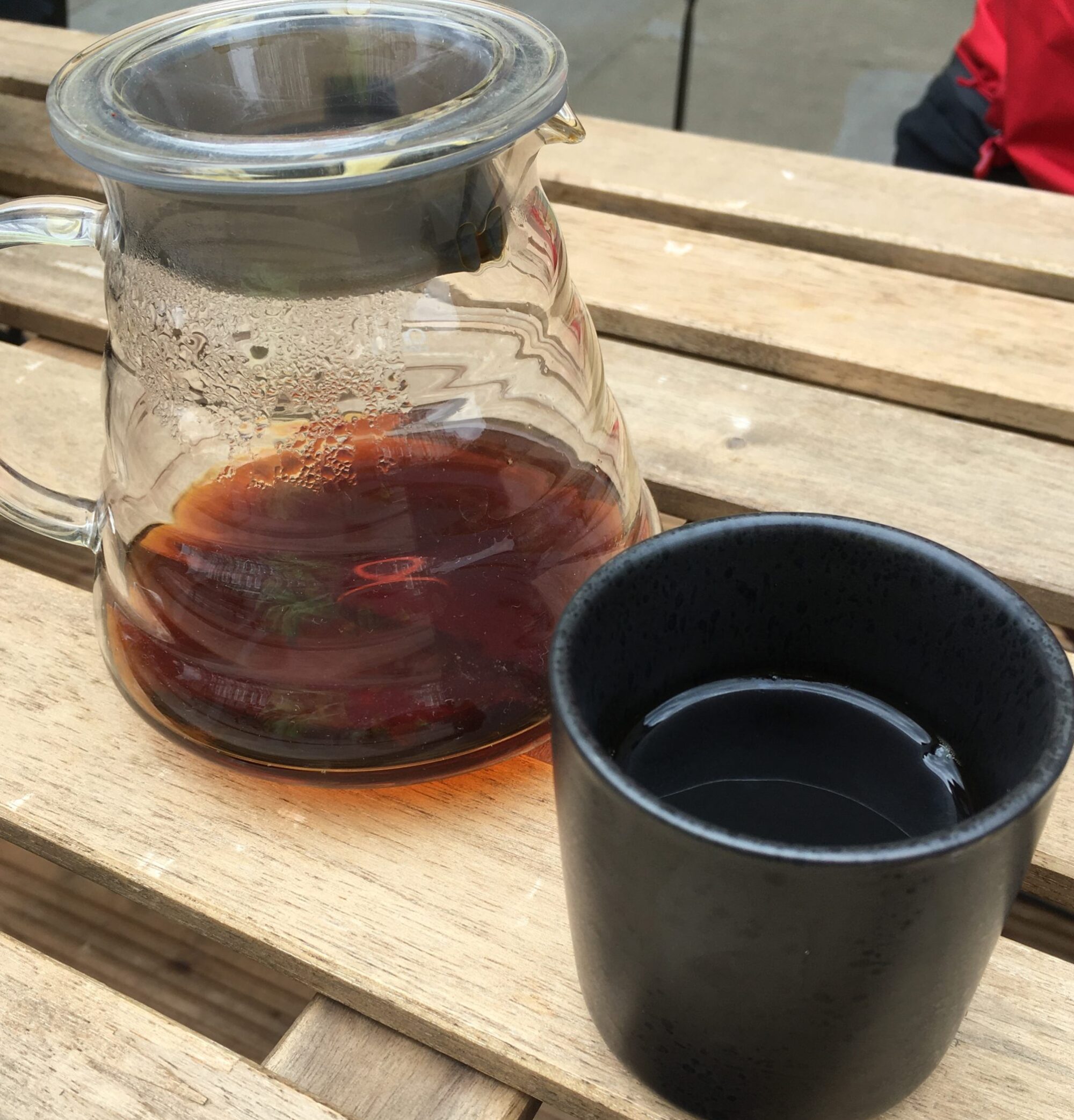
Alchemy, “a seemingly magical process of transformation, creation or combination”, is certainly a cafe that lives up to the dictionary definition of its name. The branch, on Ludgate Broadway near St Pauls, is the outlet that ‘showcases’ the coffee of Alchemy Roasters. On walking into this cafe, I was presented with a menu of two types of beans for espresso based drinks or two different beans for filter/aeropress. Both sets of coffees came with tasting notes. After a brief chat with the friendly barista I went for the San Sebastian with aeropress. Notes about the origins of the coffee are dotted around this superbly sited cafe (its location is ideal for people watching). The coffee is directly traded (where possible) and, if lattes or cappuccinos are your thing, there are also details about the farm that produces the milk.

Although there were cakes on the counter, I had just had lunch and so had to pass on what looked to be a good selection of edibles. The coffee though was certainly very good and definitely an experience to be savoured. As, perhaps I should have expected, when the coffee arrived it came in a beaker reminiscent of chemistry laboratories. From my chair in the corner, I could watch the preparation of the coffee behind the counter, the people coming into the shop to order their coffee and the crowds passing by outside.

E=mc2 Einstein relativity in a cafe
Scales at Alchemy. Weights on one side, chocolate on the other, it can only mean one thing: energy-mass equivalence

Close to where I was sitting was an old style set of measuring scales. This see-saw balance had weights on one side and chocolate on the other. Perhaps this connection seems tenuous, but for me weights on one side of the scales and an energy bar (chocolate) on the other side could only mean one thing:

E=mc²

The equation relating energy and mass for a particle at rest derived, and made famous by Einstein. The equation comes from Einstein’s theory of special relativity which states that nothing can be accelerated to faster than the speed of light (in a vacuum). First set down in 1905, the theory has some very odd predictions, among which the best known is probably the twin paradox (details here). The idea is that a moving clock will be observed to run slowly by a stationary observer, a prediction that has been confirmed several times by experiments using atomic clocks (here).

San Sebastian via Aeropress
Coffee is served at Alchemy

Moreover, the equation states that mass and energy are equivalent and that a small amount of mass can produce an awful lot of energy, (details here). A detail which will bring this story of a cafe-physics review nicely back to the Alchemy cafe, to London and to the importance of slowing down. The connection is through a set of traffic lights in Bloomsbury. Back in 1933, Leo Szilard was waiting to cross the road at the traffic lights at the intersection of Russell Square with Southampton Row. Szilard had recently escaped from Nazi Germany and was spending his time as a refugee in London pondering different aspects of physics†. That September day, Szilard was thinking about a newspaper article featuring Ernest Rutherford that he had read earlier. In 1901  Ernest Rutherford, together with Frederick Soddy, had discovered that radioactive thorium decayed into radium. The changing of one element into another could be considered a type of modern day alchemy. However Rutherford did not believe that there could ever be a way of harnessing this nuclear energy. In the article read by Szilard in The Times, Rutherford had dismissed any such ideas as “moonshine”. Szilard was forced to pause his walk as he waited for the traffic lights to change. Those few moments of pause must have helped clear Szilard’s mind because as the light went green and Szilard was able to cross the road, a thought hit him: If every neutron hitting an element released two neutrons (as one element was transmuted into another), a chain reaction could be started. As part of the mass of the decaying atom was released as energy, it would mean that, feasibly, we could harness vast amounts of energy; E=mc².

This idea, a consequence of spending five minutes waiting for a traffic light rather than checking Twitter (not yet invented in 1933), proved to underpin both the nuclear fission which we use in electricity generation and the nuclear fission that we’ve used to develop weaponry. It makes me wonder what alchemy we could conjure in our minds if we stopped to enjoy the transformations of the coffee beans at Alchemy.


Alchemy (cafe) is at 8 Ludgate Broadway, EC4V 6DU

† A book that some may find entertaining is:

“Hitler’s Scientists”, John Cornwell, Penguin Group publishers, 2003. The book contains this anecdote about Szilard: As Szilard was of Hungarian-Jewish descent, he fled Germany to Britain via Austria on a train a few days after the Reichstag fire of 1933. On the day he left, the train was empty. One day later, the same train was overcrowded and the people leaving Germany were stopped at the border and interrogated.  An event that prompted him, a few years later, to reflect “This just goes to show that if you want to succeed in this world you don’t have to be much cleverer than other people, you just have to be one day earlier than most people.” Something to reflect on in today’s refugee crisis perhaps.

Categories
Coffee review Observations Sustainability/environmental

Old and new at Sarnies, Singapore

Sarnies, Telok Ayer St, CBD, Singapore
Sarnies, Singapore

It is just possible that the name ‘Sarnies‘ may suggest a speciality at this cafe in Telok Ayer St. Singapore. And the sandwiches are definitely very good (I happened to visit one lunchtime), but don’t let this deceive you, the coffee is very good too and indeed Sarnies has been listed as one of the top 10 cafes to visit when in Singapore. Sarnies operates from an old style ‘heritage’ building near the central business district in Singapore. This style of “shop-house” used to be ubiquitous in Singapore but as Singapore has developed so the tall buildings of the “CBD” now tower over these remnants of Singapore’s past. The authorities though are keen to preserve their heritage and so many of the buildings have been carefully restored so that the exteriors are fairly faithful to the original. The interior has plenty of table space for you to enjoy your coffee (and sandwich of course) and watch the goings-on around you. Complementary water is available at the bar while you wait for your coffee and sandwich to be brought over to your table.

air vent, natural air circulation, air conditioning
The old air vent system and the new air con unit inside Sarnies in Singapore

Inside, you can see how the demands of modern living have changed the architecture of the shop-house. Above the door, and along the window were a series of vertical timber railings.  These date from the construction of the house and were presumably to assist with air ventilation in a time before air-conditioning. They work because hot air rises and so by putting an opening – a vent – near the ceiling, the  hot air in the building will rise and leave the interior to be replaced by the cooler (it is never cool in Singapore) air from outside. Unfortunately, the temperature in Singapore during the day time is in the 28-33C region and so this method of cooling is not as efficient as air conditioning which is why the vents are now covered in glass. The air-conditioned interior also means that the door of Sarnies is kept closed at all times, ensuring that the air conditioning is as efficient and cool as possible (though seats are available outside should you want to sit in the heat).

coffee at Sarnies Singapore
At the end of the day, it’s all about the coffee

Air conditioning of course needs a lot of energy in order to work. The basics of air conditioning work on the same principles as those that cool your coffee: When a liquid evaporates into a gas it takes energy from its environment and thereby cools it (think about alcohol – or sweat – evaporating from your hand). The issue with air conditioners is that this is a continuous process. The liquid that is evaporated within the air-con unit cooling the room is compressed and re-condensed in the air-con unit outside the shop, in a process that consumes electricity and generates heat which is transferred to the environment outside the shop. The process uses a lot of energy (and therefore generates a lot of carbon dioxide emissions), indeed one organisation in Singapore calculated that more than 60% of their energy consumption on one campus was due to air conditioning.

As cities use a lot of energy, clever design and engineering of the buildings in cities can be used to decrease the carbon dioxide emissions of cities and so help to mitigate the problems of climate change. The C40 is a group of more than 75 of the world’s largest cities that work together to find ways to use urban design to combat environmental problems. Perhaps it is in developing more energy efficient lighting systems or, in the case of the UWCSEA in Singapore, designing their new buildings so that they use air conditioning more efficiently and therefore less wastefully, both in terms of CO2 emissions and in economic terms.

As I was sitting enjoying my Sandwich and coffee in Sarnies, a customer coming into the cafe left the door open. As the hot and humid air started to blow in from outside, the woman sitting near the door closed it to keep the cold in. This small gesture, almost completely opposite to that which I experienced in winter in London last year, helped to ensure that the air conditioning unit did not have to work harder to keep the cafe cool. A small action but one that helps save energy and so the planet, even if just a little bit. If only more of us did this.

Sarnies is at 136 Telok Ayer St. Singapore.

Categories
Coffee review Coffee Roasters General Observations slow

Time for a slow coffee?

enamel mug, teh halia, Straits Times kopitiam
This enamel mug connected glass to the Giants Causeway (Straits Times kopitiam)

Every two weeks, the Daily Grind on Bean Thinking is devoted to what I have called a cafe-physics review. The point of these reviews is to visit a café, slow down and notice what has been going on in a cafe physics-wise. I focus on physics because it is my ‘specialist’ area but the point is to notice the connections between the coffee, or the cafe and the world around us. To see how what is going on in your mug is reflected in the science of the wider universe. Realising that things that seem disparate are in fact connected: It is the same maths that describes electrons moving in a metal and the vibrations on the surface of a cup of coffee. That sort of connection to me is mind boggling. Yet there is more. Thinking about the connections between physics and coffee can lead to meditations on the environment and sustainability, or considerations about how our attitude to drinking coffee changes our perception of it.

Everything is connected.

Parquet floor at Coffee Affair
How many people have walked on this floor? The story of evolution at Coffee Affair

It is my strong belief that whenever we go into a cafe, order a coffee and then proceed to sit down with our smart phones or tablets and check our e-mail or our Twitter accounts we lose a fantastic opportunity. It is the opportunity to be properly present and to notice what is going on around us. It is the opportunity to slow down and to appreciate what life has given us and the surprising things that the world has to offer. To look at the beauty and the complexity of the world and to say ‘wow’.

This appreciation is open to us all, provided we seize the opportunity to slow down and take that time to enjoy our coffee.

So, this week’s Daily Grind is an invitation. It is an invitation open to anyone who sits down with a coffee. If you notice anything peculiar, or interesting, that you feel deserves a mention as a cafe-physics review why not write an edition of the Daily Grind? It does not matter where in the world you are or what your level of science knowledge is. If a full Daily Grind article is too much but you have a great observation, write a paragraph review of your favourite cafe and I’ll add it to the cafe-physics review map. Think that you don’t know enough science? Never mind, share your idea with me and we can work on it together.

Hasten coffee, long black, black coffee, espresso base
Sometimes the link with physics/science is a little bit tenuous, as it was at Espresso Base

Your observations need not be physics-based. It would be great if it is based on some aspect of science, but, as past examples have shown, this link can be a little tenuous if the cafe/subject warrants it.

So, over to you. I hope that someone will respond to this invitation. Please do contact me if you would like to pen a review or if you have any questions. It is my hope that you are all enjoying such great coffee in the huge variety of cafe’s that we now have that there will be plenty of opportunities for people to slow down and to notice and then to share it with the Daily Grind.

Please contact me here, or in the comments section below. I look forward to hearing from you.


Some brief guidelines for a cafe-physics review:

1) The cafe should, preferably, be a good independent.

2) Any science/history etc. needs to be verifiable but, as mentioned, if you’ve noticed something great but are unsure of the science, get in touch and we’ll work something out together.

3) If you have noticed something fascinating with your coffee but at home and not in a café, contact me anyway.

4) Please do not write a cafe-physics review of any cafe you are financially associated with. I will have to refuse/delete any ‘reviews’ that I find are adverts.

Categories
Coffee cup science General Observations slow Tea

What haloes and crowns reveal about your coffee

Coffee Corona
Look carefully around the reflected white light. Do you see the rainbow like pattern?

Several weeks ago I had been enjoying some very good black coffee at OJO in Bangsar, KL. As is fairly typical for me, I had been trying to observe the white mists that form just above the coffee. White mists are fascinating, tissue-like clouds that you can often see hovering above the coffee. They form, tear suddenly and then reform into a slightly different pattern. As I was photographing my coffee, I noticed what seemed to be interference patterns on the mists (see picture), just like oil on water, a rainbow-like shimmering over the coffee surface. Yet that explanation did not make sense; interference patterns form because the layer of oil on water has approximately the same thickness as the wavelength of visible light (see more info here). The water droplets that make up the white mists are a good 15 times thicker than the wavelength of light. It is not possible that these mists are producing interference effects, it has to be something else.

Then, last week and back in London, I was walking towards the setting Sun one evening when I saw what looked like a rainbow in a cloud. What caused this and how was it related to what I had seen earlier in my coffee? A short trip to the library later and it was confirmed. What I had seen in the clouds was most likely a Sun-dog. Formed by the refraction of sunlight by ice crystals in the atmosphere, Sun-dogs manifest as bright regions of rainbow. The Sun-dog appeared in cirrus clouds because these are made from the sort of ice crystals that produce brilliant Sun-dogs. These ice crystals are flat and hexagonal so they refract sunlight exactly as does a prism. Just like a prism, red light and blue light will be refracted by differing amounts and so they will appear at different places in the sky. The minimum angle of refraction produces the most intense colouration and, for hexagonal platelets of ice, this occurs at 22º away from the light source.

Sun-dog, Sun dog
A Sun-dog in the clouds to the right of the setting Sun

I do not find degrees a particularly helpful way of thinking about distance but what helped me is that, in terms of the sky, if you hold your outstretched hand out at arms length, the distance from your thumb to the tip of your finger is, approximately, 22º. Hence, if you see a halo around the Sun at about that distance, it is most likely a refraction effect due to ice crystals in the sky and if you see an intense rainbow roughly parallel to the elevation of the Sun, it is very likely to be a Sun-dog.

What does this tell us about the colours in the mists above the coffee? Well, clearly the mists are not made of ice crystals but neither is the ‘rainbow’ colouring as far as 22º from the light source (a light bulb reflected in the coffee). Also, the rainbow is less vivid and, if you look closely, inverted from the rainbow in the clouds. In the cloud, the inner edge of the arc was red and the outer edge blue, in the coffee, the outer edge is more reddish, while the inner is more blue-ish. This is another clue. On the same evening as I had seen the Sun-dog, there was a full moon and around the Moon was a glowing ring, tinged slightly reddish on the outside. The ring was far closer to the Moon than the Sun-dog had been to the Sun. This Moon-ring, and the coffee colouring are the same effect, they are examples of ‘corona’ (literally crown) and they are caused by diffraction of light rather than refraction.

straw, water, glass
It is refraction that makes the straw appear broken in this glass of water.

Refraction we are all quite familiar with, it is the bending of a straw in a glass of water as you look through the glass. Diffraction is a little more tricky, but it is a consequence of how the light moves past an object. It can be understood by thinking about how water waves pass objects in a stream (or by playing with the simulation here). The amount that the wave is diffracted depends on both the size of the object and the wavelength of the wave. As blue light has a much shorter wavelength than red light, the blue will be diffracted by a different amount to the red. If the objects diffracting the light are of a similar size (as water droplets in white mists are going to be) a spectrum, or a rainbow of colour will appear around the light source. The more uniform the droplet size, the more vivid the spectrum in the corona. The thin cloud around the Moon that evening was made up of many different sized droplets and so the rainbow effect was very subtle. In contrast, around the reflection of the light bulb in the coffee, the water droplets in the white mist are a fairly similar size and so the spectrum is more vividly seen.

Seeing rainbow effects in the sky (or in the coffee) therefore gives us many clues as to what is in the sky or indeed, levitating above the coffee. Please do send me any pictures you have of coronae around light source reflections in your coffee, or indeed sun dogs if you are fortunate enough to see them*.

* Sun dogs are in fact apparently fairly common, it is more that we have to be attentive to see them.

Categories
Coffee review General Observations Science history

Can you see me? At 123 Gasing, KL

Coffee at 123 Gasing
Latte, Long black and chocolate muffin at 123 Gasing, PJ, KL

There are times when you can sit and observe things for quite a while before noticing the physics that becomes a cafe-physics review. There are other occasions when the subject of the review is staring you in the face indeed, it is practically there written for you, on a noticeboard in black and white. Such was the case at 123 Gasing, a cosy and quirkily decorated cafe located, strangely enough at 123 Jalan Gasing (ie. Gasing Road), in PJ, Kuala Lumpur. We enjoyed a lovely breakfast of scrambled egg, long black and a latte (along with a very rich chocolate muffin). The coffee is from Degayo (according to Malaysian Flavours) which means that it is practically a local food product (originating as it does from neighbouring Indonesia). Coffee with minimal ‘food miles’. The only point of regret about our time at 123 Gasing was that we didn’t manage to spend longer there.

decoration at 123 Gasing
Birds on the wall at 123 Gasing.

It is the decoration that strikes you as you look around this cafe. A couple of painted birds sit on top of an electrical wire, prompting the question “why do birds not get electrocuted when they sit on a wire?”. Another question painted to a notice board on the wall asks “what is it that we need that we cannot see or feel?” (answer at the end of this post). Yet it was another thought on another noticeboard that prompted this cafe physics review. That thought suggested invisibility (see picture below).

The idea of invisibility has fascinated story tellers and philosophers for millennia. Trying to render objects invisible is, understandably, very desirable for the military and the defence industry. Although we have always had access to camouflage and deception, it is only relatively recently that it has become feasible to talk about invisibility cloaks as a real possibility.

A sign at 123 Gasing
Am I invisible?

What has moved “invisibility cloaks” into the realm of reality has been the advent of a field called “metamaterials”. As the name suggests, metamaterials are not materials that occur naturally but materials that we manufacture. Combinations of different materials or repeating patterns of a specific material that interact with light in a way that the material itself would not do. The classic example is a so-called split-ring resonator (SRR). These are rings (that were first made with copper) which have a slice cut out of them. Many such rings are arranged in a repeating, lattice pattern. Due to the engineered pattern of the copper, these lattices interact with light in a way that ordinary copper does not (for details click here). Specifically metamaterials can be engineered to bend light around objects so that it appears that the object is not there.

In order to work, the artificial structures (e.g. the copper rings) must be smaller than the wavelength of light that is to be ‘bent’. This means that microwaves (which have a wavelength ranging from a few cm to a few m) can be manipulated far more easily than visible light (with a maximum wavelength of 700 nm, or about 1/100th of the size of a grain of espresso grind). At first sight this may seem disappointing until we remember that even devices that only work with microwaves would have a clear application for the defence industry (radar).

already disturbed
Hopefully not a comment on current scientific funding

There are many ethical and philosophical questions that follow from the fact that it is now within our reach to render some objects invisible. It is not a scientific question as to whether we should do it, the scientific question is whether we can. Where science and ethics collide though is in the funding issue. A subject such as this with obvious applications receives far more funding than fields that advance our understanding but do not enhance our weaponry. Indeed, one of the researchers involved in this field describes how he was “offered large sums of money (almost on the spot)” when he spoke of the potentials of the “Harry Potter project”¹. Something that is alien to those of us who work in less fashionable subject areas where funding is a constant struggle. Government funded science quickly becomes dominated by a quest for application and technology. In effect we bypass the ethical questions of whether we should do this because it is this that will get funded. Science that is not driven by obvious applications will not get funded.

Is this what we want? Should the humanities and philosophy play a role in helping to determine what research is beneficial for society and so which research receives funding? Should ethical considerations play a part in funding considerations, or should scientific research all be about the devices that we can use? It is certainly something to ponder while sipping on our long blacks.

Answer to the question “what is it that we need that we cannot see or feel? Answer in 1990 – Air, answer in 2000 – Wi-fi (though personally I think maybe this should be the answer in 2015, the given answer of “2000” was still a bit early for widespread wifi).

Further reading and [1]: “The Physics of Invisibility” Martin Beech, New York, Springer, 2012

Categories
General Home experiments Observations Science history Tea Uncategorized

Predicting the weather with a cup of coffee?

What do the bubbles on the surface of your coffee tell you about the weather?

weather, bubbles, coffee, coffee physics, weather prediction, meteorology
There is a lot of physics going on with the bubbles on this coffee, but can they be used to predict the weather?

You have just poured a cup of freshly brewed coffee into your favourite mug and watched as bubbles on the surface collect in the middle of the cup. It occurs to you that it is going to be a good day, but is that because you are enjoying your coffee or because of the position of the bubbles?

There are a large number of sayings about the weather in the English language. Some of the sayings have a basis in fact, for example the famous “red sky at night, shepherd’s delight, red sky in the morning, shepherd’s warning“. Others though seem to verge on the superstitious (“If in autumn cows lie on their right sides the winter will be severe; if on their left sides, it will be mild”), or unlikely (“As August, so the next February”).  In 1869, Richard Inwards published a collection of sayings about the weather. “Weather Lore” has since undergone several new editions and remains in print although Inwards himself died in 1937. Amongst the sayings contained in the book is one about coffee:

When the bubbles of coffee collect in the centre of the cup, expect fair weather. When they adhere to the cup forming a ring, expect rain. If they separate without assuming any fixed position, expect changeable weather.

A quick search on the internet shows that this example of weather lore is still circulated, there is even a ‘theory‘ as to why it should be true. But is it true or is it just an old wives’ tale? Although I have consumed a lot of coffee I have never undertaken enough of a statistical study to find out if there could be an element of truth in this particular saying. The number of bubbles on the surface of the coffee is going to depend, amongst other things, on the type of coffee, the freshness of the roast and the speed at which you poured it. While the position of the bubbles will depend on how you poured the coffee into the mug, the surface tension in the coffee and the temperature. It would appear that there are too many variables to easily do a study and furthermore that the mechanism by which coffee could work as a weather indicator is unclear. It is tempting to write off this particular ‘lore’ as just another superstition but before we do that, it is worth revisiting another old wives tale which involves Kepler, Galileo, the Moon and the tides.

tides, old wives legends, Kepler, Galileo, Lindisfarne, bubbles in coffee
The pilgrim path between Lindisfarne and the mainland that emerges at low tide is marked by sticks. But what causes the tides?

Back in the mid-17th century, Newton’s theory of universal gravitation had not yet been published. It was increasingly clear that the Earth orbited around the Sun and that the Moon orbited around the Earth, but why exactly did they do that? Gilbert’s 1600 work De Magnete (about electricity and magnetism) had revealed what seemed to be an “action at a distance”. Yet the scientific thought of the day, still considerably influenced by Aristotelianism, believed that an object could only exert a force on another object if it was somehow in contact with it. There was no room for the heavenly bodies to exert a force on things that were found on the Earth. Indeed, when Kepler suggested that the Moon somehow influenced the tides on the Earth (as we now know that it does), Galileo reproached him for believing “old wives’ tales”: We should not have to rely on some ‘magical attraction’ between the moon and the water to explain the tides!

The point of this anecdote is not to suggest that a cup of coffee can indeed predict the weather. The point is that sometimes we should be a little bit more circumspect before stating categorically that something is true or false when that statement is based, in reality, purely on what we believe we know about the world. We should always be open to asking questions about what we see in our daily life and how it relates to the world around us. It will of course be hard to do a proper statistical study of whether the bubbles go to the edge or stay in the centre depending on the weather (whilst keeping everything constant). Still, there are a lot of people who drink a lot of coffee and this seems to me to offer a good excuse to drink more, so perhaps you have some comments to make on this? Can a cup of coffee predict the weather? Let me know what you think in the comments section below.


Weather legends taken from “Weather Lore”, Richard Inwards, Revised & Edited by EL Hawke, Rider and Company publishers, 1950

Galileo/Kepler anecdote from “History and Philosophy of Science”, LWH Hull, Longmans, Green and Co. 1959

Categories
Coffee review Observations Science history slow Sustainability/environmental

In the Greenhouse at CoffeeGeek

Coffee Geek and Friends, Coffee Victoria
Coffee Geek and Friends

Earlier this year, a new café opened up in Victoria. Coffee Geek and Friends is located at the far end of Cardinal Place as you enter from Victoria Street. Cardinal Place is an odd sort of shopping centre, a small collection of shops with a glass roof. The building site near Coffee Geek as well as the constant stream of people rushing to and fro make Coffee Geek an ideal place to spend some time watching the world go by. Coffee is by Allpress espresso and is served in very individual mugs. Apparently there is a range of geek-ery in the cafe including a ‘centre piece’ water filter but I admit I missed that as I was too focussed on my coffee. Coffee Geek and Friends is definitely a cafe to keep in mind (along with Irish & June’s) if you need a good place to meet near Victoria Station.

It was a very humid day when I enjoyed my coffee at Coffee Geek and, because the mug had not been pre-warmed before my Americano/long black (my notes don’t specify which) was poured into it, condensation quickly formed around the rim of the mug. The condensation forms for the same reason that dew forms after a cool night: the vapour pressure of the water above the coffee (or the ground) has reached the dew point at the temperature of the mug. The lower the temperature, the lower the vapour pressure has to be for the water in the atmosphere to start condensing into liquid droplets. Hence you will often find that your coffee is more ‘steamy’ on a winter’s, rather than a summer’s day.

Condensation on mug in CGaF
Look carefully at the rim of the mug. Do you see the condensation?

Just over two hundred years ago, William Charles Wells made a study of dew. He observed the weather conditions under which dew formed. He observed on which surfaces dew collected. He noted whether the dew formed on space facing surfaces or ground facing surfaces. After several years of careful study he published his “Essay on Dew” in 1814. His work, showed that the earth radiated heat at night (when it was not being kept warm by the Sun) and therefore that space was cold. Cloud cover reduced the amount by which the ground cooled which implied that cloud cover was acting as a type of blanket for the Earth, keeping the heat trapped inside. Later calculations of the balance between the heat radiated by the Earth and the heat received by the Sun confirmed that, without some heat getting trapped by clouds and ‘greenhouse’ gases in the atmosphere, the earth would be a good 30 C cooler than it is observed to be. Although these calculations are just rough, “back of the envelope” figures, detailed calculations confirm that the Earth is in a delicate balance, heated by the Sun, cooled by radiation and kept warm (and live-able) by a layer of natural greenhouse gases. This “natural greenhouse effect” has been necessary for our development, the problem is that now we are adding yet more greenhouse gases to the atmosphere which threatens to tip the established delicate balance by a few degrees.

Cardinal Place roof, greenhouse
The roof of Cardinal Place shopping centre. A very appropriate place for a meditation on the greenhouse effect

What we now call the greenhouse effect are these extra gases, which are more efficient at trapping heat within our atmosphere. If you can imagine what has been happening over the past three hundred years or so as we have been pumping yet more of these gases into the atmosphere at an accelerated rate, we are in danger of tipping this delicate balance towards further heating of the earth. The 2015 Paris Climate Conference is being held with the aim of requiring all nations to agree to a legally binding commitment to reduce the amount of extra greenhouse gases that we emit to a level that will only result in a temperature increase of 2C. To achieve this requires all of us to work together to reduce our own ‘carbon footprint’. Each of us will have to find our own, individual ways to reduce our emissions but perhaps when we look at the condensation on the rim of our coffee cup, we could remember William Charles Wells and his essay on dew and just think, what can I do, at this moment, to reduce my carbon footprint? Maybe it could be something as simple as turning off that phone (to conserve the battery) and watching what is going on in a café instead. A small gesture but one that would be good for us as well as the earth.

Coffee Geek and Friends is at the northern end of Cardinal Place shopping centre (opposite Westminster Cathedral).

As a Coffee Geek note, I would like to just comment that my notes on Coffee Geek and Friends were written using a “linux-sure” ball point pen. Not particularly environmentally friendly but definitely quite geeky.

Categories
General Home experiments Observations slow Sustainability/environmental

An opportunity to become a cafe-scientist

coffee, Timberyard, wooden tray
A great place to sit and do some citizen science: Timberyard, Seven Dials has plenty of seats outside.

There are many things to be gained from putting down your smart phone when you enter a café. Firstly, there is the opportunity to fully experience the coffee. The sounds as it is made, the smell, the taste, even the feel of the coffee. Then there is the opportunity for people watching; their behaviour as they order their coffees or have their meetings or try to alleviate boredom while playing with their smartphones. Of course, there is also the opportunity to look at the history of the café and its surroundings, to think about a café-physics review or just slow down and notice things. There’s always something interesting going on.

If you are lucky enough though to be in Athens, Barcelona, Belgrade, Berlin, Copenhagen, London, Manchester, Milan or Rome there is now even more reason to put down that phone while you savour your coffee. By doing so, you could be helping scientists with a few questions that they have about atmospheric pollutants. If you are not in one of those cities, you miss out this time, but you may want to keep reading because if enough people get involved now, perhaps next time the iSPEX-EU project may come near you.

contrail, sunset
What sort of aerosols and pollutants are floating in the atmosphere above your head at this moment?

The question is, what are the atmospheric pollutants that are in the air near where you are now? Perhaps you are in a café on a main road and the answer seems obvious, it is those cars and buses that keep passing by. But there are in fact many forms of atmospheric aerosols or particles and they range in size from a few nanometers to tens of microns (which, in terms of coffee grind is from much smaller than the smallest Turkish coffee to approximately the size of a small particle in an espresso grind). Is it really so clear that where you are, in the centre of that big city, is that polluted? If on the other hand you are on the coast in Barcelona, just how salty is that salty sea air? The iSPEX-EU project allows you to measure it and find out.

These particles of dust, salt and soot etc. can have  an effect on human and animal health, so clearly we want to know more about their distribution and their prevalence. But there are also, more subtle reasons why we may want to know about them. They may have an effect on global warming and they are certainly needed in order for clouds to form, (though as yet we still do not fully understand this process). We need more data about what aerosols are around and where they are to start to know what questions to ask (let alone answer) about health, the climate and cloud formation. Yes, we have satellite measurements and pollution data at specific locations, but what people are missing is that local information. What are you actually breathing? When you look up at the blue sky, what pollutants (or other type of aerosol) are you looking through? Can we get enough data to know how the air quality varies between the cafés of Hackney and those of Hammersmith?

Skylark Wandsworth
Another ideal cafe for iSPEX-EU measurements, great coffee and a lovely outdoor seating area at Skylark cafe, Wandsworth Common

To get this data the scientists involved in iSPEX-EU need people, many people. People who are willing to spend 5 minutes turning their iPhone (sadly it is an iPhone-only project) into a pollution detector. The more people that they can get measuring, the more data that they will be able to obtain. All you need is an app from the App-store and a (free) device that fits over your iPhone camera which you can pick up from somewhere local to you. Then, you just take a seat outside the café on a lovely blue sky day between now and the 15th October, aim your phone at the sky and take a series of photographs which are shared back with the scientists coordinating the project. If you are curious to know how your air quality compares with that in another participating city, you can check the live map to see how the measurements are going across Europe.

The device works by looking at the colour spectrum as well as the polarisation of the light reaching the camera as a function of angle. This information gives tell-tale clues as to the size of the aerosols as well as their prevalence. There is a lot more information on the website of the iSPEX-EU project and so I would recommend that if you do want to know more, you click their link here. In the meantime, why not sign up with iSPEX-EU, take a seat outside in that café and enjoy a great coffee knowing that, as you do so, you are contributing to our understanding of atmospheric science.

If you do decide to participate, please let me know of any great locations that you find, both for the coffee and the measurements, or share your pollution measurements with me in the comments section. I look forward to seeing some great data on the live map.

To get involved with the iSPEX project, you can follow the link here.