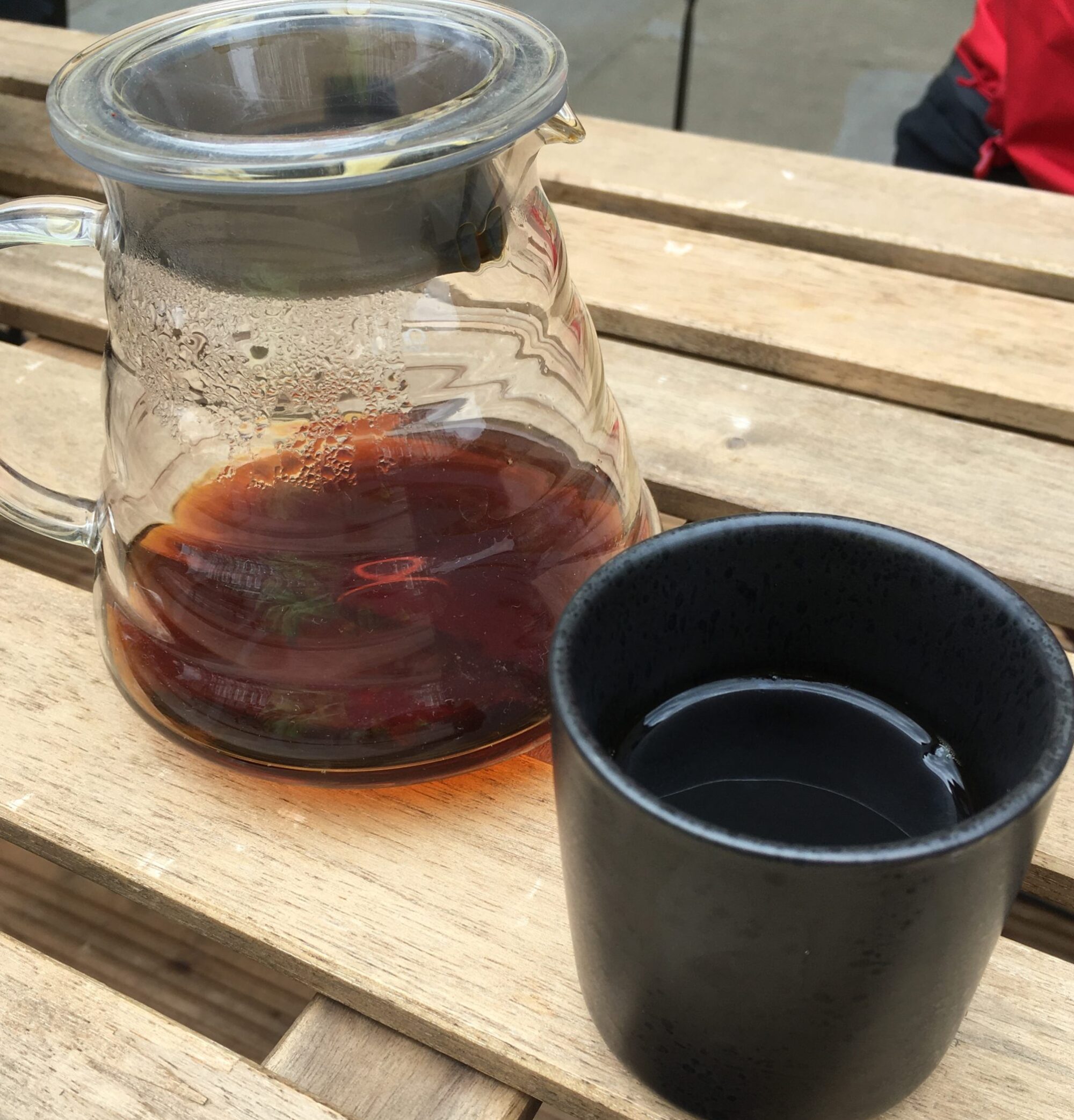
While writing last week’s cafe-review (about our sense of smell), I started to think about how to taste and appreciate coffee better. I don’t know about you but while I always try to take time to enjoy the coffee, ordinarily I don’t actively concentrate on the aroma and the sensation as I drink. This has the consequence that although I prefer some coffees over others, I am at a bit of a loss as to explain why. Moreover, it has knock on effects for how I buy my coffee. Although I tend to look for coffees with tasting notes that say “chocolate” or “caramel”, from that point on it is a somewhat random mix of information about the coffee farmers, information about the farms, price, processing method etc. Sometimes this results in a great coffee arriving in the post a short while later. Sometimes one that, although good, is not quite my cup of tea. So how can I improve my tasting skills and so have more confidence in buying coffee. And a second question, should I?
There are some coffee roasters and suppliers who take this dilemma out of your hands. If you sign up with them, they ask you to merely click to say whether or not you like the coffee after you have tried it. After a few coffees, specially designed algorithms will start to identify which coffees you are likely to like and which you are likely to find more difficult.
Similar algorithms are being used by very different companies to suggest which videos we watch, books we read or adverts we see. It has been argued that the algorithms can know us better than we do ourselves, and that choosing our reading material, or coffee, through these algorithms will result in us enjoying what we read, and what we drink, far more than if we had allowed ourselves to choose more freely.
The sign on a vending machine. How valid is the reductionism that equates human beings with computers? Our ideas as algorithms?
But is this what we want? For a start, though I may like a coffee a great deal, to call it a ‘good’ coffee may be more tricky. But secondly, an algorithm will recommend products based on what we have enjoyed in the past. Often, in order to grow (as coffee drinkers or even as people), we need to be challenged, to read or to drink things that we may not necessarily enjoy but which we can learn from. There is one author in particular who I found not because I read work that was similar to hers but because one day I decided to browse the bookshelf starting at “A”. Perhaps what you could call a semi-random discovery. Similarly, I cannot in all honesty use the word ‘enjoy’ to describe one of the most memorable coffees I’ve experienced*. Nonetheless it had such a strange and remarkable taste profile that it challenged the way that I think about coffee and I am very glad that I purchased 250g of it!
So I suspect that I will not be signing up for an algorithm based coffee for now, but rather trying to understand more about how to taste and experience coffee through the tasting wheel for example. What about you? Do you want to be challenged by the occasional cup or do you think that the algorithms can help you to better understand your own coffee preferences? And, of course, if you have any advice on how to improve my coffee tasting skills, feel free to share.
*The coffee was a 2009 Indonesian “Sidikalang” from Has bean. More details in the cafe-revew for Lundenwic which can be found here.
I had been waiting for an opportunity to try the Coffee Jar for a fair while. It is not that it is in a remote location, it is in fact situated on Parkway just five minutes walk from Camden or Primrose Hill. Nonetheless it feels as if it needed a special trip to get there (and, though this is pre-empting the end of this cafe-physics review, it does deserve such a ‘special trip’). Inside, there is seating at the window and running along one wall, and although it is not the smallest of cafés, it is certainly a ‘cosy’ one. This is not intended as an estate agent’s euphemism but instead to emphasise the additional meanings of this word to convey a warmth and friendliness about the space that the Coffee Jar definitely has. So far, we have been twice (see, the ‘special trip’ is worth it!). The coffee comes from Monmouth and so unsurprisingly, on the two occasions I had a coffee there (Americano and Soya Latte), it was very well done and enjoyable. At the front of the counter are a wide selection of home made cakes and cookies. While this presentation can be awkward for allergy sufferers (nutty cakes or cakes with loose nuts on top are placed side by side with the nut free options which could give contamination issues), the cookies were very good (more on the cookies later).
As befits the name, hand painted jars and coffee mugs decorate the end of the tables (and can be purchased should you wish). Individual art pieces decorate the walls while the window is painted with a scene that is somehow mirrored (shadowed?) in the ink prints on the take-away cups. All in all, there is plenty to notice in this “cosy” space. And so it took a fairly long time before I noticed the fish that was dangling above my head.
Apologies for the blurry photo but you can see the robot fisherman on the shelf.
Yes, this seemed an odd thing to me too, so I checked and indeed, a wooden fish was suspended on a string from something hidden on the shelf above my seat. At this point, an opportunity arose to go and sit at the window and so I was able to turn and look properly at the cause of the suspended wooden fish which was actually a toy robot. It just gets more surreal. But indeed, on the shelf above the seats against the wall was a toy robot fishing, a wooden fish hanging at the end of his (her?) line.
A robot that is fishing can prompt a large number of questions which seem to me to be at the intersection of science and philosophy. To what extent has automation improved our lives? Is it a good or a bad thing to use robots in jobs traditionally done by humans? Moving away from robots and towards computers, what about artificial intelligence? Much has been written about artificial intelligence in recent years. There is some angst about whether robots will come to take-over the world with an ability to think that far surpasses our human ability. Alternatively, there are people who look to artificial intelligence with the hope that it will help us drive cars or investigate pollution or all manner of other (to a greater or lesser degree) useful things. One test that has been suggested as a way of establishing whether any particular computer, or artificial intelligence, can think is the Turing test proposed in 1950 by Alan Turing. A prize set up to reward the first computer “chatbot” that could reliably mislead human judges into thinking that it was itself a human (the Loebner prize) has so far not been won (a prize is awarded each year for the most convincing chatbot but so far, none has been so reliably convincing as a human to win the top, “gold” prize).
Unusually I had a soya latte.
But the robot on the shelf was not represented as thinking but as fishing, an occupation that is associated with relaxation. This robot was not just thinking, it was taking time out to relax; it was represented as being alive and sentient. This prompts a rather different question to that of merely intelligence: At what point do we say that something is living? How can we define life? As could perhaps be expected, NASA has taken some time to consider this question. As they say on their website:
“Comparing the semantic task [of defining life] to the ancient Hindu story of identifying an elephant by having each of six blind men touch only the tail, the trunk, or the leg, what answer a biologist might give can differ dramatically from the answer given by a theoretical physicist.”
Which may make you wonder well, what would a theoretical physicist say about how we could define life? Erwin Schrödinger (1887-1961) had a very interesting, physics-based, definition of life. Although he is now perhaps more famous for his equation or his cat, in 1944 he wrote a book called “What is Life” (opens as pdf). To very briefly summarise, the argument goes that the tendency of all inanimate objects is towards equilibrium. A hot cup of coffee will lose heat to its immediate environment and so reach the same temperature as its surroundings, a small amount of blue food colouring at the bottom of a glass of water will eventually colour the entire glass a paler blue. To be alive is to defer this state of equilibrium for to achieve equilibrium is the same thing as death. Schrödinger argued that rather than merely consume energy, living things consumed negative entropy from their food-stuff. Entropy is a quantity introduced with the theory of thermodynamics. It is often taken as a measure of the order in a system (though there are caveats to that). The second law of thermodynamics states that for a closed system, the entropy of the system will either increase or stay the same. This suggests that to avoid equilibrium, or equivalently to avoid death, the living thing must consume order (or negative entropy) and somehow stave off this tendency to maximum entropy. To answer the objection that it would be easy to consume negative entropy by eating diamonds (which are highly ordered crystals) and so therefore that there has to be more to life than this, Schrödinger expanded on the thermodynamics of his argument. That bit gets quite technical and so is another reason that, if you are interested, it is worth getting hold of the book.
So to return to one of the first questions but phrase it in a slightly different way. Could a robot cookie maker replace the “home-made” cookies that were on offer in the Coffee Jar? It turns out that this is a subject that my often-times cafe-physics review companion (let’s call them J) has quite an opinion about. We visited the Coffee Jar twice partly because of the cookies! It seems to me that J would not have been impressed by the cookies were they robotically mass manufactured. There was something very appealing in the home made quality of them. So, there we go, one of the questions answered neither scientifically nor philosophically but on the very reasonable basis that home made cookies taste and look better. Do let me know if you agree if and when you visit the Coffee Jar.
The Coffee Jar is at 83 Parkway, NW1 7PP
“What is life?” Erwin Schrödinger, Cambridge University Press, first published 1944, my edition published 2013
I had been waiting for an opportunity to try Kin Cafe in Fitzrovia for a while. Having followed them on Twitter, I had been tempted by the large selection of great-looking vegetarian and vegan food choices tweeted almost daily. Although I’m no longer a vegetarian, appetising meat-free meals are always appealing. So it had been on my “to try” list for a long time (preferably for lunch). However, sometimes things don’t work out quite the way you had initially hoped and so it was late afternoon by the time we ended up at Kin, sadly no lunch then. So we settled on an Americano, soya hot chocolate and a slice of Butternut and ginger cake. The coffee (from Clifton Coffee) was very fruity and full of character, highly enjoyable while sitting in the window overlooking the street outside. The cake meanwhile deserves a special mention. Not only was the cake very good, the helpful staff at Kin were very confident in their knowledge that this cake was nut-free and they also ensured that the new member of staff (being trained) used a new cake slice to serve it. Extra ‘points’ for a nut-allergy aware café and definitely a tick in the “cafes with good nut knowledge box”.
As we sat with our drinks, one of Beethoven’s quartets was playing through the loudspeakers. For me, Beethoven being played in the background is a bonus for any café but it did, perhaps, mean that I was less sociable than normal with my frequent companion in these reviews; the quartets are too absorbing. I do hope the hot chocolate made up for it.
Tables are supported by struts forming triangles. But this is not the Pythagorean link.
Inside the café, tables along the wall were each stabilised by a diagonal support. A practical arrangement that had the visual effect of forming a triangle with the wall. While this did make me think about force-balancing and Pythagoras, this is not the link to Pythagoras alluded to in the title. No, instead the connection goes back to the Beethoven and the links between music and mathematics. Perhaps we no longer immediately think of music and mathematics as being particularly connected, after all one is an ‘art’ and the other a ‘science’. But music and mathematics have, traditionally, been so inextricably linked that, as Susan Wollenberg wrote in ‘Music and Mathematics’* “… it is their separation that elicits surprise”.
Some of the links between music and mathematics are explored in this TED-Ed talk about the maths to be found in Beethoven’s Moonlight Sonata. This part of the link between music and mathematics comes in the relation between what is known as consonant and dissonant notes. The first part of the Moonlight Sonata is made up of triplets of notes that sound good to our ears when they are played together. As Pythagoras is said to have discovered (see link here, opens as pdf), there is an interestingly simple relation between notes that are consonant with each other. Whether you look at the frequency of the notes or the length of a string required to play them, the ratio of two consonant notes seems to be a simple number ratio.
For example, the A of an oboe has a frequency of 440 Hz*. The A one octave higher is at 880 Hz, a factor of 2. If we took instead a series of notes of frequency f, then we could find a series of consonant notes at f:2f:3f. But now, remembering that octaves are separated by a factor of 2 and that they ‘sound good’ together, this will mean that the ratio of frequencies f:1.5f:2f will also sound good. This set of frequencies just happens to coincide with the C-G-C’ chord that forms the basis of many guitar based pieces of music. As you continue looking at these simple number ratios you can start to build a set of notes that eventually forms a scale.
The artist Fuseli once lived diagonally opposite Kin Cafe. J. James notes that Fuseli was part of the artistic revolution that was paralleled by Beethoven and the Romantics in the musical sphere**.
But the links go deeper than this. In the same book “Music and Mathematics”, JV Field wrote “..in Ancient, medieval and Renaissance times, to claim that the order of the universe was ‘musical’ was to claim that it was expressible in terms of mathematics.” Indeed, Kepler looked for these musical harmonies in the maths of the planetary system. Although he found no ‘harmonies’ in the ratio of the periods of the planets then known, he did find musical scales in the ratios of the speeds of the planets (measured when they were closest to the Sun, at the perihelion, and furthest from the Sun, at the aphelion). Other simple number ratios can be found when we look to different regions of the Solar System. The periods of three of the Galilean moons of Jupiter for example have the ratio 1:2:4 (Io:Europa:Ganymede). While we would no longer describe these patterns as reflecting the harmony of the Universe (see here instead for current understanding), perhaps we ought to ponder the next sentence that Field wrote in the chapter on Musical Cosmology:
“We still believe [that the universe is expressible in terms of mathematics] now. Indeed, mathematical cosmology has proved so powerful that it is perhaps difficult to take a sufficiently cold hard look at the metaphysical basis on which it rests. On the other hand, the explicitly musical cosmologies derived more directly from the Ancient tradition seem sufficiently fantastic to invite instant questioning of their underlying metaphysics…”
One to consider next time you happen to wander into Kin Cafe, or another café playing such mathematical composers as Beethoven.
Kin Cafe can be found at 22 Foley St, W1W 6DT
*Music and Mathematics, Edited by J. Fauvel, R. Flood, R. Wilson, Oxford University Press (2003)
** The Music of the Spheres, J. James, Copernicus (Springer-Verlag), (1993)
Lastly, a video of Wilhelm Kempff playing Beethoven’s Moonlight Sonata. I would really recommend playing it twice, the first time to listen only, the second to watch while Kempff plays. His performance is fascinating.
There’s plenty of plastic in coffee & it’s not just in the obvious take-away cups.
So we’ve probably all done it, walked into a coffee shop and purchased a take-away coffee while in a rush to get elsewhere. It’s the moment that our desired commitment to environmentally responsible behaviour clashes with our (briefly stronger) desire for sustenance on the move. Using a keep-cup (or similar) would avoid this bit of single-use plastic but even so, is this the only plastic that you encounter when you enjoy a coffee? Actually, once you start to notice it, you will find single-use plastic in a number of surprising places.
An initiative called “Plastic Free July” aims to raise awareness of the pervasiveness of single-use plastic as well as to challenge us to do something about it. So, partly as an educational exercise, I signed up to the Plastic Free July, not because plastic is always bad, (there are arguably some very good, even environmental, reasons to use plastic, see below) but because plastic is a substance that takes a long time to break down once discarded and we use it so often even without thinking. So, before revealing just how easy – or hard – it has been to eliminate single use plastic from everyday life for the past couple of weeks, it’s worth taking a look at the problems, benefits and occurrence of plastic in our lives. Particularly while we are enjoying a tea or coffee.
Some definitions
Plastic comes in many forms and Plastic Free July does not aim to avoid all of them. It is single use plastic that is the concern: Bits of plastic wrapping, plastic bags, aroma valves. Things that are used once and then discarded. Can you avoid using these, even for one week or even just one day? Why not sign up and commit yourself to trying to find out.
Plastic Problems
One planet. One home. The Blue Marble, Credit, NASA: Image created by Reto Stockli with the help of Alan Nelson, under the leadership of Fritz Hasler
Two of the major issues with our use of plastics are the problems of littering and that of degradability, particularly when that litter finds its way into the oceans. Between 60-80% of marine litter is plastic. It can cause the deaths of marine life not just through its being eaten (thereby causing internal injury or malnutrition), but also by entangling sea creatures and so causing death through drowning or other injury. Moreover, the bits of plastic that float around our oceans can provide a home to various micro-organisms transporting them around the world to areas of the planet that they would not ordinarily have been able to reach.
Nor is it just a problem for the oceans. Plastic takes many centuries to decompose and although there are plastics that decompose more quickly (oxo-biodegradable and compostable, more details below), clearly there is a need to reduce the amount of plastic we throw away. A further problem with plastics is that their manufacture requires the use of a limited resource. 4-5% of global petroleum production is used for the manufacture of plastic∗. But nor is it just petroleum products, the thing that makes carrier bags opaque is an additive called TiO2. It is therefore somewhat sobering to realise that 25% of the plastics manufactured in the US are used in packaging* and 37% of the plastics produced are for disposable items. Clearly we have room to live less wastefully here.
Why it’s not all bad
Is it better to swap to paper packaging? It may depend on what problem you’re trying to solve.
Although there is a big problem with plastic waste, a different environmental problem has arguably benefited from our use of plastic packaging: The greenhouse effect. Consider the way that ground coffee is often sold in a supermarket. Frequently the coffee comes in metallised plastic packaging complete with plastic air-valve (or aroma valve). Alternatively, coffee can be packaged in a steel can (as used by a well known coffee roasting blend). Steel is 100% recyclable and so is good for the degradability/litter problem. However it is heavy and cylindrical. This means that to transport an equivalent amount of coffee in steel cans costs more, both in terms of economic and environmental costs, than the lighter, less bulky plastic of the alternative*.
What about paper packaging? It is interesting that even here, the situation is not clear-cut. A study concerning the greenhouse gas emissions involved with the manufacture and transportation of different sorts of shopping bag had what may be a surprising conclusion. In order to achieve a lower CO2 footprint than a standard plastic shopping bag re-used once as a bin-liner, a paper shopping bag would have to be re-used 4x while a cloth bag would have to be re-used a staggering 173x. You may well argue (as I have) that it is still better, environmentally, to buy your coffee in paper packaging, but if thinking purely in terms of the CO2 emissions, you may want to try to find a way to re-use the coffee bag a few times.
Lastly, the litter and degradation problem need not be insurmountable. In recent years, various manufacturers have sought to make plastic degrade more rapidly than ordinary plastic. Oxo-biodegradable plastic has additives in it that, when exposed to UV light, eg. from the Sun, help the (otherwise perfectly ordinary) plastic to completely biodegrade. The process takes a controllable amount of time that can even be as little as 2 years. Compostable plastic too is being developed but there should be caveats on the name. “Compostable” is defined as “industrially compostable” (meaning it degrades if held at a steady 58C), it does not necessarily mean that it composts in your compost heap.
There’s plastic in my coffee?
Aroma valves: are they worth the environmental cost?
So, we’re aware of the problem and want to do something about it but how much is single use plastic really a problem for coffee (or tea) drinkers? Take-away cups are the obvious source of single-use plastic, but plastic can be found in many places as we enjoy our brew. If we are having coffee in a café (even if it is not take out), how about the spoon for the sugar, plates for the cakes or even wrapping around the chocolate bars? If you drink your coffee with milk (cow, soy or almond) it will often come in plastic bottles, yes these could be recycled but would it be better if they were made from something else? (It is an interesting fact that more plastic was sent for recycling in the UK than was used by consumers†).
An easy way of reducing your plastic use would be to use your own mug as a take-away cup (keep-cups for example are designed to be of the correct size for the cafe industry). And there may even be other advantages to you in bringing along your own cup: For Danny S Parker, taking along his own cup for his coffee allows him to better enjoy the coffee, as he says “If you choose a wide mouth cup… the involvement of the nose in the taste on the tongue will accentuate flavour and enjoyment.” Reducing your plastic consumption could mean that even a take-away coffee can provide a moment to enjoy your brew.
What about if you only ever drank coffee at home? Where’s the plastic there? Well, how do you buy your coffee? Do you buy from a coffee roaster that insists on using bags with ‘aroma valves’? These valves cannot be recycled currently and so inevitably contribute to plastic waste. Is this packaging really necessary for the way that you buy your coffee? (See here for an interesting taste comparison of coffee stored in bags with/without aroma valves). Meanwhile, the coffee itself is frequently supplied in a metallised plastic packaging, does the roaster you buy from try to minimise the environmental cost by using recycled/oxo-bio/compostable/paper packaging? Why not ask them?
And tea drinkers, you do not get away with it! There’s plastic involved in tea drinking too. Tea bags are often supplied in cardboard packaging that is then wrapped in plastic, and even loose leaf tea can come in paper bags with plastic windows or metallised plastic bags. Worryingly, even tea bags themselves can occasionally be made of a plastic material that does not break down in a composting bin‡. Plastic truly gets everywhere.
An honest appraisal of how my plastic free July has gone so far
Giving up plastic can mean taking the opportunity to enjoy your coffee properly.
So, nearly halfway through July and my attempts at being “plastic-free” are mixed. Some things are relatively easy to change, a metal tea strainer and loose leaf tea replaced the tea bags when they ran out. The coffee I use at home comes in paper packaging from Roasting House. Other things such as bottles of shampoo could be replaced by shampoo bars (like a bar of soap only for shampoo). Even the soy milk I use at home was easily exchanged for a home-made oat-milk.
However, some things have been difficult. Shopping particularly is not very plastic-free friendly. Although there is advice on taking containers with you in order to buy meat, fish or cheese from the counter in a plastic-free way, I am not sure that this would work in my local supermarket and anyway, they have to weigh the meat/fish/cheese which will involve them putting it on a plastic bag on the scales. Just because I do not walk away with plastic in my hand does not mean that I am not responsible for its use. Cooking oil too frequently comes in plastic bottles and, given the increased weight and therefore transportation costs involved in glass packaging, perhaps this is an example of a good use of plastic. An attempt to move away from aluminium-lined, plastic tube toothpaste to plastic-free tooth tabs has been complicated by the fact that the tooth-tabs are supplied in a plastic bottle. And I’m afraid that I am partial to a bottle of beer occasionally even though they do have plastic lined metal caps.
So, my plastic-free July has been a bit mixed but certainly not single use plastic free (so far). But, it has been worth it in order to really see just how ubiquitous single-use plastic is in our day to day living. Is it possible for you to cut down just a little bit on the plastic that you use every day? Why not sign up to Plastic Free July and see where your challenges lie.
If you are already signed up to Plastic Free July or if you are trying to live in a plastic-reducing way generally I’d love to hear how it’s going. Also if you have an opinion on the use of plastic in the coffee industry (either in cafes or by roasters) do let me know.
*Plastics and the Environment, AL Andrady (Ed), Wiley-Interscience, 2003
† The study was done in 2006.
‡ I was alerted to this initially by a friend’s comment that certain pyramid-type tea bags never seemed to break down on their compost heap.
Are you a hedonist or a utilitarian when it comes to drinking coffee?
Which part of the process of making and drinking coffee do you enjoy most? How do you rate the importance of smell, taste, touch (even hearing and sight) to the enjoyment of the process of brewing your cup?
It appears that your answer to this question may well be affected by your motivation for drinking your coffee in the first place. Last year, a group of researchers from Switzerland published a study that investigated whether the reason that you drank coffee (i.e. either for sensory enjoyment or just for the caffeine kick) influenced your enjoyment of the experience of making and drinking the coffee.
The researchers looked at how the participants in the study rated their own levels of enjoyment and satisfaction as they progressed through four stages of making coffee.
Water heating
Jar handling*
Cup preparation
Cup drinking
The 60 participants were divided into two groups of 30, those who drank coffee for enjoyment (the hedonists), and those who drank for stimulation (the utilitarians). After checking that both groups of participants rated their levels of pleasure and satisfaction similarly before the experiment started (they did), the participants were repeatedly interrupted while they made their coffee and asked to rate their levels of enjoyment and the importance that they attached to different sensory experiences (smell, sight, touch etc).
A very enjoyable coffee, but which part of the process of making and drinking coffee do you enjoy most?
After stage 4, when both groups had finally managed to drink their coffees, both groups reported similar levels of enjoyment, satisfaction etc. The difference came in the process. Overall, the group that were drinking the coffee purely for stimulation found the experience of making coffee less pleasant than the group who drank coffee because they enjoyed it. Meaning, those that drank coffee because they liked the taste seemed to enjoy the entire process of making and then drinking the coffee more than those who were just looking for a pick-me-up. Moreover, the ‘hedonists’ also attached more importance to the satisfaction of the smell and the taste of the coffee than did the ‘utilitarians’. Interestingly though, vision played an important role throughout the whole process for both groups of participants.
So how much we enjoy the process of making coffee depends on why we are drinking coffee in the first place. What about you? How do you rate the time that you spend brewing your coffee (I think that we can extrapolate this to tea too)? Are you a hedonist, a utilitarian or somewhere in between and does it matter? Please share your thoughts either here, on FB, or on Twitter.
*The study was performed at the Nestlé Research Centre so presumably used instant, hence the ‘jar’. Does this affect the conclusions of the study for ‘speciality’ coffee drinkers? Are you a utilitarian speciality coffee drinker who nonetheless enjoys the entire process? Please share your thoughts in the comments section below.
Mint in a glass of water. Do other species appreciate a mint aroma too?
Very often, in a café, there will be a jug of mint infused water sitting in a corner, offered as a complimentary accompaniment to the coffee. A fragrant way of ‘refreshing our palate’. Mint is one of many aromatic plants that we use to scent our rooms or freshen our breath. But are we the only species that uses mint and similar aromatics such as lavender in this way? Do other animals appreciate the aroma that a freshly plucked mint leaf can provide?
A few weeks ago (in mid-spring in the northern hemisphere), I noticed some odd bird behaviour going on just outside the window. A blue tit (Cyanistes caeruleus) had landed on the edge of a pot of mint and was busy tearing leaves off the plant that was growing just outside. We watched as the bird hopped around to the other side of the pot, tearing off the younger, fresher leaves. What on earth was it up to?
A sprig of mint growing in a pot.
A quick use of duckduckgo (or google if you’d prefer), revealed a surprising answer (or at least further questions) to this odd behaviour. It would appear that blue tits have been observed to pick mint, lavender and curry plant leaves and use them to line their nest. Moreover, individual blue tits have a preference for different plants. Some females (it appears to be the female that collects the leaves) prefer mint, some lavender, and presumably some prefer curry. There is even a video from “Springwatch” that filmed this behaviour in a blue tit nest a few years ago (link is here). Similar behaviour has been observed in some other bird species such as the Starling (Sturnus vulgaris) but not in other, related bird species such as coal tits or great tits. So what could be driving this behaviour, is it, as the BBC said in its headline “aromatherapy”?
According to research, in fragranced nests, the number of bacteria/pathogens on the chicks was significantly reduced compared with non-scented nests. The chicks also seemed healthier, not only did they have a higher red blood cell count, they grew faster. What remains unclear is the reason that this should be so. Is it that the mint is anti-bacterial? Or is it, as suggested in the programme Springwatch, that the smell can perhaps relax the immune system of the birds allowing them to “put more effort into their growth”. Moreover, how did the birds first know how to pick these plants? How did this behaviour spread?
There is always a risk that we anthropomorphise other animals and consider that they appreciate aromatherapy when they are not doing so. There is however an alternative risk that we reduce animals almost to biological automata that manifest different behaviours purely for the biological advantage it gives them (as if they know that in advance). These questions are too far outside my ‘specialist’ area, for me to attempt to consider on Bean Thinking. However, as an ‘interested observer’ I can still appreciate and wonder at the interesting sights that five minutes spent observing our surroundings can provide. I will also enjoy the feeling it brings to know that we are sharing the mint on the window sill with the blue tits and their chicks.
Have you ever observed similar behaviour by birds in your neighbourhood? What birds around the world share our preference for mint? Comments are always welcome either here or on Facebook or Twitter.
In the UK Science Museum’s library there is a book, written in 1910, by Jean Perrin called “Brownian Movement and Molecular reality”. To some extent, there is nothing surprising about the book. It describes a phenomenon that occurs in your coffee cup and the author’s own attempts to understand it. Nonetheless, this little book is quite remarkable. It is perhaps hard, from our perspective in 2016, to imagine that at the time of Perrin’s work, the idea of the existence of molecules in water was still controversial. It was even debated whether it was legitimate to hypothesise the existence of molecules (which were, almost by definition, un-detectable). However, none of that is really relevant to the question confronting today’s Daily Grind. Today, the question is how can this book help us to find beauty in a coffee cup?
What does a one hundred year old book have to do with finding beauty in a coffee cup? Perrin received the Nobel Prize in 1926 for his work establishing the molecular origins of Brownian motion and, associated with it, his determination of the value of Avogadro’s constant. It is perhaps why he wrote the book. (The experiment that he used to do this is described in a previous Daily Grind article that can be found here.) It is in his description though, both of the theory and the experiments involving Brownian motion that this little book is relevant for today. One word repeatedly crops up in Perrin’s description of Brownian motion. It comes up when he describes the theory. It comes up when he describes other people’s experiments. It comes up when he describes bits of the maths of the theory. The word? Beautiful*.
Michael Polanyi, by Elliott & Fry, vintage print, (1930s), Thanks to National Portrait Gallery for use of this image.
Throughout history, many scientists have recognised, and worked for, the beauty that they see in the science around them. In a 2007 TED talk, Murray Gell-Mann said
“What is striking and remarkable is in fundamental physics a beautiful or elegant theory is more likely to be right than a theory that is inelegant.”
So it is interesting that, although we may agree that scientific theories can be “beautiful” or “elegant”, we do not seem to have a way of quantifying what precisely beauty is. It is similar for those things that are beautiful that we find in every day life. The beauty of a sunset, or the way the light catches the ripples on the surface of a lake, these are things that we recognise as beautiful without being able to articulate what it is about them that makes them so. Instead we recognise beauty as something that strikes us when we encounter it. Elaine Scarry has talked about this as a “de-centering” that we experience when we come across beauty. Scarry writes that, when we encounter the beautiful:
“It is not that we cease to stand at the center of the world, for we never stood there. It is that we cease to stand even at the center of our own world”.¹
It is therefore quite concerning that she goes on to suggest that conversations about beauty (of paintings, poems etc) have been banished from study in the humanities “…we speak about their beauty only in whispers.”¹ This does not seem to have happened yet in science where it is still common to hear about a beautiful equation or an elegant experiment. But is there a creeping ‘ideological utilitarianism” in the scientific community? According to Michael Polanyi ²
“Ideological utilitarianism censures Archimedes today for speaking lightly of his own practical inventions and his passion for intellectual beauty, which he expressed by desiring his grave to be marked by his most beautiful geometrical theorem, is dismissed as an aberration.”²
While we may recoil from this sentiment, what do we write (or expect to read) in grant applications, scientific papers, popular science or even scientific outreach? How often is the utility of a piece of research emphasised rather than its elegance?
Does an appreciation of beauty help with a wider understanding of justice and environmental concerns? The Blue Marble, Credit, NASA: Image created by Reto Stockli with the help of Alan Nelson, under the leadership of Fritz Hasler
Another interesting question to ponder is whether our ability to appreciate (and discuss) beauty has wider ramifications. As many others have argued before her, Scarry suggests that the appreciation of the beauty in the world connects with our sense of justice¹. Recently the Pope too, in his great environmental encyclical, Laudato Si’ wrote³:
“If someone has not learned to stop and admire something beautiful, we should not be surprised if he or she treats everything as an object to be used and abused without scruple.”
Could it be true that part of the motivation that we need to change our ecological habits or stimulate our search for wider social justice is enhanced by our ability to slow down and appreciate the beautiful, wherever and whenever we find it?
So to return to our coffee. Is there something, anything, about our coffee or our tea that gives us such a radical de-centering experience? Can we, like Jean Perrin, appreciate the subtle beauty of the molecular interactions in our cup? Do we appreciate the moment as we prepare our brew? Or are we ideological utilitarians, seeing in our cup just another caffeine fix?
* Technically, the book in the Science Museum Library is a translation of Perrin’s work by Frederick Soddy. It is possible that it is Soddy’s translation rather than Perrin’s work itself that uses the word ‘beautiful’ repeatedly. It would be interesting to read Perrin’s book in its original French.
I would like to take this opportunity to say thank you to the Science Museum Library for being such a valuable resource and to the staff at the library for being so helpful.
“Brownian movement and molecular reality”, Jean Perrin, translated by F. Soddy, Taylor and Francis Publishers (1910)
1 Elaine Scarry, “On Beauty and Being Just”, Duckworth Publishers, 2006
2 Michael Polanyi, “Personal Knowledge, towards a post-critical philosophy” University of Chicago Press, 1958
There is something somehow inviting in the minimalism that greets you as you walk into Wa Café in Ealing. Behind the glass counter on your left are a series of colourful cakes along with pastries and buns containing more Japanese-style treats such as the Sakura Anpan (a roll filled with red bean paste). The drinks menu features the usual set of coffees with a more extensive tea menu serving different sorts of Japanese tea. We had a long black (which according to London’s Best coffee is from Nude), the Sakura Anpan and a pot of Hoji Cha (roasted green tea). The coffee came in a delightful ceramic cup with a layering in the interior of the cup reminiscent of rock strata of the Earth. The tea arrived in a pot together with a glass that seemed linked to the type of tea that had been ordered. Glancing around the cafe, it was apparent that different teas were served in differently shaped glasses. Was this due to the fact that glass shape can affect the perceived taste of wine and so maybe also tea?
The saucer for the coffee cup featured a carved pattern that, although different, reminded me of the medieval labyrinths that you can find (such as in Chartres Cathedral). But it was the individual style of the pottery that caused me to recollect a story I had discovered while researching a previous Daily Grindarticle (and then didn’t use at the time). The story concerned a ship wreck just off the coast of Malaysia which was leading to a reassessment of our ideas about ancient trading routes and population migrations. As pottery is often one of the bits of the cargo that does not degrade significantly under the water, it is pottery that provides clues for some of our ideas about the past.
Drinking the coffee revealed ‘layers’ in the cup.
For this article on Wa Cafe though, a little digging revealed a recent archaeological discovery that involved not the pottery itself, but what had been in the pots. It had been known for some time that the first pottery found in Japan dated to about 16,000 years ago, and that around 11,500 years ago there was a significant increase in the volume of pottery produced. As this surge in pottery making was coincident with the end of the last ice age, it was thought that this increase in pottery production was driven by the availability of new sources of food as the climate warmed. So, it came as a surprise when the ‘charred surface deposits’ – meaning the bits of food left after cooking, found in the interior of the pots were actually analysed.
Using a general technique called mass spectrometry, the authors of the study investigated what elements could be found in the food deposits on the pots. They particularly looked at the ratio of carbon and nitrogen in the pots. The proportion and type of element in the food remains have been shown to indicate what had been cooked in the pot, whether it was meat, fish or vegetable matter. As the authors analysed the results they found that the pots were used for cooking fish, fish and more fish. From 16,000 years ago and on for a further 9000 years, the pots were used for fish. Although there was a shift towards the consumption of freshwater fish through the time period studied, there was not the significant change to meat and vegetable matter that had been expected prior to this analysis. The function of the pots had remained constant over millennia.
A medieval labyrinth and the coffee saucer at Wa. It is thought that many labyrinths were used as meditative aids as you walked your way through them. What would you meditate on while drinking your coffee?
This suggests that rather than the increase in pottery production being about a change in function of the pot, the pots had a distinct cultural use that was unchanged through the warming climate. The results of the analysis challenge the preconceived ideas that had been previously been held. The full paper can be found here.
To an untrained and naive eye of course, I wonder if the people using these pots just had some odd recipes for fish. Maybe they made plenty of vegetable soup (which they rarely burned) but always chargrilled the fish in the pot leading to a prevalence of fish in the ‘charred surface remains’. Nonetheless, this is probably just a poor understanding of what the authors meant by ‘charred surface remains’, surely not every cook burns their fish!
It was my birthday a short while ago and someone who knows me well got me a perfect present: a kettle specially adapted for making pour-over V60 style coffees. Until this point I had been struggling with a normal kettle with it’s large spout but now, I can dream that I pour like a barista. Of course, it is important to try out your birthday present as soon as you receive it. And then try it again, and again, just to make sure that it does really make a difference to your coffee. So it is fair to say, that recently I have been enjoying some very good coffees prepared with a variety of lovely beans from Roasting House and my new V60/V60 kettle combination.
Spending the time to prepare a good coffee seems to make it even more enjoyable (though it turns out that whether you agree with this partly depends on why you are drinking coffee). Grinding the beans, rinsing the filter, warming the pot, the whole process taken slowly adds to the experience. But then, while watching the coffee drip through the filter one day, I saw a coffee drop dance over the surface of the coffee. Then another one, and another, a whole load of dancing droplets (video below). Perhaps some readers of Bean Thinking may remember a few months back a similar story of bouncing droplets on soapy water. In that case, fairly large drops of water (up to about 1cm wide) were made to ‘float’ on the surface of a dish of water that had been placed on a loudspeaker.
Sadly, for that initial experiment the coffee had been made undrinkable by adding soap to it. The soap had the effect of increasing the surface viscosity of the droplets which meant that the drop could bounce back from the vibrating water surface before it recombined with the liquid. Adding soap to the coffee meant that these liquid drops could ‘float’ (they actually bounce) on the water for many minutes or even longer (for more of the physics behind this click here).
A still from the video above showing three drops of coffee on the surface.
On the face of it, there are some similarities between the drops dancing on the coffee in my V60 and these bouncing droplets. As each drop falls from the filter, it creates a vibration on the surface of the coffee. The vibration wave is then reflected back at the edges of the V60 and when the next drop falls from the filter it is ‘bounced’ back up by the vibration of the coffee.
But there are also significant differences. Firstly, as mentioned, there was no soap added to this coffee (I was brewing it to drink it!). This means that the viscosity of the drops should be similar to that of ordinary water. Although water drops can be made to bounce, the reduced viscosity means that this is less likely. Secondly, the water is hot. This acts to reduce the viscosity still further (think of honey on hot toast). Perhaps other effects (such as an evaporation flux or similar) could be having an effect, but it is noticeable that although the drops “live” long enough to be caught on camera, they are not very stable. Could it be that the vibrations caused by the droplets hitting the coffee are indeed enough to bounce the incoming droplets back up but that, unlike the soapy-water, these “anti-bubbles” do not survive for very long? Or is something deeper at play? I admit that I do not know. So, over to you out there. If you are taking time to make coffee in a V60, why not keep an eye out for these bouncing droplets and then do some experiments with them. Do you think that the bounce vibration is enough to sustain the bouncing droplet – does the speed of pour make a difference? Is it associated with the heat of the coffee? I’d be interested to hear what you think.
(The original soapy-coffee bouncing droplet video).
If you see anything interesting or odd in your coffee, why not let me know, either here in the comments section below, e-mail, or over on Twitter or on Facebook.
As the name suggests, there is a lot of history behind the café at 3 Fleet St (the Fleet Street Press). Not only is it just around the corner from the Devereux (which was once the “Grecian” where Halley met Newton), it is a few doors down from the site of the second ever coffee house established in London (the “Rainbow” was at number 15). There is also plenty of history in the café itself. Fleet St Press operates from a listed building, considered especially noteworthy for its 1912 shop interior (ie. the café). The stained glass at the back of the shop (which was nearly the subject of this cafe-physics review) is apparently original while a sign (for “Tobacco blenders”) in the front window hints at the building’s previous use.
Inside, a row of tall stools offers seating along the wall while a large table at the front of the café offers a space to sit more comfortably to enjoy your coffee. We enjoyed a very nice long black (coffee from Caravan) and a soya hot (white) chocolate. The staff were friendly and it was a lovely space to spend a while. Keep-cups and other coffee making equipment are on sale just next to the counter and the café is just full of things to notice. It’s not just the stained glass. The window to the left of the main door has been stocked with a film camera with flash (presumably a nod to the Fleet St of old), an aeropress, a series of sand-timers and many other items of distraction. We sat at the window which had a good view towards the Royal Courts of Justice and two wonky K2 telephone boxes. Just across the passageway from the phone boxes was a post box and this got me thinking about communication and how we communicate with each other.
An interesting concept. A white chocolate hot chocolate made with soya milk
In an editorial to a book that rolled off one of Europe’s first printing presses, the Bishop of Aleria, Giovanni de Bussi wrote that printing could be considered an act of generosity “the act of sharing what was hoarded”*†. Since then, the newspapers of the old Fleet St have made way for coffee shops and the papers for the internet. The ‘snail mail’ post box across the road has been almost superseded by email or other forms of internet communication. The telephone box, replaced by mobile phones or Skype. Although we may feel overloaded with information, our ancestors felt the same way. Even in the 1640s it was claimed that they were living in times of a media explosion in which there were just too many books*.
So, rather than look at how the scribe gave way to the printing press, books to newspapers, letters to telegraphs and then telephones and now email, Twitter and instant messaging, perhaps it is worth dwelling a short while on what underlies all of these. Indeed, we are so used to what underlies these communication techniques that we may not even notice it.
Writing.
It may be an obvious point but none of these communication methods would have been possible were it not for writing. Given that Homo sapiens are thought to have come out of Africa some 200 000 years ago, and have been farming since 13000 – 8000 BCE, it is perhaps surprising that the first record that we have of a writing system was not until ~3500 BCE. Writing is thought to have originated in Sumer, Mesopotamia as pictographs. Phonographic writing was not developed until later. Shortly afterwards it was again ‘invented’ in Egypt (3150 BCE) and separately in China (1200 BCE) and MesoAmerica (~500BCE). Writing is a surprisingly recent phenomenon.
The view from the window at Fleet St Press
As with the fixtures at Fleet St Press, clues from these earlier cultures pervade the space around us rather like the ghost signs of advertising past. The tobacco sign above the door is suggestive of former occupiers Weingott and Sons. Famous for their pipes, they ran a shop on the site from the mid-nineteenth century until the 1930s. Meanwhile, the writing systems of the ancients lives on both in our alphabet and in our time keeping. Even the name ‘alphabet’ resonates with the history of the Greek “alpha, beta” and the Hebrew “Aleph, Beth” (themselves originating from the Phoenician). The Babylonian number system meanwhile, which dates from around 1800 BCE and used base 60 to count (i.e. rather than 1-9, their number system counted 1-59) echoes down the ages. It is thought that remnants of this system remain both in how we count the degrees of a circle (360) and how we tell the time (60 minutes in an hour, 60 seconds in a minute).
Signs and systems that are both instantly familiar and a ghostly ripple from the people of the past.
Fleet St Press can be found at 3 Fleet St, EC4Y 1AU.
*E.L. Eisenstein, “Divine Art, Infernal Machine, the reception of printing in the West from first impressions to the sense of an ending”, University of Pennsylvania Press, (2012)
†Quote from de Bussi is as quoted in Divine Art, Infernal Machine on p 15.
Some interesting anecdotes about the history of communication can be found in Robert Winston “Bad Ideas, An arresting history of our inventions” Bantam books, (2010),
Also recommended “A history of mathematics, from Mesopotamia to modernity”, L Hodgkin, Oxford University Press, (2005)